

1 Thaler – Teutonic Order
Germany

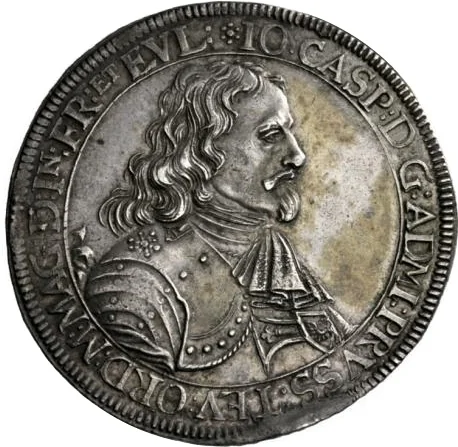
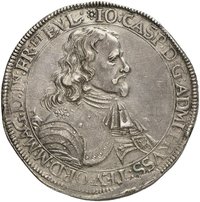
Obverse
Description:
Johann Caspar bust, facing right.
Script: Latin
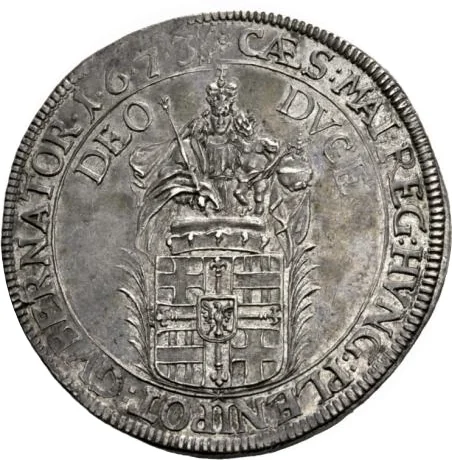
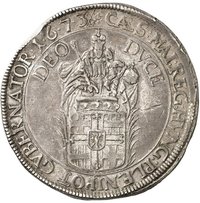
Reverse
Description:
Madonna and child over arms.
Script: Latin
Edge
Mintings
| Year | Mint Mark | Mintage | Quality | Collection |
|---|---|---|---|---|
| 1673 | MF | — |
Historical background
In 1673, the currency situation within the Teutonic Order State (centered in the Duchy of Prussia, a Polish fief) was characterized by significant instability and inflationary pressure. The state’s economy was still recovering from the devastation of the mid-century Northern Wars, particularly the Second Northern War (1655-1660) and the subsequent Polish-Swedish conflicts, which had drained the treasury and disrupted trade. To meet wartime expenses, the Order had heavily debased its coinage, notably the schilling, reducing its silver content and flooding the market with low-value currency. This practice, combined with the circulation of numerous foreign coins from Poland, the Holy Roman Empire, and the Netherlands, created a complex and unreliable monetary environment.
The primary challenge was a severe lack of high-quality, full-bodied specie. While the Order officially minted its own coins at the Königsberg mint, the reality was a chaotic mix of undervalued local coins and more trusted foreign silver thalers and guilders used for larger transactions. This disparity led to Gresham's Law in action, where "bad money drives out good," as people hoarded sound foreign coins and passed on the debased local currency. The monetary chaos hindered commerce, complicated tax collection for the state treasury, and eroded public trust in the currency system.
Furthermore, the currency issue was deeply intertwined with the Order's political subordination to the Polish Crown. Any significant monetary reform required at least the tacit approval of the Polish King, limiting the Order's autonomy. While efforts were made to stabilize the currency later in the decade, the situation in 1673 remained one of fragmentation and devaluation. The state’s financial weakness reflected the broader decline of the Teutonic Order as a political and military power, now more focused on managing its secular ducal estates than on its original crusading mission.
The primary challenge was a severe lack of high-quality, full-bodied specie. While the Order officially minted its own coins at the Königsberg mint, the reality was a chaotic mix of undervalued local coins and more trusted foreign silver thalers and guilders used for larger transactions. This disparity led to Gresham's Law in action, where "bad money drives out good," as people hoarded sound foreign coins and passed on the debased local currency. The monetary chaos hindered commerce, complicated tax collection for the state treasury, and eroded public trust in the currency system.
Furthermore, the currency issue was deeply intertwined with the Order's political subordination to the Polish Crown. Any significant monetary reform required at least the tacit approval of the Polish King, limiting the Order's autonomy. While efforts were made to stabilize the currency later in the decade, the situation in 1673 remained one of fragmentation and devaluation. The state’s financial weakness reflected the broader decline of the Teutonic Order as a political and military power, now more focused on managing its secular ducal estates than on its original crusading mission.
✨ Legendary