

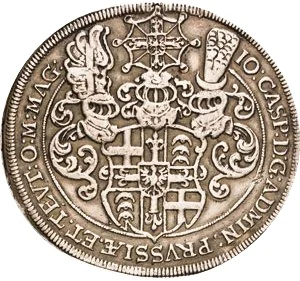
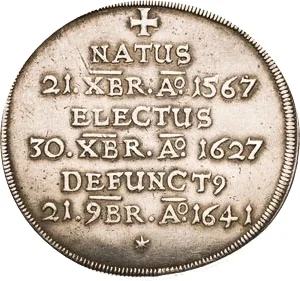
1 Thaler – Teutonic Order
Circulating commemorative coins
Commemoration: Death of Johann Caspar von Stadion
Germany
Obverse
Description:
Armed and helmeted.
Script: Latin
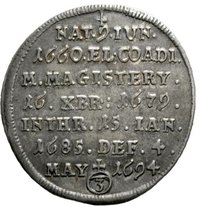
Reverse
Description:
Six-line inscription.
Script: Latin
Edge
Mintings
| Year | Mint Mark | Mintage | Quality | Collection |
|---|---|---|---|---|
| 1641 | — | — |
Historical background
In 1641, the Teutonic Order’s currency situation was a complex and strained system, reflective of the Order’s diminished political and economic power. The Order’s territory was now largely confined to the secular Duchy of Prussia (a Polish fief held by the Hohenzollern Elector of Brandenburg) and the small ecclesiastical state of Livonia. While the Order’s Grand Master still minted coins, such as the schilling and groschen, their authority was overshadowed by the powerful monetary systems of neighboring states. The region was awash with a multitude of foreign coins, particularly Polish grosz and złoty, Swedish coins due to ongoing conflicts in Livonia, and thalers from the Holy Roman Empire, which circulated widely and often held more trust than local issues.
The primary challenge was chronic debasement and monetary instability. To finance its military obligations and administrative costs, especially in the contested Livonian theatre, the Order frequently reduced the silver content in its coinage. This practice, common across war-torn Europe, led to inflation, a loss of public confidence, and Gresham’s Law in action (“bad money drives out good”), where older, full-weight coins were hoarded or exported. Consequently, everyday transactions became fraught with uncertainty over the real value of the mixed coinage in circulation, hindering trade and economic stability within the Order’s lands.
Ultimately, the currency situation of 1641 was a symptom of the Teutonic Order’s transition from a medieval crusading power to a minor state actor within the shifting geopolitics of Northern Europe. Its monetary policy was no longer autonomous but was heavily influenced by and dependent upon the economic currents of powerful neighbors like Poland-Lithuania, Sweden, and Brandenburg. This financial fragility mirrored the Order’s broader existential crisis, culminating just over a decade later in the formal secularization of its remaining Prussian territories and its effective dissolution as a sovereign territorial entity.
The primary challenge was chronic debasement and monetary instability. To finance its military obligations and administrative costs, especially in the contested Livonian theatre, the Order frequently reduced the silver content in its coinage. This practice, common across war-torn Europe, led to inflation, a loss of public confidence, and Gresham’s Law in action (“bad money drives out good”), where older, full-weight coins were hoarded or exported. Consequently, everyday transactions became fraught with uncertainty over the real value of the mixed coinage in circulation, hindering trade and economic stability within the Order’s lands.
Ultimately, the currency situation of 1641 was a symptom of the Teutonic Order’s transition from a medieval crusading power to a minor state actor within the shifting geopolitics of Northern Europe. Its monetary policy was no longer autonomous but was heavily influenced by and dependent upon the economic currents of powerful neighbors like Poland-Lithuania, Sweden, and Brandenburg. This financial fragility mirrored the Order’s broader existential crisis, culminating just over a decade later in the formal secularization of its remaining Prussian territories and its effective dissolution as a sovereign territorial entity.
✨ Legendary