


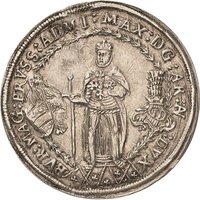
Obverse
Description:
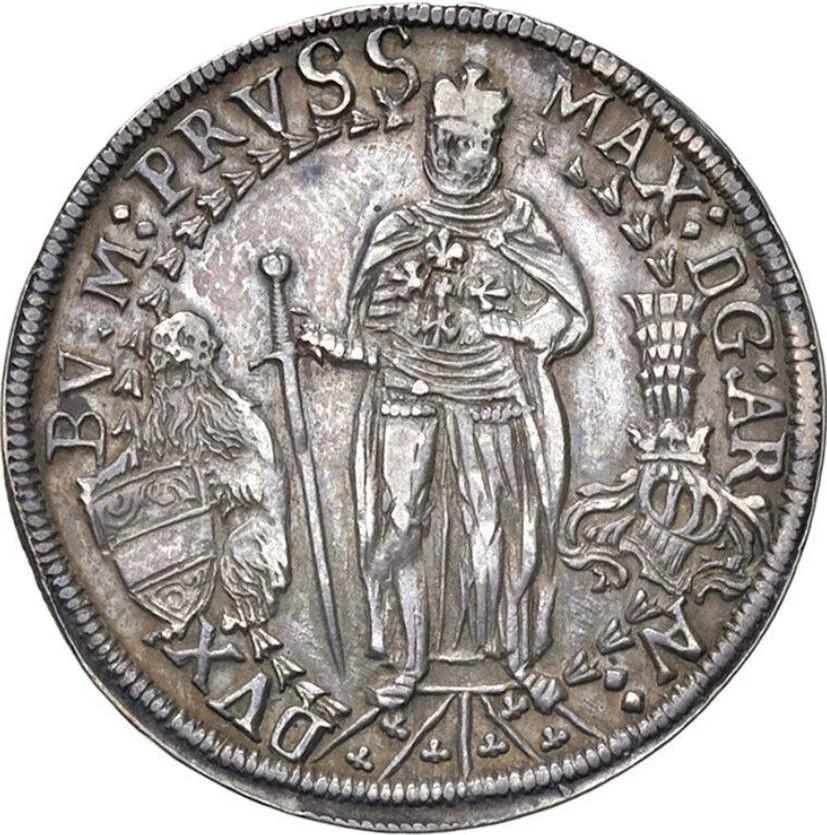
Portrait of Maximilian III in armor, facing slightly left. He wears a mantle and helmet, holds a sword, and displays the Teutonic Order cross. A lion holds a shield with Austrian arms on the left; a great helm is on the right. The legend is divided by his feet, the floor pattern, the lion, and the helm.
Inscription:
MAXI:DG:AR AV: DVX BV:M:PRVSS
Script: Latin
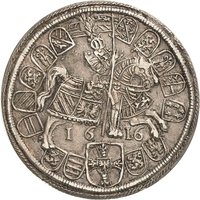
Reverse
Description:
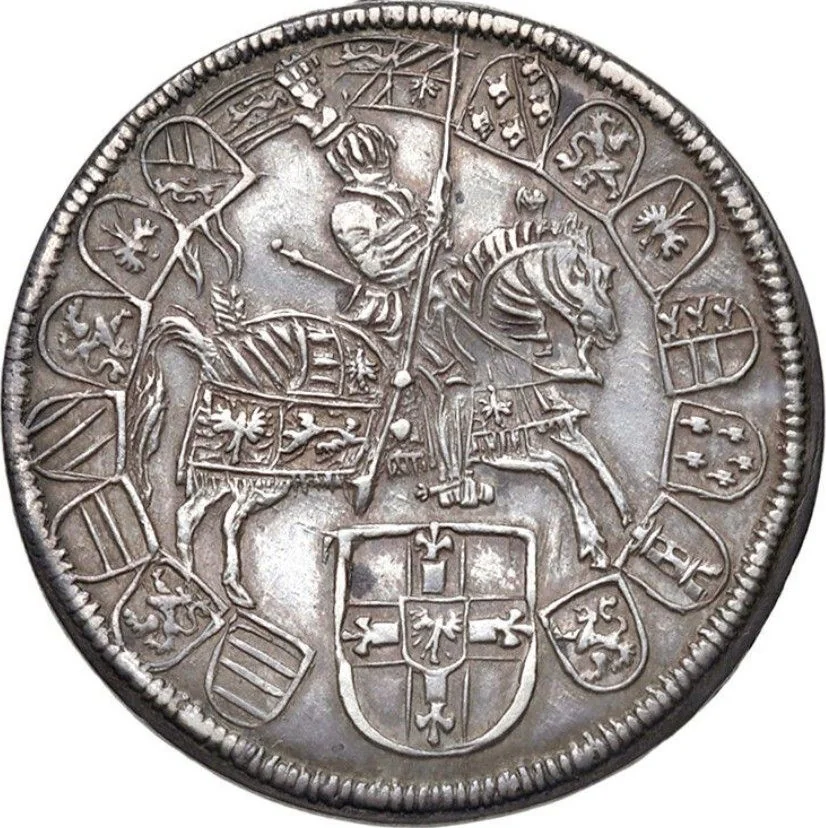
An armored knight on horseback faces right, wearing a great helm and carrying a banner. He is encircled by 14 small shields displaying the arms of (clockwise from top): Alsace, Habsburg, Prussia, Carinthia, Lower Austria, Castile, Leon, (Teutonic Order), Hungary, Bohemia, Austria, Ancient Burgundy, Styria, Carniola, and Gorizia. Below, a larger shield shows the Teutonic Order cross with the arms of Tyrol at its center.
Edge
Categories
| Animal> Feline |
| Animal> Bird> Eagle |
| Animal> Horse |
| Object> Armour |
| Building> Castle or fortification |
| Symbols> Coat of Arms |
Mints
| Name | Mark |
|---|---|
| Hall | — |
Mintings
| Year | Mint Mark | Mintage | Quality | Collection |
|---|---|---|---|---|
| 1615 | — | — |
Historical background
In 1615, the Teutonic Order, governing the Duchy of Prussia as a fief of the Polish Crown, operated within a complex and challenging monetary environment. The state’s currency system was not autonomous but was heavily influenced by and integrated with the broader Polish-Lithuanian Commonwealth. The primary circulating coins were Polish issues, such as the złoty, grosz, and solidus (szeląg), alongside a significant influx of foreign specie, particularly German thalers from the Holy Roman Empire and Dutch rijksdaalders. These foreign coins were essential for larger transactions and international trade, especially with the Order's Hanseatic connections, but their fluctuating values created instability.
The Order’s own minting activity was limited and problematic. While it had the right to strike coinage, its output was sporadic and often of inferior quality compared to Polish royal mints. A key issue was the practice of debasement—reducing the precious metal content in coins to generate seigniorage revenue for the state treasury. This led to the circulation of "light" or "bad" Prussian schillings alongside "good" Polish coins, causing Gresham’s Law ("bad money drives out good") to take effect. Consequently, higher-quality coins were hoarded or exported, leaving the local economy with degraded currency, which eroded public trust and complicated commerce.
This monetary confusion posed significant economic and political difficulties for Grand Master Johann Sigismund von Brandenburg (who was also the Elector of Brandenburg). The situation undermined internal trade, state finances, and the Duchy’s economic credibility. It also highlighted Prussia’s dependent position, as any substantive monetary reform required navigating the sovereignty of the Polish King. The currency disarray of 1615 thus reflected the broader tensions of a state caught between its feudal obligations, the economic realities of regional trade, and the financial pressures of maintaining its aristocratic and military structure.
The Order’s own minting activity was limited and problematic. While it had the right to strike coinage, its output was sporadic and often of inferior quality compared to Polish royal mints. A key issue was the practice of debasement—reducing the precious metal content in coins to generate seigniorage revenue for the state treasury. This led to the circulation of "light" or "bad" Prussian schillings alongside "good" Polish coins, causing Gresham’s Law ("bad money drives out good") to take effect. Consequently, higher-quality coins were hoarded or exported, leaving the local economy with degraded currency, which eroded public trust and complicated commerce.
This monetary confusion posed significant economic and political difficulties for Grand Master Johann Sigismund von Brandenburg (who was also the Elector of Brandenburg). The situation undermined internal trade, state finances, and the Duchy’s economic credibility. It also highlighted Prussia’s dependent position, as any substantive monetary reform required navigating the sovereignty of the Polish King. The currency disarray of 1615 thus reflected the broader tensions of a state caught between its feudal obligations, the economic realities of regional trade, and the financial pressures of maintaining its aristocratic and military structure.
✨ Legendary