


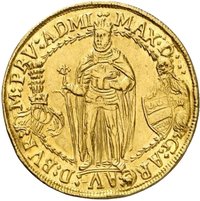
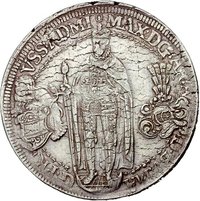
Obverse
Description:
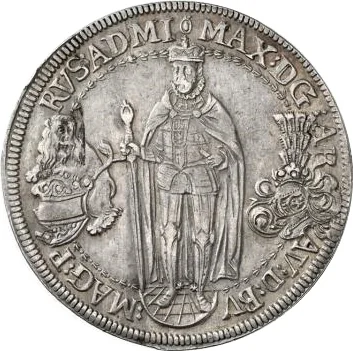
Grandmaster standing, helmet to his right.
Inscription:
MAX: D G: ARC :AV: D: BV: MAG: PRVSS: ADMI.
Script: Latin
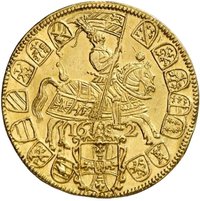
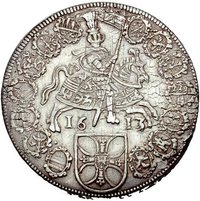
Reverse
Description:
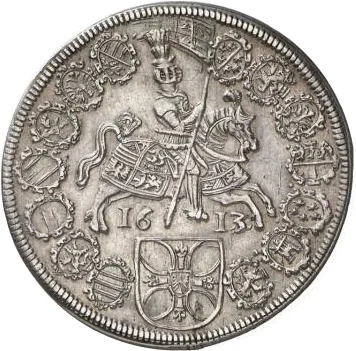
Emperor on horseback within a ring of shields, date beneath.
Script: Latin
Edge
Plain
Mintings
| Year | Mint Mark | Mintage | Quality | Collection |
|---|---|---|---|---|
| 1613 | — | — |
Historical background
In 1613, the Teutonic Order, governing the Duchy of Prussia as a fief of the Polish Crown, operated within a complex and challenging monetary environment. The state’s currency system was not autonomous; it was deeply entangled within the wider Polish-Lithuanian Commonwealth’s economy and subject to disruptive regional forces. The primary circulating coins included the Prussian schilling and groschen, but these competed with a flood of foreign specie, particularly Polish coins and a vast influx of debased thalers from the neighbouring Holy Roman Empire. This created a chronic problem of bad money driving out good, destabilizing local trade and state revenues.
The financial administration of the Order, under Grand Master Johann Sigismund von Brandenburg (who was also the Elector of Brandenburg), faced significant pressure. The need to finance the state, pay its obligations to the Polish king, and maintain the Order's infrastructure required a stable currency. However, the right to mint coins was a royal privilege, meaning the Order's ability to reform its coinage was constrained by its feudal subordination to Poland. This period saw repeated but often ineffective ordinances aimed at fixing exchange rates and banning inferior foreign coins, measures that were difficult to enforce in practice.
Consequently, the monetary situation in 1613 was one of fragility and transition. It reflected the Order’s diminishing political independence and its precarious economic position caught between Polish authority and German economic influence. This instability would persist until the full integration of the Duchy with Brandenburg later in the century, which eventually allowed for a more unified and controlled monetary policy under the Hohenzollern dynasty.
The financial administration of the Order, under Grand Master Johann Sigismund von Brandenburg (who was also the Elector of Brandenburg), faced significant pressure. The need to finance the state, pay its obligations to the Polish king, and maintain the Order's infrastructure required a stable currency. However, the right to mint coins was a royal privilege, meaning the Order's ability to reform its coinage was constrained by its feudal subordination to Poland. This period saw repeated but often ineffective ordinances aimed at fixing exchange rates and banning inferior foreign coins, measures that were difficult to enforce in practice.
Consequently, the monetary situation in 1613 was one of fragility and transition. It reflected the Order’s diminishing political independence and its precarious economic position caught between Polish authority and German economic influence. This instability would persist until the full integration of the Duchy with Brandenburg later in the century, which eventually allowed for a more unified and controlled monetary policy under the Hohenzollern dynasty.
✨ Legendary