

1 Thaler – Teutonic Order
Germany
Obverse
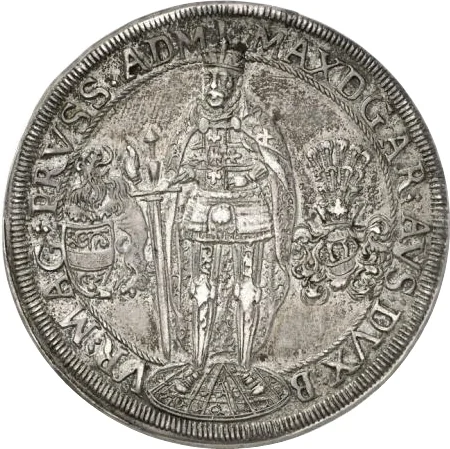
Description:
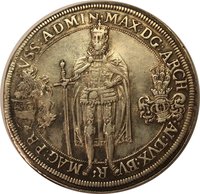
Grandmaster standing, helmet to his right.
Script: Latin
Reverse
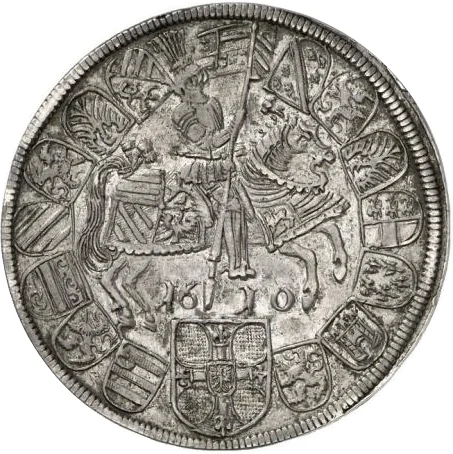
Description:
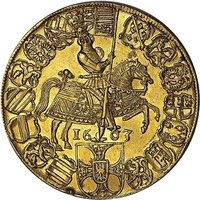
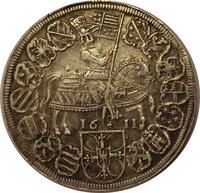
Emperor on horse, encircled by shields. Rear legs lowered, date split by spear and rider's foot.
Script: Latin
Edge
Mintings
| Year | Mint Mark | Mintage | Quality | Collection |
|---|---|---|---|---|
| 1610 | — | — |
Historical background
In 1610, the Teutonic Order's currency situation was complex and largely defined by its status as a vassal to the Polish Crown. Following the Prussian Homage of 1525, the Order's territory was reduced to its Livonian holdings and, more significantly, the secular Duchy of Prussia, which was held as a Polish fief by the Hohenzollern branch of the family. While the Grand Master in Livonia minted his own coins (such as schillings and thalers), the economic heartland in Ducal Prussia operated under the Polish monetary system. This created a de facto dual system where Polish coins, particularly the grosz and the złoty, circulated widely alongside local Prussian and Livonian issues, leading to practical challenges in trade and accounting.
The period was marked by significant monetary instability across the Polish-Lithuanian Commonwealth, which directly impacted the Order's lands. The early 17th century saw rampant debasement of the Polish-Lithuanian currency, especially the small-denomination copper shillings (boratynki) and silver grosz. This "currency crisis" caused inflation, confusion in exchange rates, and a loss of public trust in coinage. For the Teutonic territories, this meant that the value of coins in circulation was volatile, and the Grand Masters struggled to maintain the integrity of their own mintages amidst a flood of depreciated Polish coins.
Furthermore, the Teutonic Order's financial and political power was in steep decline. Its Livonian territories were a perpetual battleground between Sweden, Poland, and Russia, draining resources and disrupting economic activity. The right to mint coins was a crucial regalian privilege, but the Order's capacity to leverage it for profit or monetary stability was severely limited by these external pressures and its vassalage. Consequently, the currency situation in 1610 reflected a state in transition—clinging to the symbols of sovereignty through coinage while being increasingly subsumed into the turbulent economic sphere of its powerful neighbors.
The period was marked by significant monetary instability across the Polish-Lithuanian Commonwealth, which directly impacted the Order's lands. The early 17th century saw rampant debasement of the Polish-Lithuanian currency, especially the small-denomination copper shillings (boratynki) and silver grosz. This "currency crisis" caused inflation, confusion in exchange rates, and a loss of public trust in coinage. For the Teutonic territories, this meant that the value of coins in circulation was volatile, and the Grand Masters struggled to maintain the integrity of their own mintages amidst a flood of depreciated Polish coins.
Furthermore, the Teutonic Order's financial and political power was in steep decline. Its Livonian territories were a perpetual battleground between Sweden, Poland, and Russia, draining resources and disrupting economic activity. The right to mint coins was a crucial regalian privilege, but the Order's capacity to leverage it for profit or monetary stability was severely limited by these external pressures and its vassalage. Consequently, the currency situation in 1610 reflected a state in transition—clinging to the symbols of sovereignty through coinage while being increasingly subsumed into the turbulent economic sphere of its powerful neighbors.
✨ Legendary