Logo Title
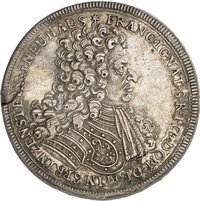
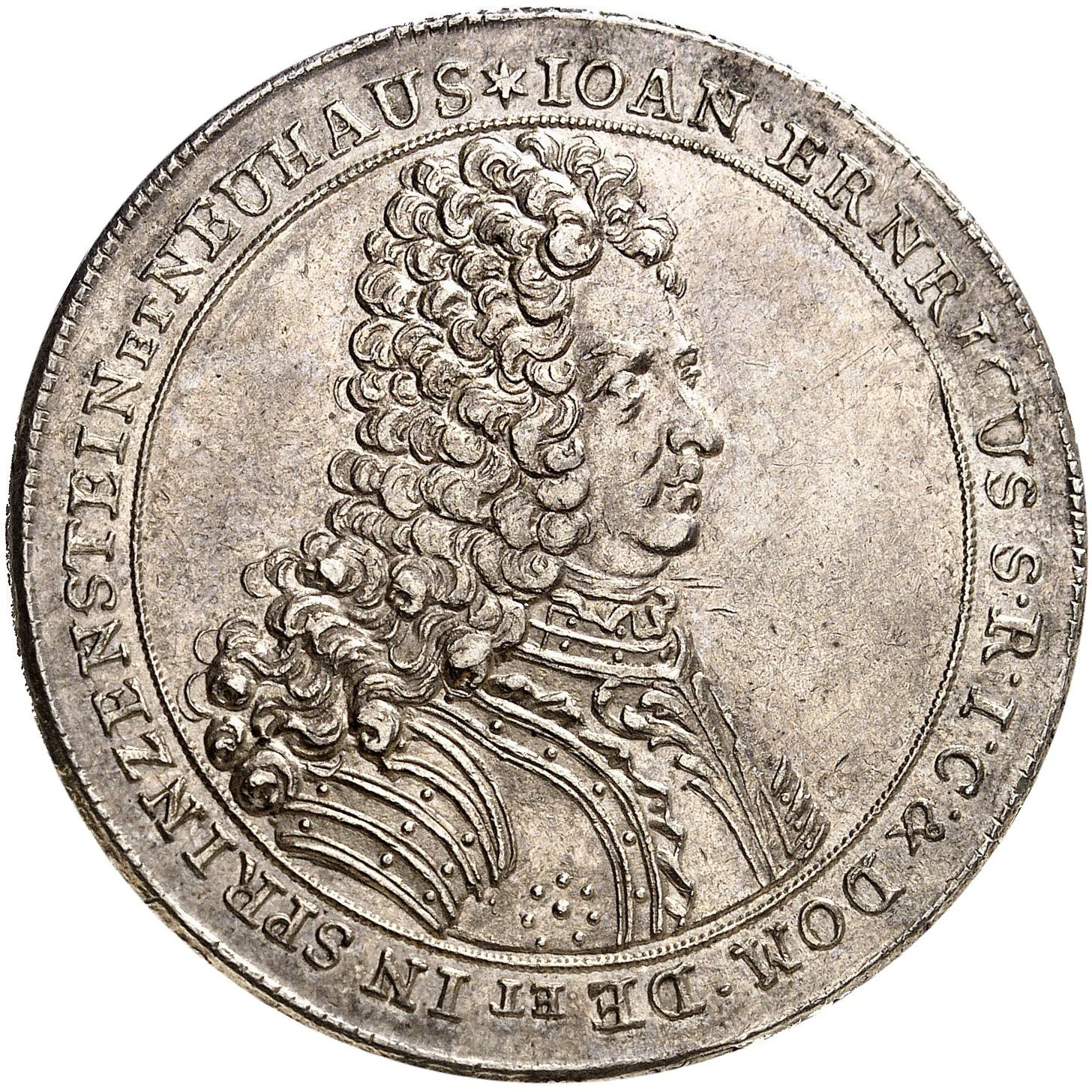
obverse
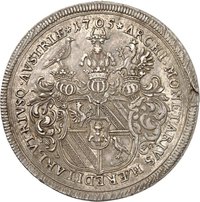
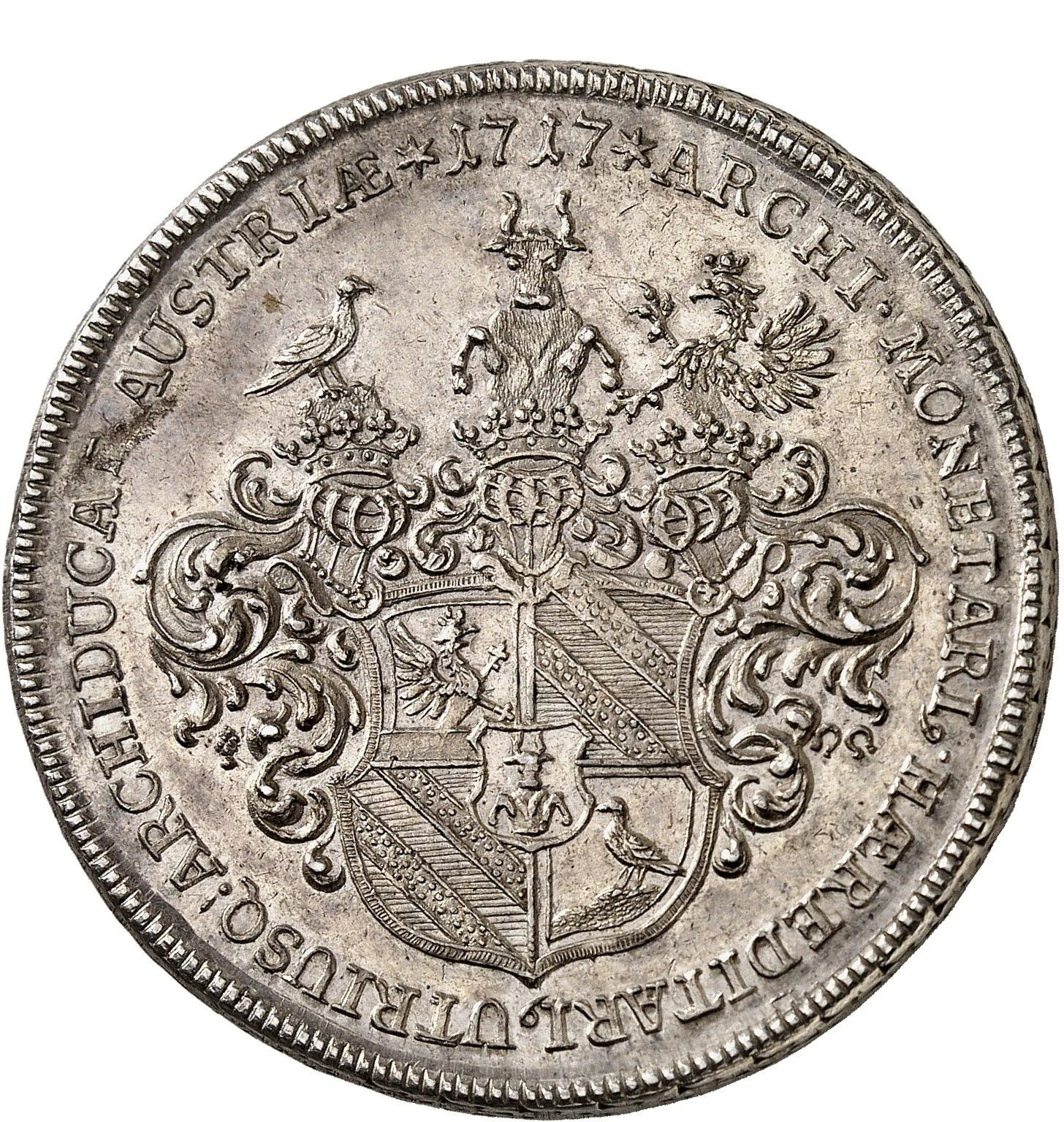
reverse
Fritz Rudolf Künker GmbH & Co. KG, Osnabrück and Lübke & Wiedemann KG, Leonberg

1 Thaler – Counts of Sprinzenstein

Austria
Context
Year: 1717
Country: Austria Country flag
Currency:
Demonetized: Yes
Material
Diameter: 41 mm
Weight: 29.2 g
Silver weight: 29.20 g
Shape: Round
Composition: Silver
Magnetic: No
Technique: Milled
References
KM: #Click to copy to clipboard10
Numista: #103452
Value
Bullion value: $82.60

Obverse

Description:
Bust of Count Francis Ignaz in armor and long wig, facing right.
Inscription:
🟉 IOAN · ERNRICUS S · R · I C · & DOM · DE · ET IN SPRINZENSTEIN ET NEUHAUS
Script: Latin

Reverse

Description:
Coat of arms of the Count of Sprinzenstein, featuring three helms: left with a sparrowhawk, center with a rampant bull, right with a crowned griffin, and scrolls behind.
Inscription:
🟉 ARCHI · MONETARI, · HÆREDITARI, · UTRIUSQ · ARCHIDUCAT · AUSTRIÆ 🟉 1717
Script: Latin

Edge


Mints

NameMark
Augsburg

Mintings

YearMint MarkMintageQualityCollection
1717

Historical background

The currency situation in the County of Sprinzenstein in 1717 was a direct reflection of the wider monetary chaos within the Holy Roman Empire in the decades following the Thirty Years' War. The Empire operated on no single, unified currency, but rather a complex system where numerous territorial lords, bishops, and imperial cities held the right of coinage (Münzregal). This led to a proliferation of coins of varying quality, weight, and metal content circulating simultaneously. The primary framework was the Reichsmünzfuß (imperial minting standard), but it was widely ignored, particularly by smaller states engaging in debasement to profit from seigniorage or to finance local debts.

For a small, non-sovereign county like Sprinzenstein, the practical monetary reality was one of imported instability. The Counts themselves likely did not possess an independent minting right, meaning they depended on the circulation of coins from larger regional powers, such as the Habsburg Austrian Empire (issuing Conventionsthalers and Kreuzers) and the neighboring Electorate of Bavaria. Furthermore, the region was flooded with lower-quality coins from states engaging in "Kipper und Wipper" practices—clipping, sweating, or issuing intentionally debased coinage. This created a severe problem where good, high-silver coins were hoarded or melted down, while poor money was forced into daily transactions, eroding public trust and causing price inflation.

Consequently, in 1717, the economic life in Sprinzenstein would have been characterized by constant calculation and uncertainty. Merchants and tenants paying rents to the Count would have needed to negotiate not just amounts, but the specific type and quality of coinage, often requiring assays. The Count's own finances, including toll collections, land rents, and payments for goods, were likely managed through a mixture of physical specie and bookkeeping in established units of account (like Gulden and Kreuzer), which were abstract benchmarks against which the ever-fluctuating value of physical coins had to be reconciled. Thus, the currency situation was less a defined system and more a daily administrative challenge of assessing and mitigating monetary risk.
Legendary