

1⁄24 Thaler – Swedish dominion of Pomerania
Sweden
Context
Year: 1671
Country: Sweden 
Issuer: Swedish dominion of Pomerania
Ruler: Charles XI
Currency:
(1630—1815)
Demonetized: Yes
References
KM: #Click to copy to clipboard249.2
Numista: #136779
Value
Bullion value: $4.91
Obverse
Description:
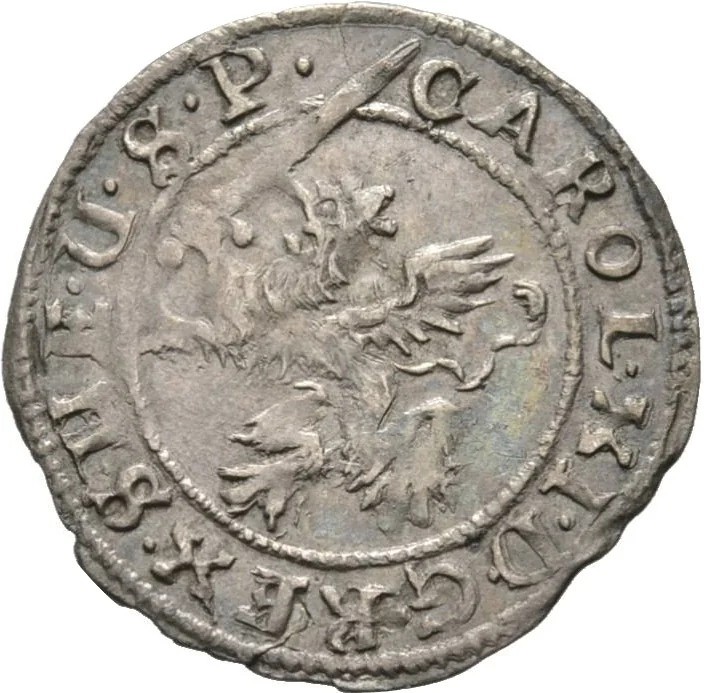
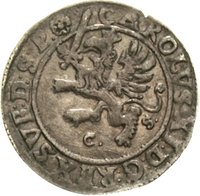
Crowned griffin, sword in left claw.
Script: Latin
Reverse
Description:
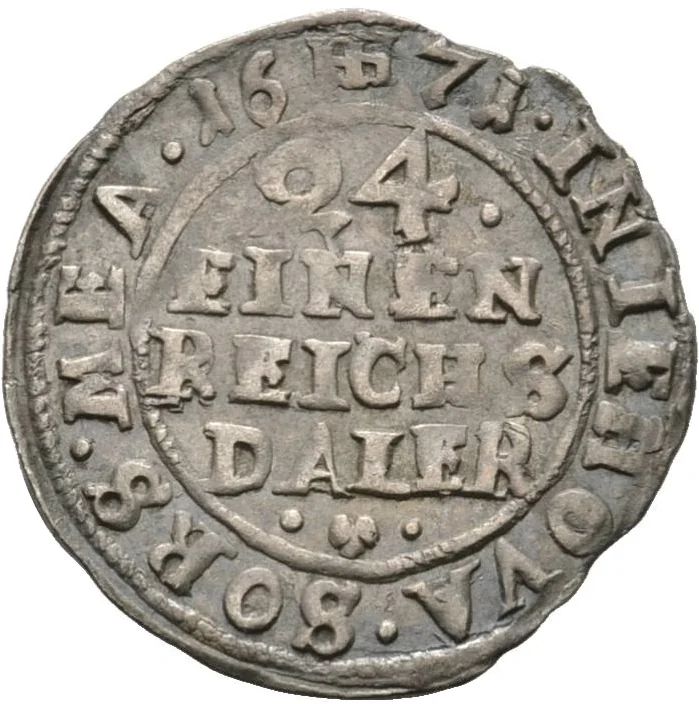
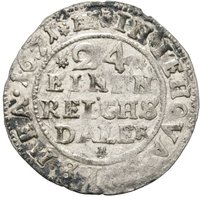
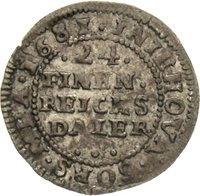
Central inscription in four lines, date after legend, separated by mintmaster initials.
Script: Latin
Edge
Mintings
| Year | Mint Mark | Mintage | Quality | Collection |
|---|---|---|---|---|
| 1671 | HIH | — |
Historical background
In 1671, the currency situation in Swedish Pomerania was complex and strained, reflecting the territory's unique position as a Swedish dominion within the Holy Roman Empire. The province operated under a dual monetary system, where both Swedish and local German currencies circulated, often at competing values. The official currency was the Swedish riksdaler, but in daily commerce, the widely used Reichsthaler and various lower-denomination coins from neighboring German states, such as Mecklenburg and Brandenburg, were pervasive. This created constant challenges for trade and taxation, as exchange rates fluctuated and the values of different coinages were difficult to stabilize.
The primary issue was severe coinage debasement and a chronic shortage of high-quality specie. Decades of warfare, including the Thirty Years' War and ongoing conflicts like the Scanian War (which began in 1675), had drained the treasury and led successive administrations to issue depreciated coinage to meet military expenses. Furthermore, the lucrative right of minting was often farmed out to private contractors who, seeking profit, produced lightweight or low-purity coins. This practice, combined with the influx of even more debased "Kipper und Wipper" coinage from other German states, eroded public trust and provoked price inflation, harming the local economy.
Swedish authorities in Stettin struggled to assert monetary control but were largely ineffective. Their attempts to mandate the use of Swedish currency and set fixed exchange rates were routinely undermined by market forces and the economic gravity of the surrounding German lands. Consequently, by 1671, the monetary landscape was fragmented and unstable, characterized by a confusing multiplicity of coins, widespread suspicion of their intrinsic value, and a persistent gap between official policy and economic reality. This instability weakened Swedish administrative control and placed a significant burden on the Pomeranian population.
The primary issue was severe coinage debasement and a chronic shortage of high-quality specie. Decades of warfare, including the Thirty Years' War and ongoing conflicts like the Scanian War (which began in 1675), had drained the treasury and led successive administrations to issue depreciated coinage to meet military expenses. Furthermore, the lucrative right of minting was often farmed out to private contractors who, seeking profit, produced lightweight or low-purity coins. This practice, combined with the influx of even more debased "Kipper und Wipper" coinage from other German states, eroded public trust and provoked price inflation, harming the local economy.
Swedish authorities in Stettin struggled to assert monetary control but were largely ineffective. Their attempts to mandate the use of Swedish currency and set fixed exchange rates were routinely undermined by market forces and the economic gravity of the surrounding German lands. Consequently, by 1671, the monetary landscape was fragmented and unstable, characterized by a confusing multiplicity of coins, widespread suspicion of their intrinsic value, and a persistent gap between official policy and economic reality. This instability weakened Swedish administrative control and placed a significant burden on the Pomeranian population.
✨ Legendary