

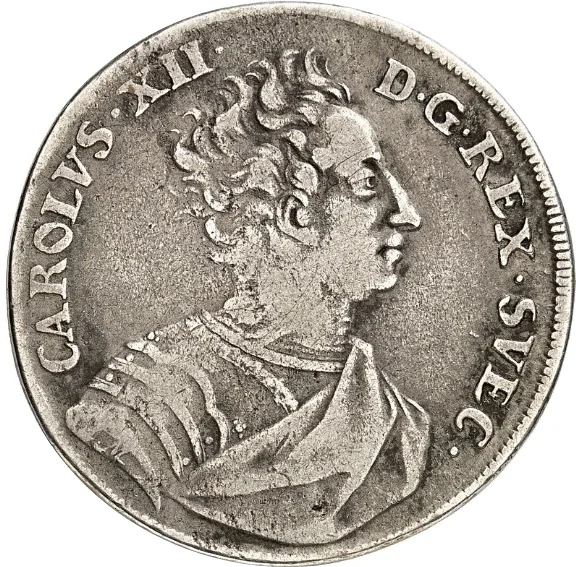
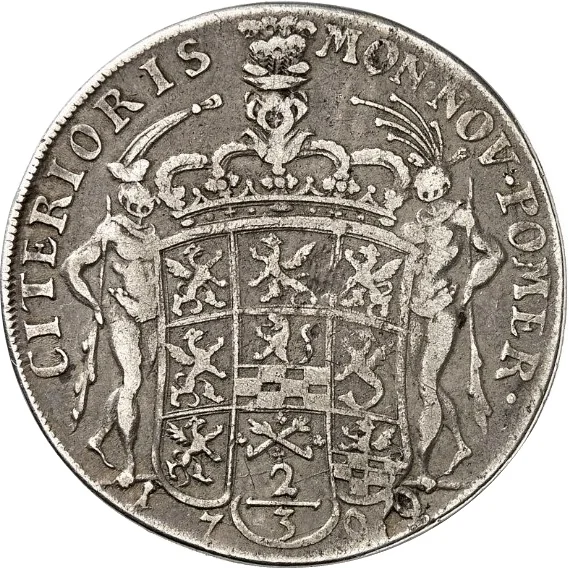
⅔ Thaler – Swedish dominion of Pomerania
Sweden
Context
Years: 1708–1709
Country: Sweden 
Issuer: Swedish dominion of Pomerania
Ruler: Charles XII
Currency:
(1630—1815)
Demonetized: Yes
References
KM: #Click to copy to clipboard365
Numista: #136760
Obverse
Description:
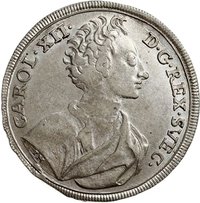
Bust right, left shoulder draped.
Script: Latin
Reverse
Description:
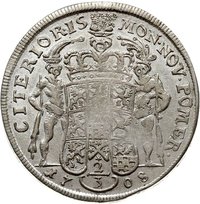
Crowned arms with value and date.
Script: Latin
Edge
Mintings
| Year | Mint Mark | Mintage | Quality | Collection |
|---|---|---|---|---|
| 1708 | — | — | ||
| 1709 | — | — |
Historical background
In 1708, the currency situation in Swedish Pomerania was one of severe crisis and complexity, deeply entangled in the broader turmoil of the Great Northern War (1700-1721). The Swedish state, financially exhausted by the prolonged conflict, was increasingly unable to supply its distant German dominion with sufficient official coinage. This scarcity created a vacuum filled by a chaotic mix of debased local coins, foreign currencies (particularly Polish and Saxon coins from the war zone), and a proliferation of counterfeit money. The result was a loss of public trust in the monetary system, rampant inflation, and significant disruption to commerce and daily life.
The Swedish administration in Stralsund attempted to manage the crisis through repeated ordinances and currency manipulations, a practice known as Kipper- und Wipperzeit. They periodically decreed new exchange rates for the various circulating coins, often overvaluing the debased money used to pay soldiers and suppliers while demanding taxes in higher-quality specie. This policy, essentially a form of war financing through currency devaluation, transferred wealth from the local Pomeranian population to the Swedish war effort but further eroded economic stability. Merchants and citizens faced heavy losses as the value of money could change abruptly by royal decree.
Ultimately, the monetary chaos of 1708 was a direct symptom of Swedish Pomerania’s role as a strategic garrison and logistical base for the Swedish army on the continent. The province’s economy was subordinated to the military needs of a struggling empire, with its currency system used as a fiscal instrument to sustain the war. This instability would persist until the war's conclusion, leaving the Pomeranian economy depleted and in need of prolonged recovery.
The Swedish administration in Stralsund attempted to manage the crisis through repeated ordinances and currency manipulations, a practice known as Kipper- und Wipperzeit. They periodically decreed new exchange rates for the various circulating coins, often overvaluing the debased money used to pay soldiers and suppliers while demanding taxes in higher-quality specie. This policy, essentially a form of war financing through currency devaluation, transferred wealth from the local Pomeranian population to the Swedish war effort but further eroded economic stability. Merchants and citizens faced heavy losses as the value of money could change abruptly by royal decree.
Ultimately, the monetary chaos of 1708 was a direct symptom of Swedish Pomerania’s role as a strategic garrison and logistical base for the Swedish army on the continent. The province’s economy was subordinated to the military needs of a struggling empire, with its currency system used as a fiscal instrument to sustain the war. This instability would persist until the war's conclusion, leaving the Pomeranian economy depleted and in need of prolonged recovery.
✨ Legendary