

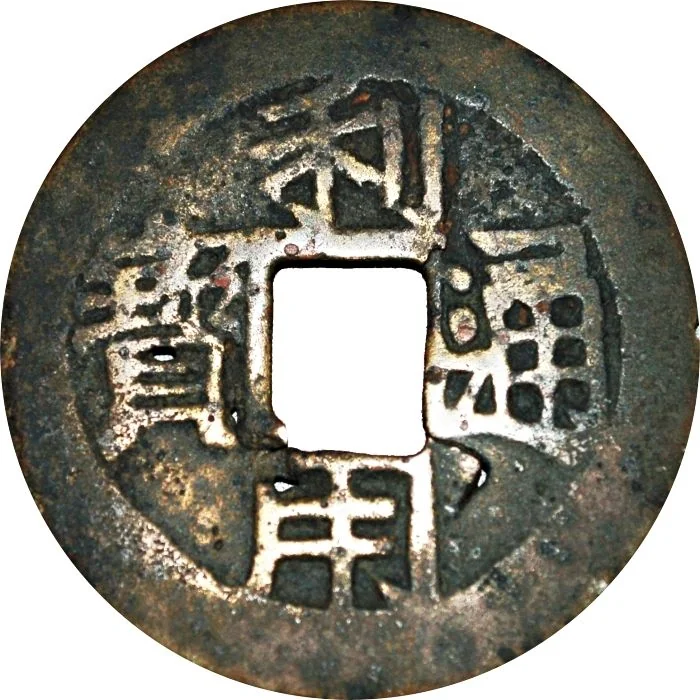
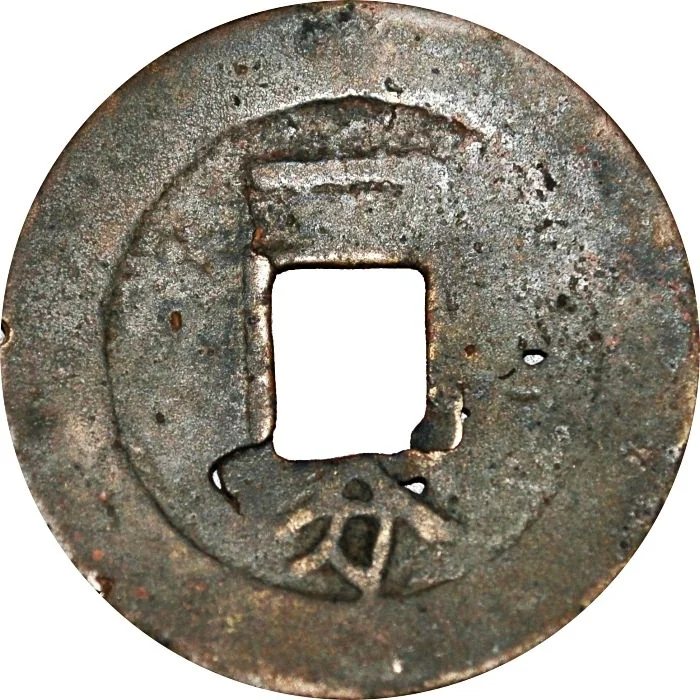
10 Cash – Great Zhou dynasty
China
Context
Years: 1674–1678
Country: China 
Issuer: Great Zhou dynasty
Ruler: Wu Sangui
Currency:
(1674—1681)
Demonetized: Yes
Material
Diameter: 44 mm
Weight: 16.17 g
Thickness: 0.7 mm
Shape: Round with a square hole
Composition: Brass
Magnetic: No
Technique: Cast
Alignment: Medal alignment
flip
References
KM: #Click to copy to clipboard199
Numista: #136608
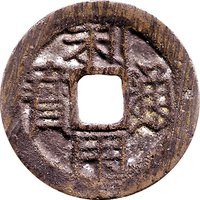
Obverse
Description:
Four Chinese characters read vertically, right to left.
Inscription:
利
寶 通
用
寶 通
用
Scripts: Chinese (traditional, regular script)
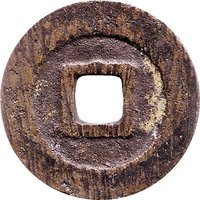
Reverse
Description:
Two Chinese characters in multiple places.
Inscription:
一
分
分
Scripts: Chinese (traditional, regular script)
Edge
Plain
Mintings
| Year | Mint Mark | Mintage | Quality | Collection |
|---|---|---|---|---|
| — | — | — |
Historical background
In 1674, the Great Zhou dynasty, proclaimed by the rebel leader Wu Sangui in the southwestern provinces of China, faced a precarious and inflationary currency crisis. Having declared himself emperor in a bid to overthrow the ruling Qing dynasty, Wu Sangui’s fledgling state lacked the stable economic foundation and precious metal reserves of his established rival. To finance his massive military mobilization for the ongoing Revolt of the Three Feudatories, his administration was forced to heavily rely on the casting and circulation of low-quality, high-denomination copper cash coins, often marked with the reign title "Zhaowu."
The currency system was characterized by rampant debasement. To stretch limited copper supplies, the Zhou mints produced coins with inferior alloys, increased lead and tin content, and reduced both their size and weight. Furthermore, the government issued coins with inflated nominal values far exceeding their intrinsic metal worth, a desperate measure to pay troops and procure supplies. This led to a rapid loss of public confidence; merchants and civilians, recognizing the declining value of the new cash, began hoarding older, fuller-weight coins from previous Ming and Qing issues, which only exacerbated the scarcity of trustworthy currency in the marketplace.
Consequently, the economic landscape within Zhou territory was one of severe instability. Prices for basic goods soared as the value of the official currency plummeted, creating hardship for the population and logistical strain on the military itself. This self-inflicted hyperinflation undermined the Zhou dynasty's legitimacy and administrative effectiveness, revealing the hollow core of Wu Sangui's rebel regime. The currency crisis of 1674 thus became a critical weakness, eroding the internal stability of the Great Zhou even as its armies fought on the external front, and foreshadowed the dynasty's eventual collapse despite early military successes.
The currency system was characterized by rampant debasement. To stretch limited copper supplies, the Zhou mints produced coins with inferior alloys, increased lead and tin content, and reduced both their size and weight. Furthermore, the government issued coins with inflated nominal values far exceeding their intrinsic metal worth, a desperate measure to pay troops and procure supplies. This led to a rapid loss of public confidence; merchants and civilians, recognizing the declining value of the new cash, began hoarding older, fuller-weight coins from previous Ming and Qing issues, which only exacerbated the scarcity of trustworthy currency in the marketplace.
Consequently, the economic landscape within Zhou territory was one of severe instability. Prices for basic goods soared as the value of the official currency plummeted, creating hardship for the population and logistical strain on the military itself. This self-inflicted hyperinflation undermined the Zhou dynasty's legitimacy and administrative effectiveness, revealing the hollow core of Wu Sangui's rebel regime. The currency crisis of 1674 thus became a critical weakness, eroding the internal stability of the Great Zhou even as its armies fought on the external front, and foreshadowed the dynasty's eventual collapse despite early military successes.
✨ Legendary