

1 Ducat – Swabian Circle
Germany
Context

Material
References
KM: #Click to copy to clipboard5
Numista: #135858
Value
Bullion value: $573.26
Obverse
Description:
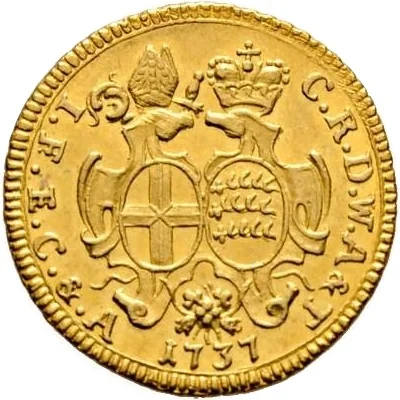
Two shields: one crowned, one mitred, dated together.
Script: Latin
Reverse
Description:
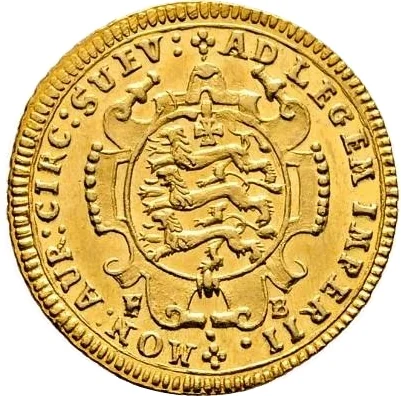
Lion arms in cartouche.
Script: Latin
Edge
Mints
| Name | Mark |
|---|---|
| Staatliche Münze Baden-Württemberg | — |
Mintings
| Year | Mint Mark | Mintage | Quality | Collection |
|---|---|---|---|---|
| 1737 | — | — |
Historical background
In 1737, the currency situation within the Swabian Circle, a defensive and administrative association of Imperial Estates in the Holy Roman Empire, was characterized by profound complexity and instability. The core issue was the coexistence of multiple monetary standards, primarily the Reichsthaler (Imperial Thaler) as the official accounting unit decreed by imperial ordinances, and the widely circulating Gulden (florin), which itself had both a gold (Goldgulden) and a silver (Kreuzergulden) variant. Each of the Circle's numerous member states—including imperial cities like Augsburg, ecclesiastical territories, and small knightly holdings—often minted their own subsidiary coinage (kreuzers, batzen, etc.) with varying silver content. This created a chaotic patchwork where exchange rates fluctuated locally, facilitating arbitrage and damaging trade.
The instability was exacerbated by the economic strain of recent military conflicts, particularly the War of the Polish Succession (1733-1738), in which Circle members had financial obligations. Princes and cities, frequently in need of revenue, engaged in debasement—reducing the precious metal content in their coinage while maintaining its face value. This practice, known as Kipper- und Wipperzeit in an earlier severe crisis, led to a loss of public trust, drove good money out of circulation (Gresham's Law), and caused price inflation. Consequently, merchants and authorities struggled with uncertain valuations in everyday transactions and long-distance commerce.
Efforts to impose order were persistent but struggled against regional particularism. The Circle's own ordinances and the Imperial Coinage Acts (Reichsmünzordnungen) aimed to standardize the monetary system by defining the silver content of the Reichsthaler and its subdivisions. However, enforcement was weak, as sovereign minting rights were a cherished privilege. Therefore, in 1737, the monetary landscape remained a source of constant friction, hindering economic integration and reflecting the broader decentralized and fragmented nature of the Holy Roman Empire in the decades before the major reforms of the late 18th century.
The instability was exacerbated by the economic strain of recent military conflicts, particularly the War of the Polish Succession (1733-1738), in which Circle members had financial obligations. Princes and cities, frequently in need of revenue, engaged in debasement—reducing the precious metal content in their coinage while maintaining its face value. This practice, known as Kipper- und Wipperzeit in an earlier severe crisis, led to a loss of public trust, drove good money out of circulation (Gresham's Law), and caused price inflation. Consequently, merchants and authorities struggled with uncertain valuations in everyday transactions and long-distance commerce.
Efforts to impose order were persistent but struggled against regional particularism. The Circle's own ordinances and the Imperial Coinage Acts (Reichsmünzordnungen) aimed to standardize the monetary system by defining the silver content of the Reichsthaler and its subdivisions. However, enforcement was weak, as sovereign minting rights were a cherished privilege. Therefore, in 1737, the monetary landscape remained a source of constant friction, hindering economic integration and reflecting the broader decentralized and fragmented nature of the Holy Roman Empire in the decades before the major reforms of the late 18th century.
✨ Legendary