

1 thaler – Swabian Circle
Add to wishlist
Germany
Context
References
KM: #
Numista: #135577
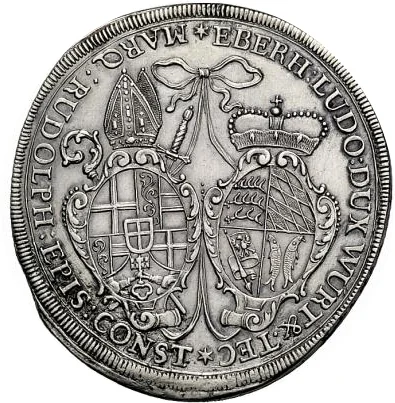
Obverse
Description:
Two shields: one crowned, one mitered.
Inscription:
EBERH:LUDO:DUX WURT.&TEC
MARQ:RUDOLPH:EPIS:CONST
MARQ:RUDOLPH:EPIS:CONST
Script: Latin
Engraver: Philipp Heinrich Müller
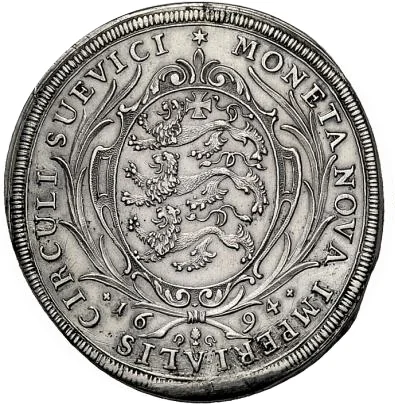
Reverse
Description:
Arms framed with sprays, date beneath.
Inscription:
MONETA NOVA ARGENT.IMPERIALIS CIRCULI SUEVICI
Script: Latin
Engraver: Philipp Heinrich Müller
Edge
Mints
| Name | Mark |
|---|---|
| Augsburg | — |
Mintings
| Year | Mint Mark | Mintage | Quality | Collection |
|---|---|---|---|---|
| 1694 | — | — |
Historical background
In 1694, the Swabian Circle, a defensive and administrative coalition of Imperial Estates within the Holy Roman Empire, was grappling with severe monetary disorder. This crisis was a local manifestation of the wider Kipper- und Wipperzeit, a period of currency debasement and inflation that had plagued the Empire for decades. The fundamental issue was the fragmentation of minting rights among numerous Circle members—including Imperial Cities like Augsburg and Ulm, ecclesiastical states, and minor counts—who often prioritized short-term profit over monetary stability. By issuing underweight and debased coinage, these authorities could seigniorage, but in doing so, they eroded public trust and disrupted commerce, as the value of coinage was uncertain and varied wildly between territories.
The immediate pressures of the Nine Years' War (1688-1697) exacerbated this structural flaw. The conflict demanded immense financial resources for troop levies and fortifications, pushing even traditionally conservative minters to debase their coinage to generate quick revenue. Consequently, "bad" debased coins from aggressive minters drove "good," full-weight coins out of circulation (Gresham's Law), hoarded or melted for their higher silver content. This led to a shortage of reliable currency, hampering trade and causing price instability that burdened the local population and merchants.
Recognizing the threat to the regional economy and their collective security, the Circle's Diet took action. In 1694, they attempted to reassert control by proposing or reinforcing Münzverein agreements—imperial currency treaties aimed at standardizing coinage weight and fineness across member states. The goal was to suppress the circulation of debased coins and restore a uniform, trustworthy monetary system. However, these efforts were often undermined by the very sovereignty of the individual estates, making enforcement difficult. Thus, the situation in 1694 was one of acute crisis met with a fragile, collaborative attempt at reform, highlighting the constant tension between local autonomy and imperial cohesion in the Holy Roman Empire.
The immediate pressures of the Nine Years' War (1688-1697) exacerbated this structural flaw. The conflict demanded immense financial resources for troop levies and fortifications, pushing even traditionally conservative minters to debase their coinage to generate quick revenue. Consequently, "bad" debased coins from aggressive minters drove "good," full-weight coins out of circulation (Gresham's Law), hoarded or melted for their higher silver content. This led to a shortage of reliable currency, hampering trade and causing price instability that burdened the local population and merchants.
Recognizing the threat to the regional economy and their collective security, the Circle's Diet took action. In 1694, they attempted to reassert control by proposing or reinforcing Münzverein agreements—imperial currency treaties aimed at standardizing coinage weight and fineness across member states. The goal was to suppress the circulation of debased coins and restore a uniform, trustworthy monetary system. However, these efforts were often undermined by the very sovereignty of the individual estates, making enforcement difficult. Thus, the situation in 1694 was one of acute crisis met with a fragile, collaborative attempt at reform, highlighting the constant tension between local autonomy and imperial cohesion in the Holy Roman Empire.
✨ Legendary