

100 Dram – Armenia
Non-circulating coins
Commemoration: ⅩⅩⅫ Chess Olympiad in Yerevan
Armenia
Context
Material
References
KM: #Click to copy to clipboard70
Numista: #100222
Value
Exchange value: 100 AMD
Bullion value: $75.88
Obverse
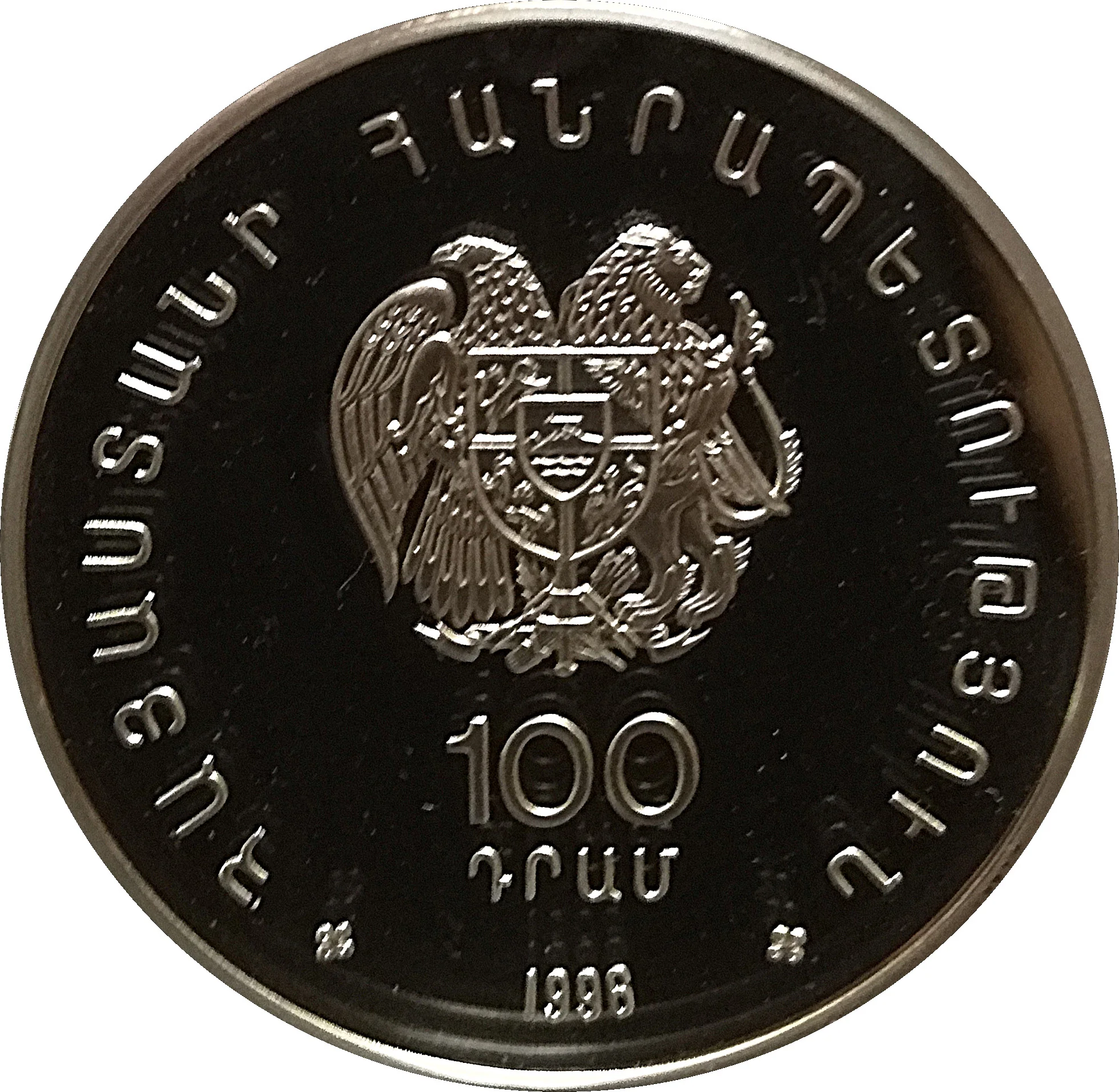
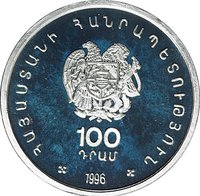
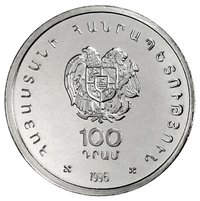
Description:
Coat of arms top, denomination middle, date bottom.
Inscription:
ՀԱՅԱՍՏԱՆԻ ՀԱՆՐԱՊԵՏՈՒԹՅՈՒՆ
100
ԴՌԱՄ
1996
100
ԴՌԱՄ
1996
Translation:
REPUBLIC OF ARMENIA
100
DRAM
1996
100
DRAM
1996
Script: Armenian
Language: Armenian
Engraver: Hrachya Aslanyan
Reverse
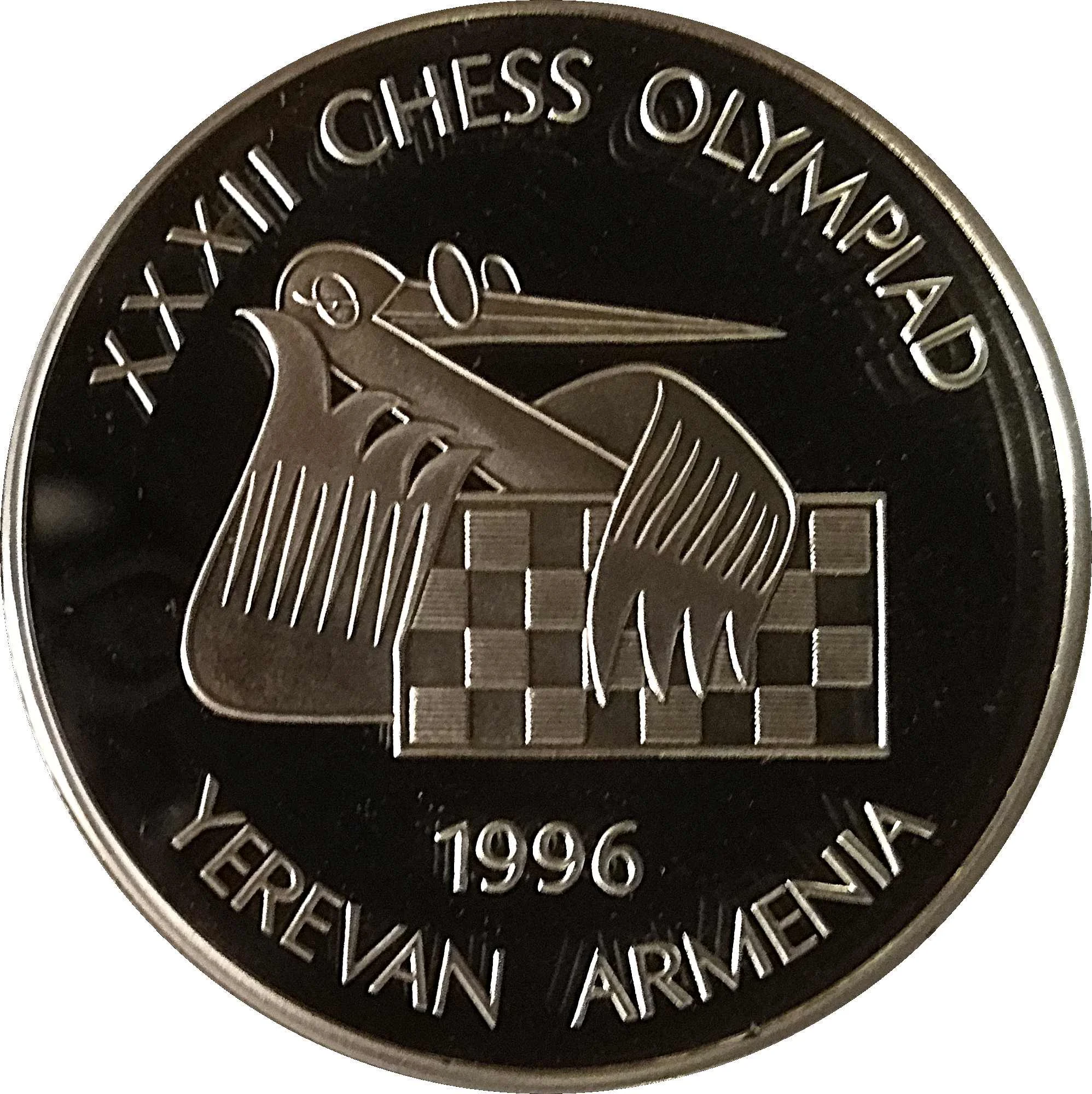
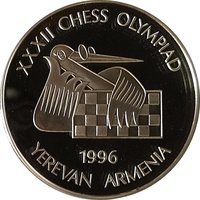
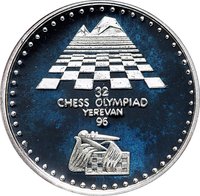
Description:
Chessboard stork illustration
Inscription:
ⅩⅩⅫ CHESS OLYMPIAD
1996
YEREVAN ARMENIA
1996
YEREVAN ARMENIA
Script: Latin
Engraver: Hrachya Aslanyan
Edge
Reeded
Categories
| Symbols> Coat of Arms |
| Animal> Bird |
Mints
| Name | Mark |
|---|---|
| Royal Mint | — |
Mintings
| Year | Mint Mark | Mintage | Quality | Collection |
|---|---|---|---|---|
| 1996 | — | 10,000 | Proof |
Historical background
In 1996, Armenia's currency situation was defined by the aftermath of severe hyperinflation and the recent introduction of a new national currency, the dram (AMD). Following independence from the Soviet Union in 1991, the country endured a devastating economic blockade, the loss of Soviet-era energy subsidies, and the Nagorno-Karabakh conflict, leading to a catastrophic economic collapse. The initial period of 1993-1994 saw hyperinflation estimated at over 10,000%, rendering the temporary Russian ruble virtually worthless and crippling the economy.
To combat this, the government, under President Levon Ter-Petrosyan, implemented a drastic stabilization program in late 1994 with IMF support. This included stringent fiscal austerity, tight monetary policy, and the formal introduction of the dram in November 1993, which by 1996 was fully established as the sole legal tender. The program was remarkably successful in taming inflation, which fell to single-digit monthly rates by 1996, and in achieving a measure of macroeconomic stability. However, this stability came at a significant social cost, with widespread poverty and a large shadow economy.
Thus, the currency situation in 1996 was one of fragile and hard-won stability. The dram was stable but not yet fully trusted, operating within a managed float. The Central Bank focused on maintaining tight control to prevent a return to hyperinflation, while the government faced the ongoing challenge of fostering real economic growth and formalizing the economy after the drastic stabilization. The year represented a critical transitional phase from survival to a tentative, albeit painful, recovery.
To combat this, the government, under President Levon Ter-Petrosyan, implemented a drastic stabilization program in late 1994 with IMF support. This included stringent fiscal austerity, tight monetary policy, and the formal introduction of the dram in November 1993, which by 1996 was fully established as the sole legal tender. The program was remarkably successful in taming inflation, which fell to single-digit monthly rates by 1996, and in achieving a measure of macroeconomic stability. However, this stability came at a significant social cost, with widespread poverty and a large shadow economy.
Thus, the currency situation in 1996 was one of fragile and hard-won stability. The dram was stable but not yet fully trusted, operating within a managed float. The Central Bank focused on maintaining tight control to prevent a return to hyperinflation, while the government faced the ongoing challenge of fostering real economic growth and formalizing the economy after the drastic stabilization. The year represented a critical transitional phase from survival to a tentative, albeit painful, recovery.
💎 Extremely Rare