Logo Title
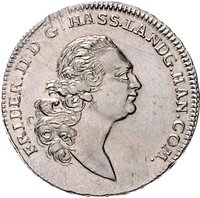
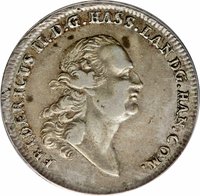
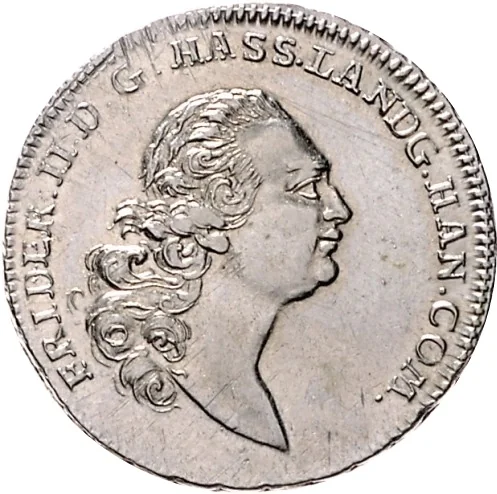
obverse
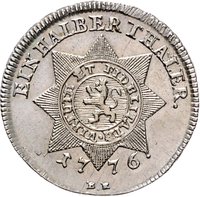
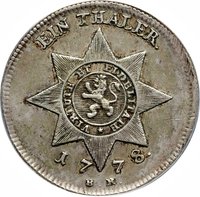
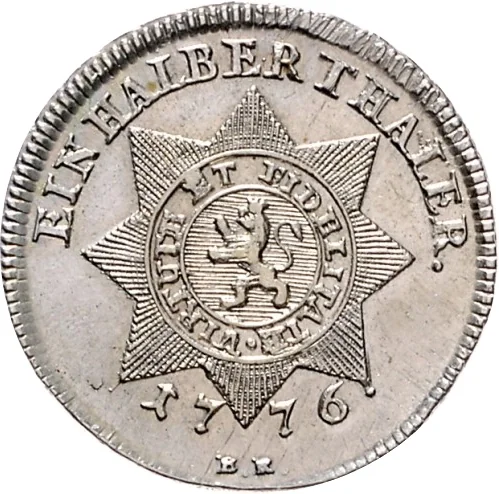
reverse
Münzenhandlung Harald Möller GmbH

½ Thaler – Landgraviate of Hesse-Cassel

Context
Year: 1776
Currency:
Demonetized: Yes
Material
Diameter: 28 mm
Weight: 11.75 g
Silver weight: 11.75 g
Thickness: 2 mm
Shape: Round
Composition: Silver
Magnetic: No
Alignment: Medal alignment
Obverse
OBVERSE ↑
flip
Reverse
REVERSE ↑
References
KM: #Click to copy to clipboard515
Numista: #133671
Value
Bullion value: $32.94

Obverse

Description:
Go right
Inscription:
FRIDER. II. D. G. HASS. LANDG. HAN. COM.
Script: Latin

Reverse

Description:
Lion arms in star, value above, date below.
Inscription:
EIN HALBER STERNTHALER.

1776

B. R.
Script: Latin

Edge

Mints

NameMark
Kassel

Mintings

YearMint MarkMintageQualityCollection
1776

Historical background

In 1776, the Landgraviate of Hesse-Cassel was a financially robust but monetarily complex state within the Holy Roman Empire. Its ruler, Landgrave Frederick II, had amassed great wealth, largely through a notorious system of leasing Hessian soldiers as mercenaries to foreign powers, most notably to Great Britain for service in the American Revolutionary War. This substantial income, however, existed alongside a convoluted currency system typical of the German territories of the time. The official unit of account was the Reichsthaler, but in practice, a multitude of physical coins—both domestic and foreign—circulated, including Taler, Gulden, Kreuzer, and Albuses, all with fluctuating exchange rates.

The monetary landscape was defined by the Konventionsmünzfuß of 1753, a regional treaty that attempted to standardize coinage among several German states, including Hesse-Cassel. This system established a fixed silver content for the Konventionsthaler. However, the landgravate also issued its own lower-quality Landmünze (local coinage) for everyday domestic trade, creating a persistent duality between "good" convention money and "inferior" local money. Furthermore, a significant portion of the mercenary subsidy payments from Britain was received in high-quality British specie, which further complicated the circulating mix of silver.

Consequently, merchants and citizens in Hesse-Cassel in 1776 navigated a challenging environment of constant calculation and exchange risk. While the state treasury was famously full, the actual currency in daily use was a heterogeneous and often unstable blend. This situation required frequent official ordinances to adjust exchange rates and combat the outflow of good silver, making the monetary system a source of administrative headache even as the landgrave's foreign policy filled the coffers.
Legendary