

½ Thaler – Brandenburg-Franconia
Circulating commemorative coins
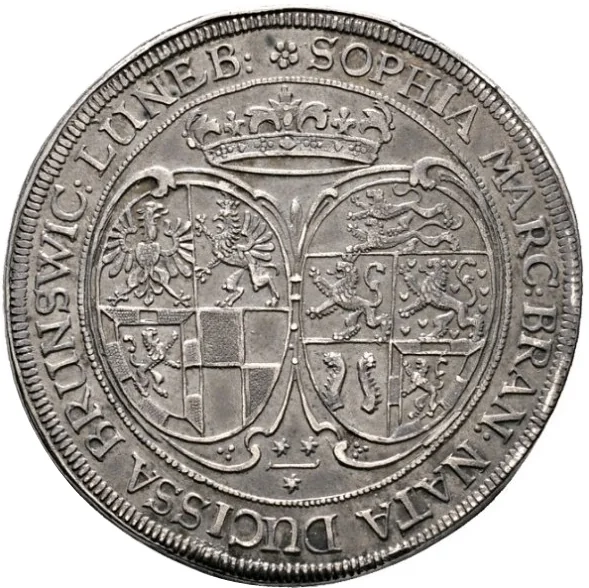
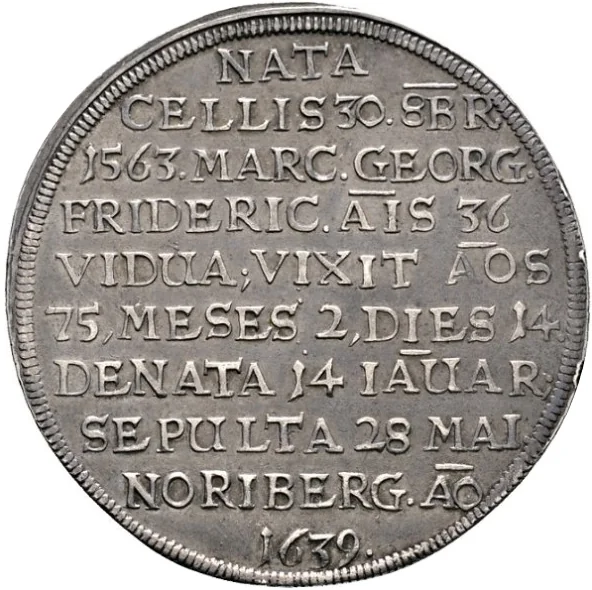
Commemoration: Death of Sophia von Braunschweig-Lüneburg
Germany

Obverse
Description:
Oval arms, crowned.
Script: Latin
Reverse
Description:
Dated 10-line inscription.
Script: Latin
Edge
Mints
| Name | Mark |
|---|---|
| Nuremberg | — |
Mintings
| Year | Mint Mark | Mintage | Quality | Collection |
|---|---|---|---|---|
| 1639 | — | — |
Historical background
In 1639, the currency situation in the war-ravaged territories of Brandenburg and Franconia was one of catastrophic debasement and monetary chaos, a direct consequence of the prolonged horrors of the Thirty Years' War. The relentless financial demands of sustaining armies had led territorial rulers and even occupying military forces to repeatedly debase the coinage, notably the small-denomination Kipper und Wipper coins. This involved drastically reducing the precious metal content of coins like Kreuzers and Groschen while minting them in enormous quantities to fund war expenses, flooding the economy with near-worthless currency.
The result was a vicious cycle of hyperinflation, a collapse of public trust, and a retreat to barter economy in many areas. Prices for essential goods like grain and salt skyrocketed, devastating the civilian population already suffering from famine and plague. Creditors were ruined as debts were repaid in debased coin, and trade was severely hampered as merchants refused unfamiliar or suspect currency. The Holy Roman Empire's decentralized monetary system, with numerous minting authorities, made a coordinated response impossible, allowing the crisis to deepen.
While the intense Kipper und Wipper inflation had peaked over a decade earlier, the monetary landscape in 1639 remained fractured and unstable. Older, full-weight coins were hoarded and disappeared from circulation, leaving a confusing mix of inferior regional issues. Any larger transactions or state finances relied heavily on more stable foreign coins like the Reichsthaler, but these were scarce. Thus, the currency situation reflected the broader state of the region: a patchwork of local survival amidst systemic collapse, with no effective central authority to restore monetary order until the war's conclusion.
The result was a vicious cycle of hyperinflation, a collapse of public trust, and a retreat to barter economy in many areas. Prices for essential goods like grain and salt skyrocketed, devastating the civilian population already suffering from famine and plague. Creditors were ruined as debts were repaid in debased coin, and trade was severely hampered as merchants refused unfamiliar or suspect currency. The Holy Roman Empire's decentralized monetary system, with numerous minting authorities, made a coordinated response impossible, allowing the crisis to deepen.
While the intense Kipper und Wipper inflation had peaked over a decade earlier, the monetary landscape in 1639 remained fractured and unstable. Older, full-weight coins were hoarded and disappeared from circulation, leaving a confusing mix of inferior regional issues. Any larger transactions or state finances relied heavily on more stable foreign coins like the Reichsthaler, but these were scarce. Thus, the currency situation reflected the broader state of the region: a patchwork of local survival amidst systemic collapse, with no effective central authority to restore monetary order until the war's conclusion.
✨ Legendary