

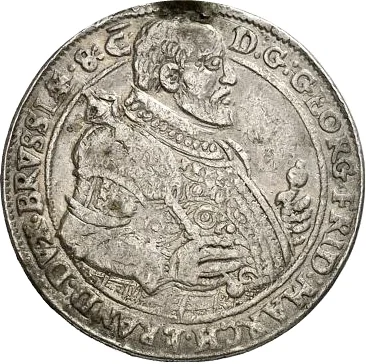
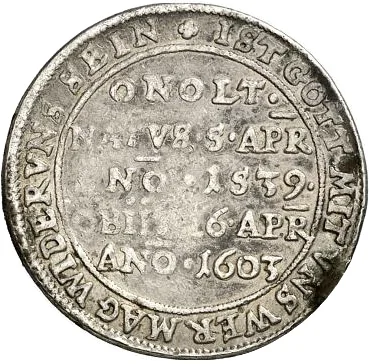
⅛ Thaler – Brandenburg-Franconia
Circulating commemorative coins
Commemoration: Death of Georg Friedrich
Germany
Context
Year: 1603
Country: Germany 
Issuer: Brandenburg-Franconia
Ruler: George Frederick I
Currency:
Demonetized: Yes
References
KM: #Click to copy to clipboard5
Numista: #133037
Obverse
Description:
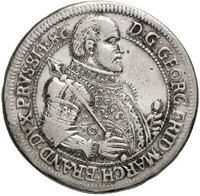
Half-length armored portrait facing right, titled Georg Friedrich I.
Script: Latin
Reverse
Description:
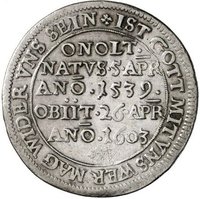
Dated five-line inscription.
Inscription:
IST GOTT MIT VNS WER MAG WIDERVNS SEIN
ONOLT. // NATVS.5.APR // ANO.1539. // OBiiT.26.APR // ANO.1603
ONOLT. // NATVS.5.APR // ANO.1539. // OBiiT.26.APR // ANO.1603
Script: Latin
Edge
Mints
| Name | Mark |
|---|---|
| Nuremberg | — |
Mintings
| Year | Mint Mark | Mintage | Quality | Collection |
|---|---|---|---|---|
| 1603 | — | — |
Historical background
In 1603, the currency situation in the joint territory of Brandenburg-Franconia (administered by Margrave Christian, son of the Elector of Brandenburg) was a microcosm of the profound monetary chaos plaguing the Holy Roman Empire. The region was awash in a bewildering variety of coins, not only from local mints in Kulmbach, Bayreuth, and Ansbach, but also from neighboring states and vast quantities of debased foreign currency, particularly "Kipper" coins from the Austrian Habsburg lands. This proliferation created a complex and unstable multi-currency system where the intrinsic silver content of a coin rarely matched its declared face value, leading to widespread confusion, suspicion in daily trade, and significant economic friction.
The core of the problem was competitive debasement. Facing immense fiscal pressures from the looming threat of war with the Ottoman Empire and the extravagant court expenditures typical of the era, princes across the Empire, including those in the Franconian territories, increasingly resorted to reducing the silver content of their coinage while maintaining its nominal value. This short-term revenue grab, known as "Kipper und Wipper" (clipping and tipping), was reaching a fever pitch. As bad money drove out good, older, full-weight thalers and gulden were hoarded or melted down, leaving circulation to the increasingly worthless new issues, which in turn fueled rapid price inflation and eroded public trust.
Consequently, 1603 fell within a period of acute monetary crisis just before a wider, formal response. While imperial attempts at currency regulation, like the Reichsmünzordnung (Imperial Coinage Ordinance), existed on paper, they were largely ineffective. Local authorities in Brandenburg-Franconia were likely engaged in stopgap measures, issuing mandates against the influx of foreign debased coins while potentially contributing to the problem themselves. The situation would soon culminate in the official "Kipper und Wipper" inflationary period (c. 1619-1623), demonstrating that the unstable practices of 1603 were a prelude to a full-blown monetary collapse exacerbated by the outbreak of the Thirty Years' War.
The core of the problem was competitive debasement. Facing immense fiscal pressures from the looming threat of war with the Ottoman Empire and the extravagant court expenditures typical of the era, princes across the Empire, including those in the Franconian territories, increasingly resorted to reducing the silver content of their coinage while maintaining its nominal value. This short-term revenue grab, known as "Kipper und Wipper" (clipping and tipping), was reaching a fever pitch. As bad money drove out good, older, full-weight thalers and gulden were hoarded or melted down, leaving circulation to the increasingly worthless new issues, which in turn fueled rapid price inflation and eroded public trust.
Consequently, 1603 fell within a period of acute monetary crisis just before a wider, formal response. While imperial attempts at currency regulation, like the Reichsmünzordnung (Imperial Coinage Ordinance), existed on paper, they were largely ineffective. Local authorities in Brandenburg-Franconia were likely engaged in stopgap measures, issuing mandates against the influx of foreign debased coins while potentially contributing to the problem themselves. The situation would soon culminate in the official "Kipper und Wipper" inflationary period (c. 1619-1623), demonstrating that the unstable practices of 1603 were a prelude to a full-blown monetary collapse exacerbated by the outbreak of the Thirty Years' War.
✨ Legendary