

3 Kreuzers – Salm-Grumbach, Wildgraviate and Rhinegraviate of
Germany
Context

References
KM: #Click to copy to clipboard3
Numista: #131404
Obverse
Description:
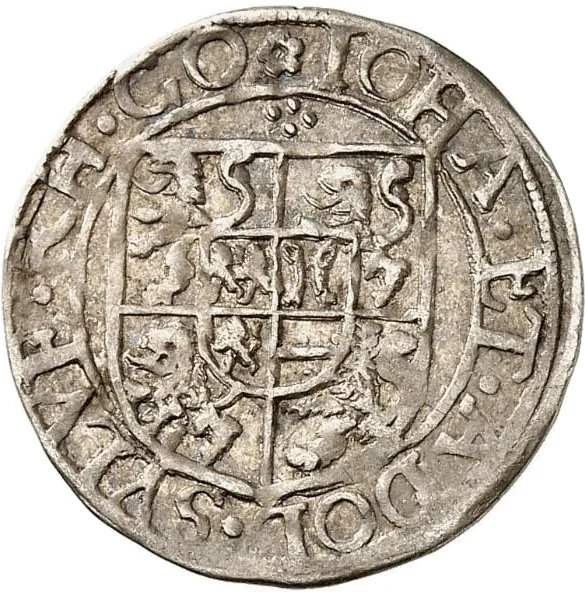
Four arms, central shield, encircled by "Johann" and "Adolf."
Inscription:
IOHA . ET . ADOL . SYLVE . RH . CO
Script: Latin
Reverse
Description:
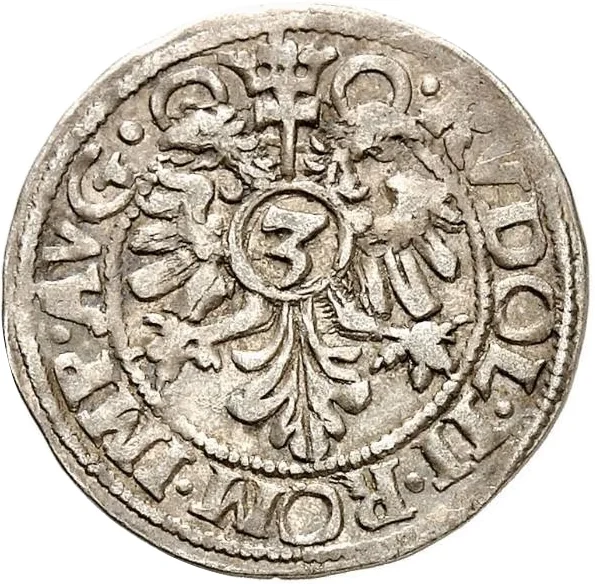
Imperial eagle with crown, breast shield displaying "3," encircled by titles of Rudolf II.
Inscription:
RVDOL . II . ROM . IMP . AVG
Script: Latin
Edge
Mints
| Name | Mark |
|---|---|
| Alsenz | — |
Mintings
| Year | Mint Mark | Mintage | Quality | Collection |
|---|---|---|---|---|
| — | — | — |
Historical background
In 1607, the currency situation within the combined territories of the Wild- and Rhinegraviate of Salm-Grumbach was one of profound complexity and instability, typical of the Holy Roman Empire's fragmented monetary landscape. The region did not possess its own sovereign mint but operated within a dense web of circulating coins from neighboring states, ecclesiastical principalities, and imperial cities. The most authoritative legal framework was the Imperial Coinage Ordinance (Reichsmünzordnung), which aimed to standardize the silver Thaler and its subdivisions, but its enforcement was weak. In practice, the monetary reality was dictated by a chaotic mix of physically worn, clipped, and debased coins from various sources, leading to chronic uncertainty in trade and valuation.
Local transactions were heavily reliant on smaller denomination coins, particularly the ubiquitous Kreuzer and Heller, which were essential for daily market life. However, the value and silver content of these coins varied dramatically depending on their origin—whether from the nearby Electorate of the Palatinate, the Archbishopric of Trier, or more distant Austrian mints. This created a constant need for money changers (Wechsler) and led to frequent disputes, as merchants and subjects struggled with the fluctuating intrinsic value of their currency. The territorial lords faced significant challenges in exercising monetary sovereignty, as they lacked the resources to control this influx or to issue a competitive, stable currency of their own.
The year 1607 fell within the tense calm before the storm of the Thirty Years' War (1618-1648). Economic pressures were already mounting, and the Wild- and Rhinegraves would have been acutely aware of the monetary chaos as a threat to their domain's economic health and their own fiscal stability. While they likely adhered to imperial circles' (Kreise) attempts at regional coinage treaties, their effective power was limited. Thus, the currency "situation" was less a defined system and more a state of contested and precarious monetary pluralism, where the value of money was as fragmented as the Empire itself, posing a persistent administrative and economic challenge for the small gräfliche (comital) house of Salm-Grumbach.
Local transactions were heavily reliant on smaller denomination coins, particularly the ubiquitous Kreuzer and Heller, which were essential for daily market life. However, the value and silver content of these coins varied dramatically depending on their origin—whether from the nearby Electorate of the Palatinate, the Archbishopric of Trier, or more distant Austrian mints. This created a constant need for money changers (Wechsler) and led to frequent disputes, as merchants and subjects struggled with the fluctuating intrinsic value of their currency. The territorial lords faced significant challenges in exercising monetary sovereignty, as they lacked the resources to control this influx or to issue a competitive, stable currency of their own.
The year 1607 fell within the tense calm before the storm of the Thirty Years' War (1618-1648). Economic pressures were already mounting, and the Wild- and Rhinegraves would have been acutely aware of the monetary chaos as a threat to their domain's economic health and their own fiscal stability. While they likely adhered to imperial circles' (Kreise) attempts at regional coinage treaties, their effective power was limited. Thus, the currency "situation" was less a defined system and more a state of contested and precarious monetary pluralism, where the value of money was as fragmented as the Empire itself, posing a persistent administrative and economic challenge for the small gräfliche (comital) house of Salm-Grumbach.
✨ Legendary