

½ Penny – United Kingdom
United Kingdom
Context
Years: 1740–1754
Issuer: United Kingdom 
Ruler: George II
Currency:
(1158—1970)
Demonetization: 31 December 1869
Material
References
KM: #Click to copy to clipboard579
Numista: #13118
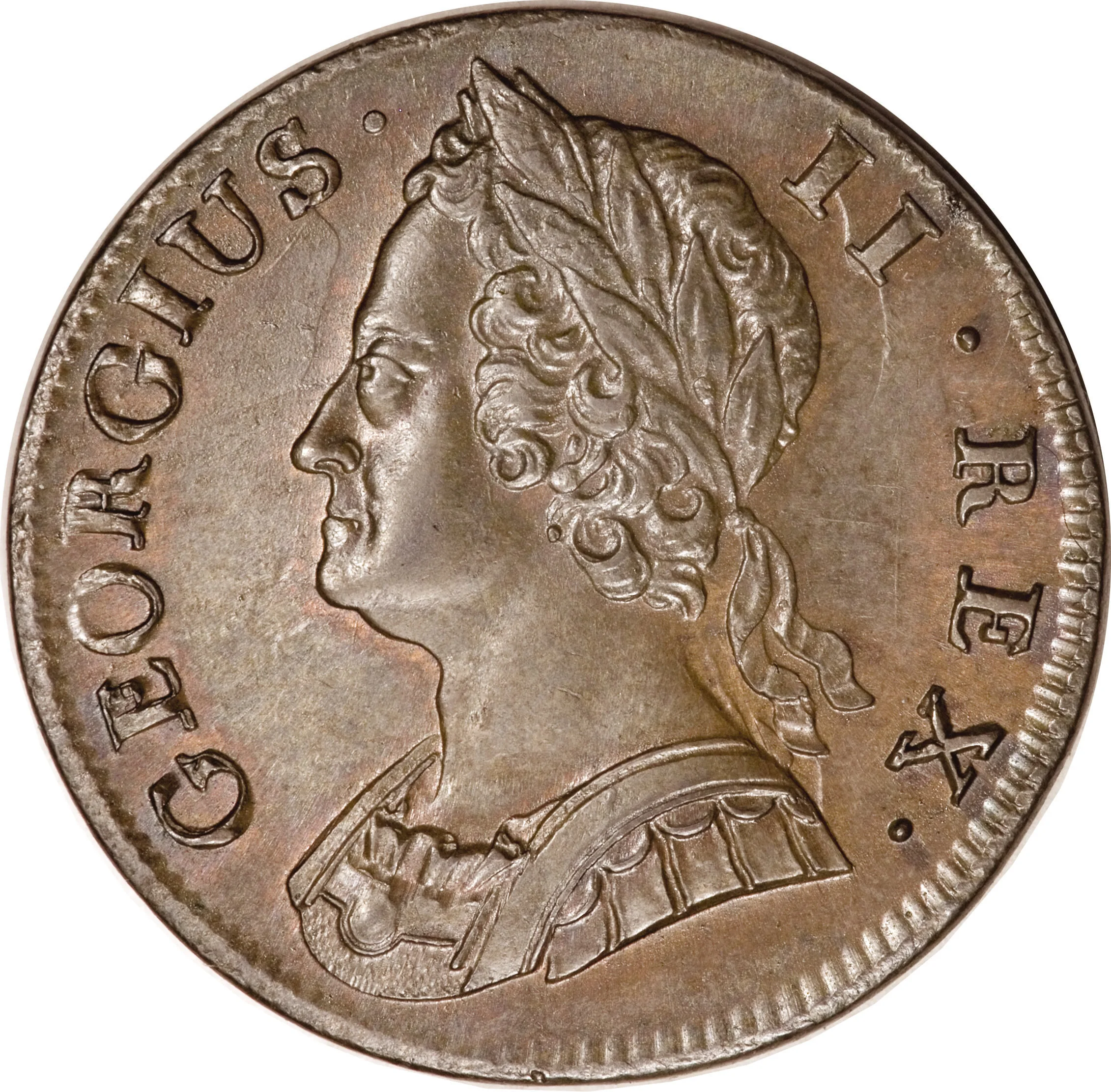
Obverse
Description:
King George II facing left in armor, legend encircling.
Inscription:
GEORGIUS· II· REX·
Script: Latin
Engraver: John Tanner
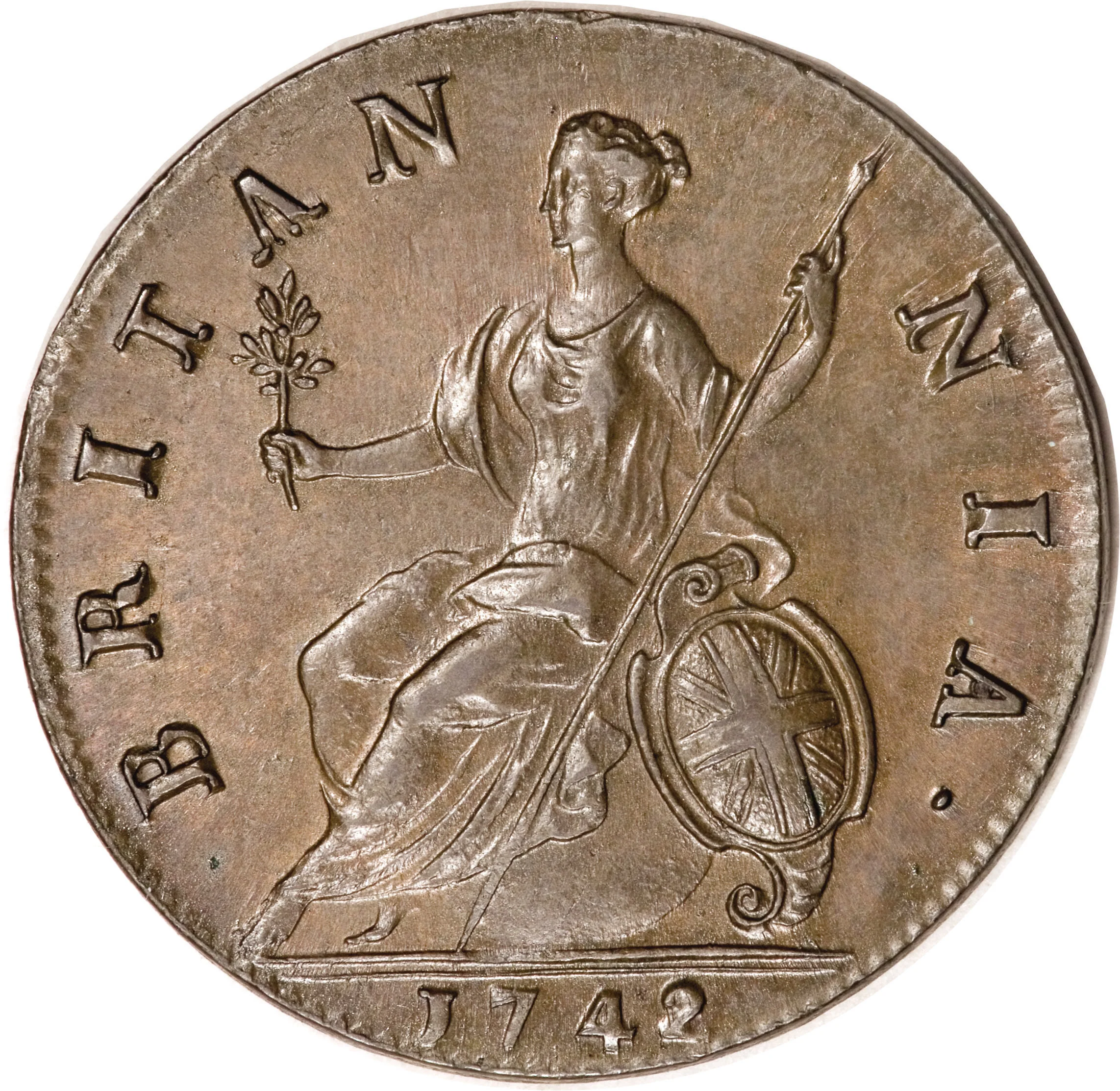
Reverse
Description:
Britannia seated left, holding trident and olive branch, shield with Union flag beside her, legend around, date below.
Inscription:
BRITANNIA·
1742
1742
Script: Latin
Edge
Plain
Mints
| Name | Mark |
|---|---|
| Royal Mint (Tower of London) | — |
Mintings
| Year | Mint Mark | Mintage | Quality | Collection |
|---|---|---|---|---|
| 1740 | — | — | ||
| 1742 | — | — | ||
| 1743 | — | — | ||
| 1744 | — | — | ||
| 1745 | — | — | ||
| 1746 | — | — | ||
| 1747 | — | — | ||
| 1748 | — | — | ||
| 1749 | — | — | ||
| 1750 | — | — | ||
| 1751 | — | — | ||
| 1752 | — | — | ||
| 1753 | — | — | ||
| 1754 | — | — |
Historical background
In 1740, the British monetary system was a complex and often unstable bimetallic standard, relying on both gold and silver coins. The official shilling was a silver coin, but its value in relation to gold was fixed by law, creating persistent problems. A critical issue was the chronic shortage of small-denomination coinage for everyday trade, as silver coins were underweight due to wear, clipping, and the fact that their bullion value often exceeded their face value, leading to them being melted down or exported. This forced commerce to rely on a confusing array of foreign coins, tokens issued by merchants and towns, and cumbersome credit notes, making transactions inefficient and prone to fraud.
The period was dominated by the consequences of Sir Isaac Newton's tenure as Master of the Mint earlier in the century. In 1717, he had set the gold guinea at 21 shillings, but this valuation inadvertently overvalued gold in relation to silver. This meant it became profitable to pay debts in silver (which was effectively undervalued) and export gold, but more critically, it caused Britain's full-weight silver coinage to steadily drain out of the country to Europe where it was worth more as bullion. By 1740, the silver coinage in circulation was so degraded that a full-weight shilling was a rarity, undermining public trust in the currency.
This deteriorating currency situation occurred against a backdrop of global conflict, as Britain was engaged in the War of Jenkins' Ear (soon to merge into the War of the Austrian Succession). The war placed enormous financial strain on the government, requiring massive borrowing and the mobilization of resources, yet it was being conducted with a defective domestic coinage. The situation would eventually force major reforms, but in 1740, the system was in a state of unsatisfactory equilibrium—just about functioning through makeshift solutions but recognized by economists and merchants as a serious hindrance to economic growth and stability. The need for a comprehensive recoinage was widely debated, but the immense cost and logistical challenge prevented action until later in the century.
The period was dominated by the consequences of Sir Isaac Newton's tenure as Master of the Mint earlier in the century. In 1717, he had set the gold guinea at 21 shillings, but this valuation inadvertently overvalued gold in relation to silver. This meant it became profitable to pay debts in silver (which was effectively undervalued) and export gold, but more critically, it caused Britain's full-weight silver coinage to steadily drain out of the country to Europe where it was worth more as bullion. By 1740, the silver coinage in circulation was so degraded that a full-weight shilling was a rarity, undermining public trust in the currency.
This deteriorating currency situation occurred against a backdrop of global conflict, as Britain was engaged in the War of Jenkins' Ear (soon to merge into the War of the Austrian Succession). The war placed enormous financial strain on the government, requiring massive borrowing and the mobilization of resources, yet it was being conducted with a defective domestic coinage. The situation would eventually force major reforms, but in 1740, the system was in a state of unsatisfactory equilibrium—just about functioning through makeshift solutions but recognized by economists and merchants as a serious hindrance to economic growth and stability. The need for a comprehensive recoinage was widely debated, but the immense cost and logistical challenge prevented action until later in the century.
🌱 Common