

½ Guinea – United Kingdom
United Kingdom
Context

Material
References
KM: #Click to copy to clipboard565
Numista: #13095
Value
Bullion value: $643.24
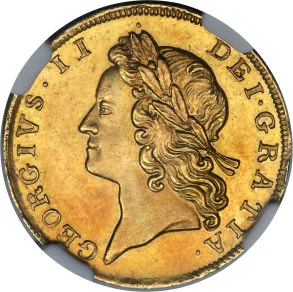
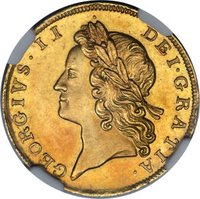
Obverse
Description:
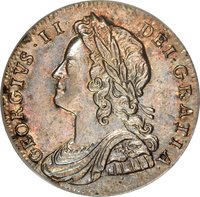
Young laureate King George II left, legend surrounding.
Inscription:
GEORGIVS·II· DEI·GRATIA·
Script: Latin
Engraver: John Croker
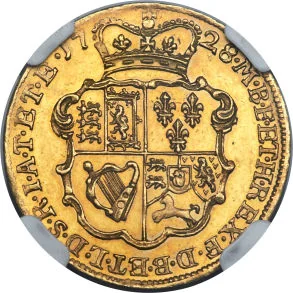
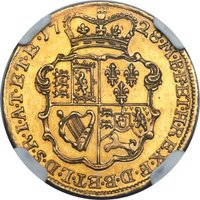
Reverse
Description:
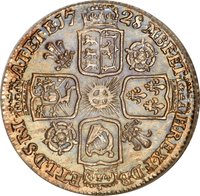
Royal coat of arms (shield variant available)
Inscription:
·M·B·F·ET·H·REX·F·D·B·ET·L·D·S·R·I·A·T·ET·E·1728
Script: Latin
Edge
Mintings
| Year | Mint Mark | Mintage | Quality | Collection |
|---|---|---|---|---|
| 1728 | — | — | ||
| 1729 | — | — | ||
| 1730 | — | — | ||
| 1731 | — | — | ||
| 1732 | — | — | ||
| 1733 | — | — | ||
| 1734 | — | — | ||
| 1735 | — | — | ||
| 1736 | — | — | ||
| 1737 | — | — | ||
| 1738 | — | — | ||
| 1739 | — | — |
Historical background
In 1728, the currency situation in the United Kingdom was one of relative stability but underlying strain, governed by the principles of the Great Recoinage of 1696. The nation operated on a bimetallic system of gold and silver, where the value of coins was officially tied to their precious metal content. The primary unit was the silver pound sterling, but the century's early decades saw a significant rise in the use of gold guineas. A key issue was that the official mint ratio between gold and silver undervalued silver, causing full-weight silver coins to be melted down or exported, leaving the circulation reliant on worn, clipped, and lightweight silver coinage alongside newer gold.
This erosion of the silver coinage created practical difficulties for everyday commerce, particularly for smaller transactions. While the problem was less acute than the crisis that prompted the 1696 recoinage, it persisted as a nuisance to trade. The government, under Prime Minister Robert Walpole, was focused on fiscal stability and avoided the enormous expense of another full recoinage. Instead, the focus remained on maintaining the gold standard's credibility, which was increasingly seen as the foundation for London's growing role in international finance.
Consequently, the year 1728 did not see major monetary legislation but existed within a period of managed tension. The currency system was functional enough to support Britain's commercial expansion and the early stages of the Industrial Revolution, yet it was fundamentally unbalanced. The situation would gradually lead to the mid-century establishment of the gold standard de facto, a process solidified later when Sir Isaac Newton, as Master of the Mint, formally set an undervalued silver price in 1717, a policy whose consequences defined the currency landscape of 1728.
This erosion of the silver coinage created practical difficulties for everyday commerce, particularly for smaller transactions. While the problem was less acute than the crisis that prompted the 1696 recoinage, it persisted as a nuisance to trade. The government, under Prime Minister Robert Walpole, was focused on fiscal stability and avoided the enormous expense of another full recoinage. Instead, the focus remained on maintaining the gold standard's credibility, which was increasingly seen as the foundation for London's growing role in international finance.
Consequently, the year 1728 did not see major monetary legislation but existed within a period of managed tension. The currency system was functional enough to support Britain's commercial expansion and the early stages of the Industrial Revolution, yet it was fundamentally unbalanced. The situation would gradually lead to the mid-century establishment of the gold standard de facto, a process solidified later when Sir Isaac Newton, as Master of the Mint, formally set an undervalued silver price in 1717, a policy whose consequences defined the currency landscape of 1728.
✨ Legendary