

1 guinea – England
Add to wishlist
United Kingdom
Context
Years: 1702–1707
Country: United Kingdom
Issuer: England
Ruler: Anne
Currency:
(1158—1970)
Demonetized: Yes
Material
References
KM: #
Numista: #13058
Value
Bullion value: $1172.94
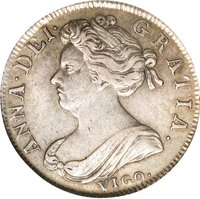
Obverse
Description:
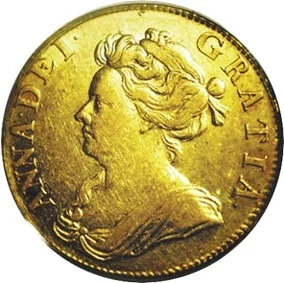
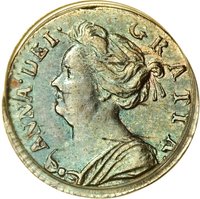
Queen Anne left-facing bust, legend surrounding.
Inscription:
ANNA·DEI· GRATIA·
Script: Latin
Engraver: John Croker
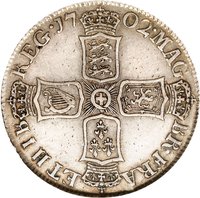
Reverse
Description:
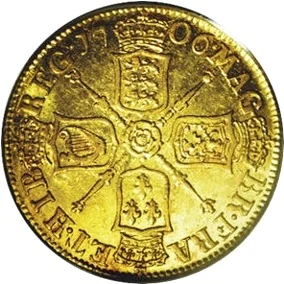
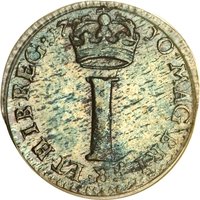
Crowned shields and sceptres flank a central rose, date above, legend around.
Inscription:
MAG· BR·FRA· ET·HIB REG·17 06·
Script: Latin
Edge
Mintings
| Year | Mint Mark | Mintage | Quality | Collection |
|---|---|---|---|---|
| 1702 | — | — | ||
| 1703 | VIGO | — | BU | |
| 1705 | — | — | ||
| 1706 | — | — | ||
| 1707 | — | — |
Historical background
In 1702, England's currency system was in a state of profound crisis and transition. The nation operated on a silver standard, but the official silver coins in circulation—primarily crowns, shillings, and sixpences—were severely degraded. Decades of clipping and filing by individuals seeking to profit from the precious metal content had reduced the average weight of coins to well below their face value. Furthermore, the official mint price for silver was lower than its market price, causing bullion to be hoarded or exported. This resulted in a chronic shortage of sound coin, with a public that deeply distrusted the physical money in their pockets, hampering everyday trade and state finance.
The government, under the newly ascended Queen Anne, recognised that this monetary instability threatened economic growth and the nation's ability to fund the ongoing War of the Spanish Succession. Previous attempts at reform had failed, but the lessons of the Great Recoinage of 1696, masterminded by Sir Isaac Newton as Warden of the Mint, were still fresh. That massive undertaking had replaced the old hammered coinage with new, machine-milled coins with raised edges to prevent clipping. However, the process had been economically disruptive, and by 1702, the problem was re-emerging as the new coins began to disappear from circulation due to continued exportation of silver.
Consequently, the monetary landscape in 1702 was a fragile one. While high-value transactions were increasingly facilitated by paper instruments—promissory notes, Exchequer bills, and the notes of the recently established Bank of England—the common populace relied on a chaotic mix of underweight silver, foreign coins (like Spanish dollars), and small change that was often tokens issued by private traders. The fundamental imbalance between the metallic value and face value of silver coinage remained unresolved, setting the stage for a gradual shift in monetary policy that would, over the following decades, lead England accidentally towards a de facto gold standard, as the guinea (a gold coin) became the more stable measure of value in large transactions.
The government, under the newly ascended Queen Anne, recognised that this monetary instability threatened economic growth and the nation's ability to fund the ongoing War of the Spanish Succession. Previous attempts at reform had failed, but the lessons of the Great Recoinage of 1696, masterminded by Sir Isaac Newton as Warden of the Mint, were still fresh. That massive undertaking had replaced the old hammered coinage with new, machine-milled coins with raised edges to prevent clipping. However, the process had been economically disruptive, and by 1702, the problem was re-emerging as the new coins began to disappear from circulation due to continued exportation of silver.
Consequently, the monetary landscape in 1702 was a fragile one. While high-value transactions were increasingly facilitated by paper instruments—promissory notes, Exchequer bills, and the notes of the recently established Bank of England—the common populace relied on a chaotic mix of underweight silver, foreign coins (like Spanish dollars), and small change that was often tokens issued by private traders. The fundamental imbalance between the metallic value and face value of silver coinage remained unresolved, setting the stage for a gradual shift in monetary policy that would, over the following decades, lead England accidentally towards a de facto gold standard, as the guinea (a gold coin) became the more stable measure of value in large transactions.
✨ Legendary