

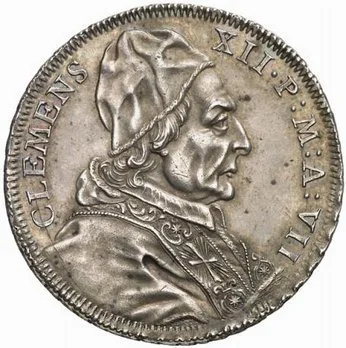
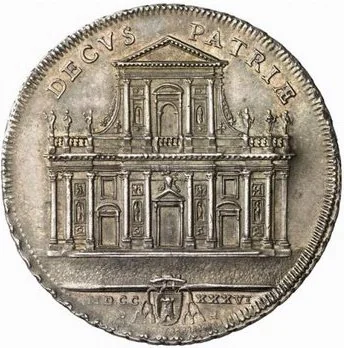
½ Piastra – Papal States
Circulating commemorative coins
Commemoration: Restoration of the Basilica of St. John the Baptist of the Florentines
Vatican City
Context
Year: 1736
Country: Vatican City 
Issuer: Papal States
Ruler: Clement XII
Currency:
(1534—1835)
Demonetized: Yes
Material
References
KM: #Click to copy to clipboard879
Numista: #130509
Value
Bullion value: $37.98
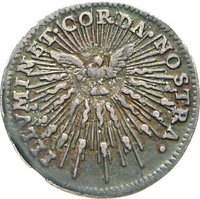
Obverse
Reverse
Description:
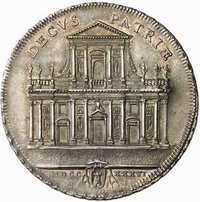
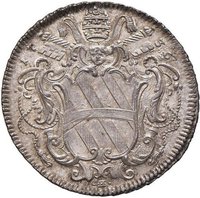
St John of the Florentines, Rome, with date in Roman numerals and arms below.
Inscription:
DECVS PATRIÆ
MDCC XXXVI
MDCC XXXVI
Script: Latin
Edge
Mintings
| Year | Mint Mark | Mintage | Quality | Collection |
|---|---|---|---|---|
| 1736 | — | — |
Historical background
In 1736, the Papal States' currency system was a complex and fragmented relic of medieval and Renaissance monetary practices, lacking a unified, modern standard. The primary unit of account was the Papal Scudo, a silver coin, but its circulation was limited and its value unstable due to recurring debasement. In practice, a multitude of foreign coins—especially Spanish silver reales and gold doppie from Genoa and Florence—circulated widely, creating a chaotic exchange environment. Furthermore, individual cities within the Papal territories, such as Bologna and Ancona, often minted their own subsidiary coinage (baiocchi, quattrini), leading to inconsistent values and hindering regional trade.
This monetary disarray was a direct symptom of the Papal States' weak central administration and chronic fiscal distress. The treasury, often depleted by the lavish court in Rome and the costs of maintaining temporal power, frequently resorted to reducing the silver content in its coinage to generate short-term revenue. This practice, known as debasement, eroded public trust in the official currency and encouraged hoarding of older, purer coins or stable foreign specie. Consequently, everyday transactions were cumbersome, requiring constant reference to exchange rate bulletins (bollettini) that listed the fluctuating values of dozens of different coins.
The situation in 1736 fell within the long and largely ineffective pontificate of Pope Clement XII (1730-1740). While his administration focused on architectural projects and faced challenges like the War of Polish Succession, no comprehensive monetary reform was achieved. The currency chaos thus persisted, acting as a drag on the regional economy and reflecting the broader administrative and economic stagnation of the Papal States in the early 18th century. True standardization would only begin decades later under Pope Pius VI in the late 1780s.
This monetary disarray was a direct symptom of the Papal States' weak central administration and chronic fiscal distress. The treasury, often depleted by the lavish court in Rome and the costs of maintaining temporal power, frequently resorted to reducing the silver content in its coinage to generate short-term revenue. This practice, known as debasement, eroded public trust in the official currency and encouraged hoarding of older, purer coins or stable foreign specie. Consequently, everyday transactions were cumbersome, requiring constant reference to exchange rate bulletins (bollettini) that listed the fluctuating values of dozens of different coins.
The situation in 1736 fell within the long and largely ineffective pontificate of Pope Clement XII (1730-1740). While his administration focused on architectural projects and faced challenges like the War of Polish Succession, no comprehensive monetary reform was achieved. The currency chaos thus persisted, acting as a drag on the regional economy and reflecting the broader administrative and economic stagnation of the Papal States in the early 18th century. True standardization would only begin decades later under Pope Pius VI in the late 1780s.
✨ Legendary