

1 Guinea – England
United Kingdom
Context
Years: 1692–1693
Country: United Kingdom 
Issuer: England 
Ruler: Mary II
Currency:
(1158—1970)
Demonetized: Yes
Material
References
KM: #Click to copy to clipboard474.3
Numista: #130274
Value
Bullion value: $1280.71
Obverse
Description:
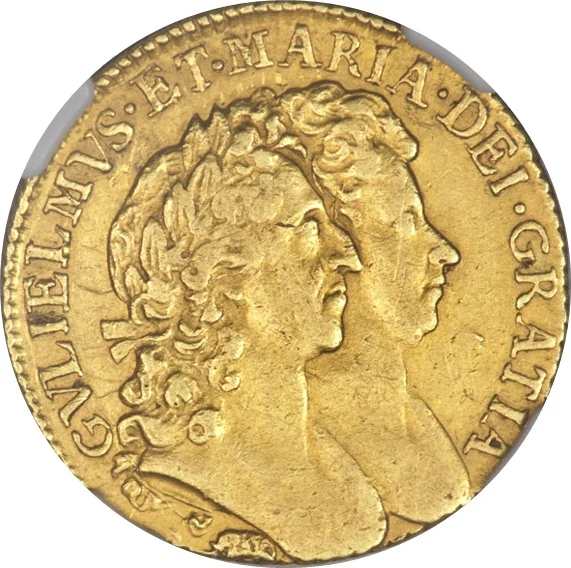
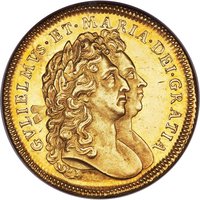
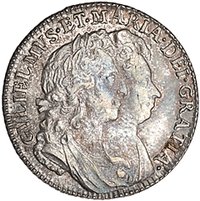
Conjoined busts of William and Mary right, legend around, elephant below.
Inscription:
GVLIELMVS·ET·MARIA·DEI·GRATIA
Script: Latin
Engravers: James Roettier, Norbert Roettier
Reverse
Description:
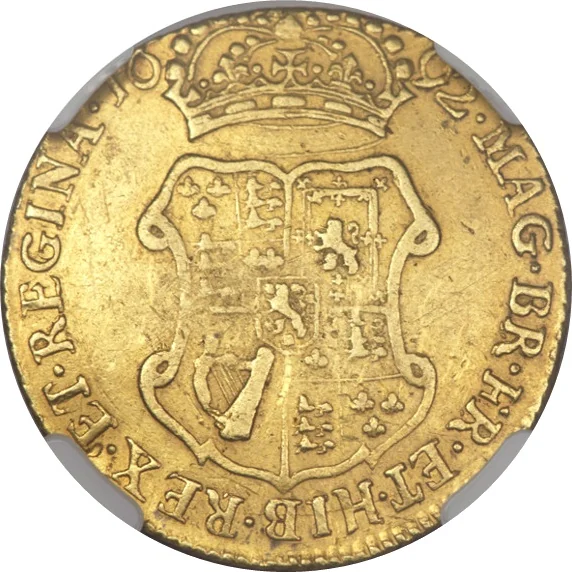
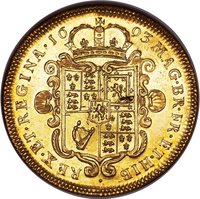
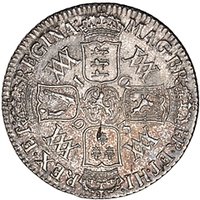
Quartered shield with central Nassau lion, date above, legend around.
Inscription:
MAG·BR·FR·ET·HIB·REX·ET·REGINA·16 92·
Script: Latin
Engravers: James Roettier, Norbert Roettier
Edge
Milled
Mintings
| Year | Mint Mark | Mintage | Quality | Collection |
|---|---|---|---|---|
| 1692 | — | — | ||
| 1693 | — | — |
Historical background
In 1692, England was in the midst of a profound monetary crisis, largely stemming from the Great Recoinage of 1696. The root cause was the widespread clipping and counterfeiting of silver coins, which had been rampant for decades. This degraded the currency, as the silver content of many coins in circulation was far below their face value, leading to Gresham's Law in action: "bad money drives out good." People hoarded the full-weight coins for their intrinsic bullion value or for foreign trade, while only the lightweight, clipped coins remained in daily use, creating uncertainty and hampering commerce.
The situation was exacerbated by the financial demands of King William III's war against France (the Nine Years' War), which placed immense strain on the Treasury. The government needed to raise funds but found its credit weak and its currency unstable. This period saw the birth of the National Debt and the establishment of the Bank of England in 1694, which were revolutionary financial solutions, but in 1692 these were still nascent ideas. The state's immediate problem was a severe shortage of reliable specie, which disrupted tax collection, soldier pay, and economic confidence.
Consequently, the monetary system was in a precarious and transitional state. While the full recoinage was still years away, the recognition of the crisis was acute. Discussions in Parliament and among intellectuals like John Locke and Isaac Newton (who would later become Warden of the Mint) were intensively debating whether to recall and remint all silver coinage at the old standard weight (as Locke advocated) or to devalue it to reflect its market reality. Thus, 1692 represents a pivotal year of financial strain and intellectual ferment, setting the stage for the drastic and transformative reforms that would define England's financial revolution in the closing years of the 17th century.
The situation was exacerbated by the financial demands of King William III's war against France (the Nine Years' War), which placed immense strain on the Treasury. The government needed to raise funds but found its credit weak and its currency unstable. This period saw the birth of the National Debt and the establishment of the Bank of England in 1694, which were revolutionary financial solutions, but in 1692 these were still nascent ideas. The state's immediate problem was a severe shortage of reliable specie, which disrupted tax collection, soldier pay, and economic confidence.
Consequently, the monetary system was in a precarious and transitional state. While the full recoinage was still years away, the recognition of the crisis was acute. Discussions in Parliament and among intellectuals like John Locke and Isaac Newton (who would later become Warden of the Mint) were intensively debating whether to recall and remint all silver coinage at the old standard weight (as Locke advocated) or to devalue it to reflect its market reality. Thus, 1692 represents a pivotal year of financial strain and intellectual ferment, setting the stage for the drastic and transformative reforms that would define England's financial revolution in the closing years of the 17th century.
✨ Legendary