

5 guineas – England
Add to wishlist
United Kingdom
Context
Year: 1701
Country: United Kingdom
Issuer: England
Ruler: William III
Currency:
(1158—1970)
Demonetized: Yes
Material
References
KM: #
Numista: #12977
Value
Bullion value: $5932.40
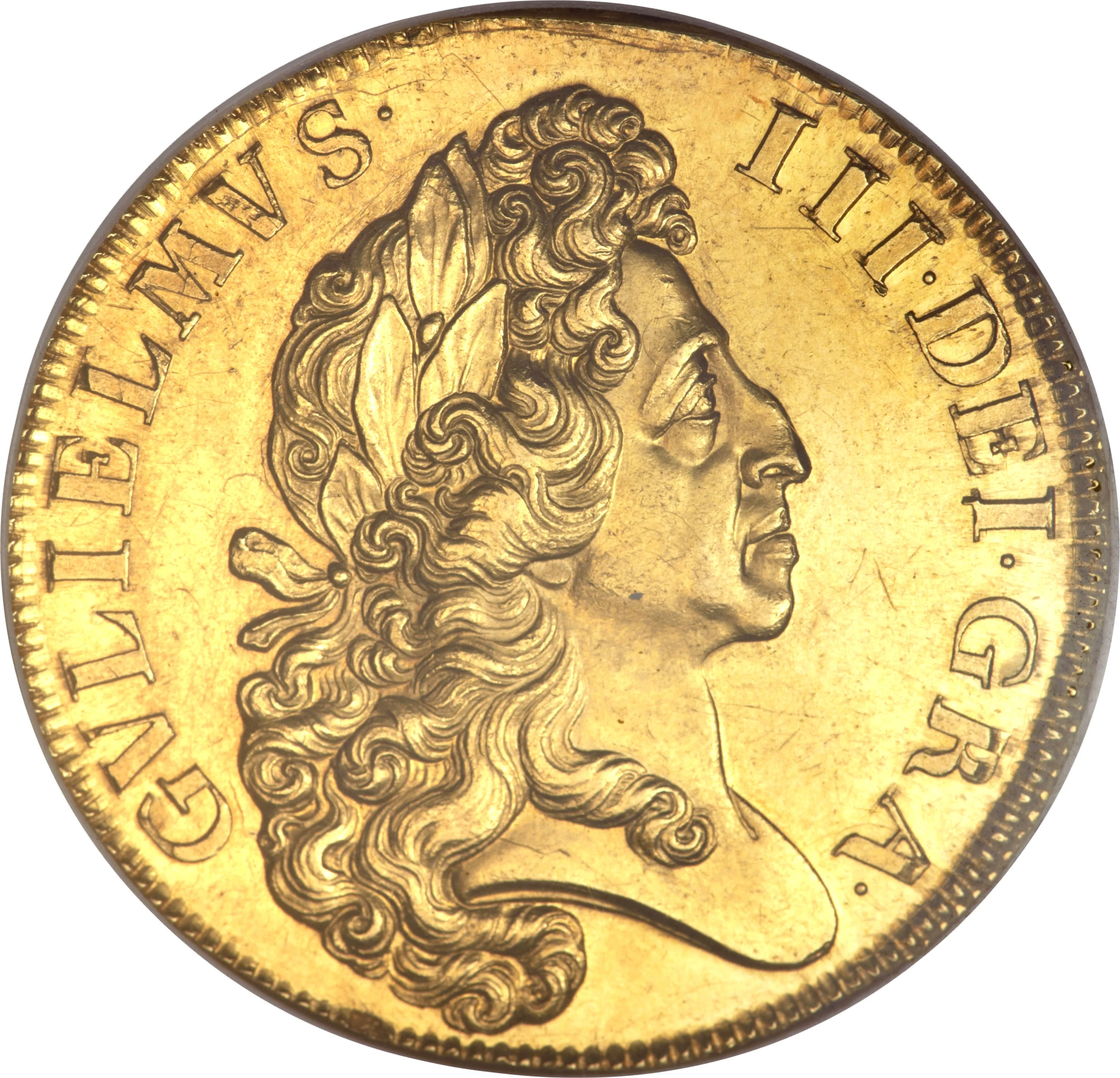
Obverse
Description:
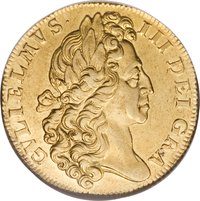
King William III laureate bust right, legend surrounding.
Inscription:
GVLIELMVS· III·DEI·GRA
Script: Latin
Engraver: John Croker
Reverse
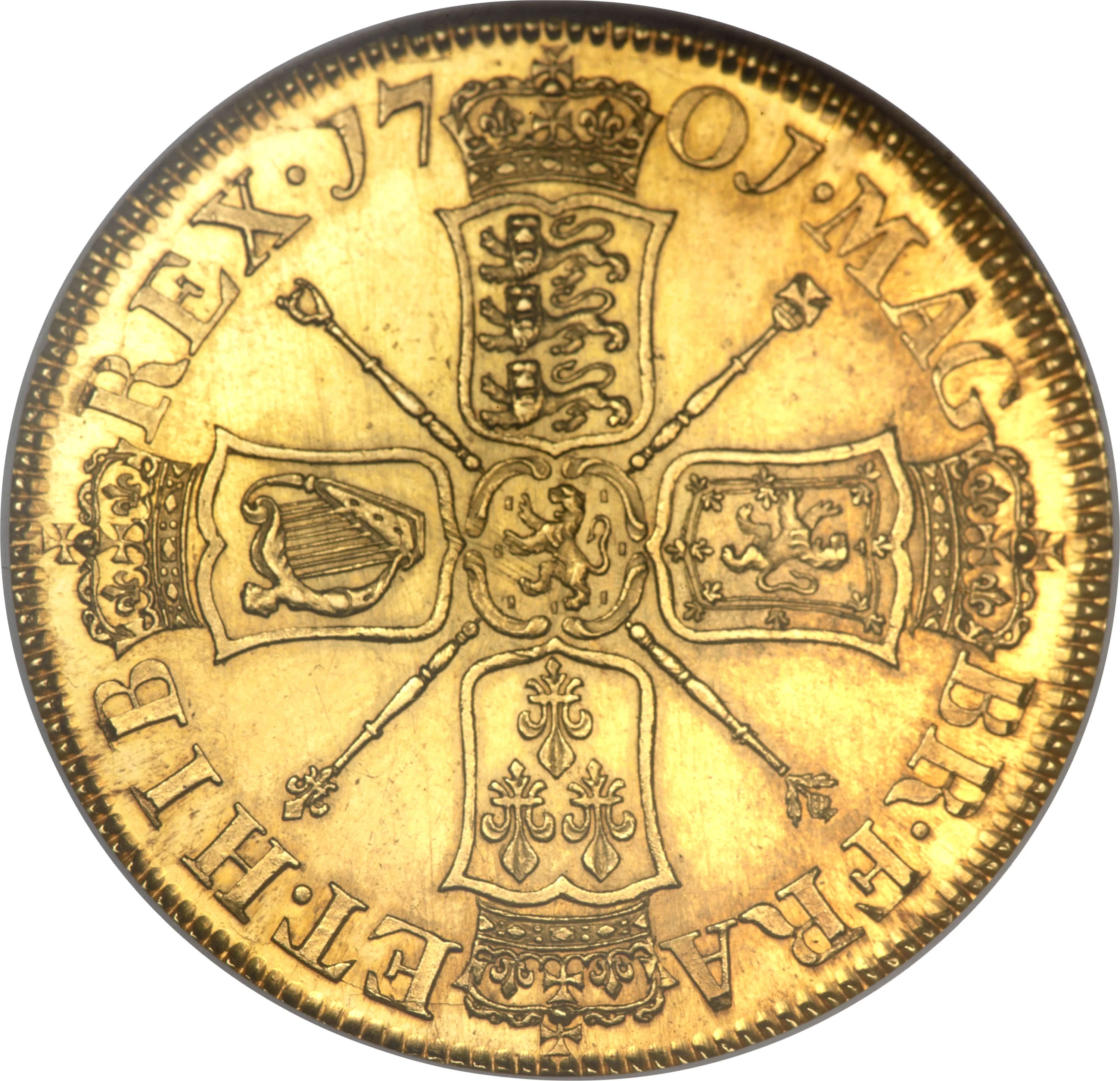
Description:
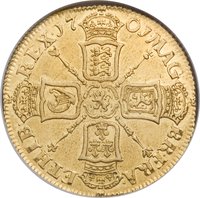
Crowned shields flank a central lion; sceptres with national emblems in corners, date above, legend around.
Inscription:
MAG· BR·FRA· ET·HIB REX·17 01·
Script: Latin
Edge
Regnal year in Latin
Legend:
+ DECVS • ET • TVTAMEN • ANNO REGNI • DECIMO • TERTIO +
Mintings
| Year | Mint Mark | Mintage | Quality | Collection |
|---|---|---|---|---|
| 1701 | — | — |
Historical background
In 1701, England operated under a bimetallic monetary system, where both silver and gold coins were legal tender, but the system was under severe strain. The official mint ratio, set by Sir Isaac Newton as Warden of the Mint, valued gold too highly relative to silver. This meant it was more profitable to export silver bullion to Europe or to the East India Company than to bring it to the Royal Mint for coinage. Consequently, England was suffering a persistent drain of full-weight silver coin, leaving the circulating currency dominated by worn, clipped, and counterfeit silver coins, and an increasing number of gold guineas.
This "great recoinage" of the 1690s, which aimed to replace all hammered silver coinage with new, milled-edge coins to prevent clipping, had been only a partial success. While it restored the integrity of newly minted coins, the process was costly and the shortage of small-denomination silver coinage crippled everyday trade. The value of the gold guinea, initially worth 20 shillings, was unstable and often traded at a premium, causing price confusion. The economy was effectively demonetizing silver and moving towards a de facto gold standard, though this would not be formalized for another century.
The currency instability occurred within a critical political context: 1701 was the year of the Act of Settlement, securing the Protestant succession, and England was on the brink of the War of the Spanish Succession (1702-1713). The state's need to raise massive funds for war through loans and the fledgling Bank of England (founded 1694) further intertwined monetary policy with public credit. Thus, the currency situation was not merely a commercial nuisance but a matter of national security, influencing the financial innovations that would underpin the rise of the British fiscal-military state in the 18th century.
This "great recoinage" of the 1690s, which aimed to replace all hammered silver coinage with new, milled-edge coins to prevent clipping, had been only a partial success. While it restored the integrity of newly minted coins, the process was costly and the shortage of small-denomination silver coinage crippled everyday trade. The value of the gold guinea, initially worth 20 shillings, was unstable and often traded at a premium, causing price confusion. The economy was effectively demonetizing silver and moving towards a de facto gold standard, though this would not be formalized for another century.
The currency instability occurred within a critical political context: 1701 was the year of the Act of Settlement, securing the Protestant succession, and England was on the brink of the War of the Spanish Succession (1702-1713). The state's need to raise massive funds for war through loans and the fledgling Bank of England (founded 1694) further intertwined monetary policy with public credit. Thus, the currency situation was not merely a commercial nuisance but a matter of national security, influencing the financial innovations that would underpin the rise of the British fiscal-military state in the 18th century.
✨ Legendary