

1 Sultani – Damascus Eyalet
Syria
Context
Year: 1622
Islamic (Hijri) Year: 1031
Country: Syria 
Issuer: Damascus Eyalet
Ruler: Mustafa I
Currency:
(1516—1687)
Demonetized: Yes
Material
References
KM: #Click to copy to clipboard27
Numista: #103070
Value
Bullion value: $575.45
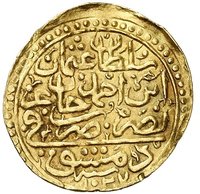
Obverse
Description:
Sovereign coin.
Inscription:
سلطان
مصطفى بن
محمد
ضرب في
دمشق
مصطفى بن
محمد
ضرب في
دمشق
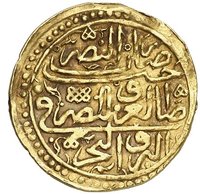
Reverse
Description:
Carved words.
Inscription:
ضارب النضر
صاحب العز والنصر في
البر والبحر
صاحب العز والنصر في
البر والبحر
Edge
Mints
| Name | Mark |
|---|---|
| Damascus | — |
Mintings
| Year | Mint Mark | Mintage | Quality | Collection |
|---|---|---|---|---|
| 1622 | — | — |
Historical background
In 1622, the currency situation in Damascus Eyalet, a key Ottoman province encompassing much of the Levant, was characterized by severe instability and devaluation, mirroring a broader imperial crisis. The primary unit was the silver akçe, but its value had been drastically eroded by decades of debasement, as the central treasury in Istanbul repeatedly reduced its silver content to finance prolonged wars, notably against the Safavids and the Habsburgs. This "Great Debasement" led to rampant price inflation, a loss of public confidence in coinage, and widespread economic distress, disrupting both local trade and the tax revenue system upon which the empire depended.
The chaos was compounded by the circulation of a multitude of foreign and obsolete coins, including Spanish reales (pieces of eight), Venetian ducats, and older Ottoman issues, creating a complex and unreliable monetary environment. Merchants in Damascus and Aleppo, vital nodes in international trade, were forced to constantly assess and haggle over the intrinsic metal value of each coin, as their nominal face value became increasingly meaningless. This monetary fragmentation severely hampered commercial transactions and contributed to social unrest, as soldiers and officials paid in devalued akçe saw their real incomes plummet.
Provincial authorities in Damascus faced immense pressure, caught between imperial mandates and local realities. While the ultimate authority over minting and monetary policy rested with the Sultan, the local governor (beylerbeyi) had to manage the day-to-day economic fallout. The situation in 1622 was part of a prolonged deterioration that would spur attempts at reform later in the century, but at that moment, the currency crisis was a potent symbol of the Ottoman Empire's deepening administrative and financial strains during the early 17th-century "Sultanate of Women" and the ensuing period of internal conflict known as the Edirne Event.
The chaos was compounded by the circulation of a multitude of foreign and obsolete coins, including Spanish reales (pieces of eight), Venetian ducats, and older Ottoman issues, creating a complex and unreliable monetary environment. Merchants in Damascus and Aleppo, vital nodes in international trade, were forced to constantly assess and haggle over the intrinsic metal value of each coin, as their nominal face value became increasingly meaningless. This monetary fragmentation severely hampered commercial transactions and contributed to social unrest, as soldiers and officials paid in devalued akçe saw their real incomes plummet.
Provincial authorities in Damascus faced immense pressure, caught between imperial mandates and local realities. While the ultimate authority over minting and monetary policy rested with the Sultan, the local governor (beylerbeyi) had to manage the day-to-day economic fallout. The situation in 1622 was part of a prolonged deterioration that would spur attempts at reform later in the century, but at that moment, the currency crisis was a potent symbol of the Ottoman Empire's deepening administrative and financial strains during the early 17th-century "Sultanate of Women" and the ensuing period of internal conflict known as the Edirne Event.

✨ Legendary