

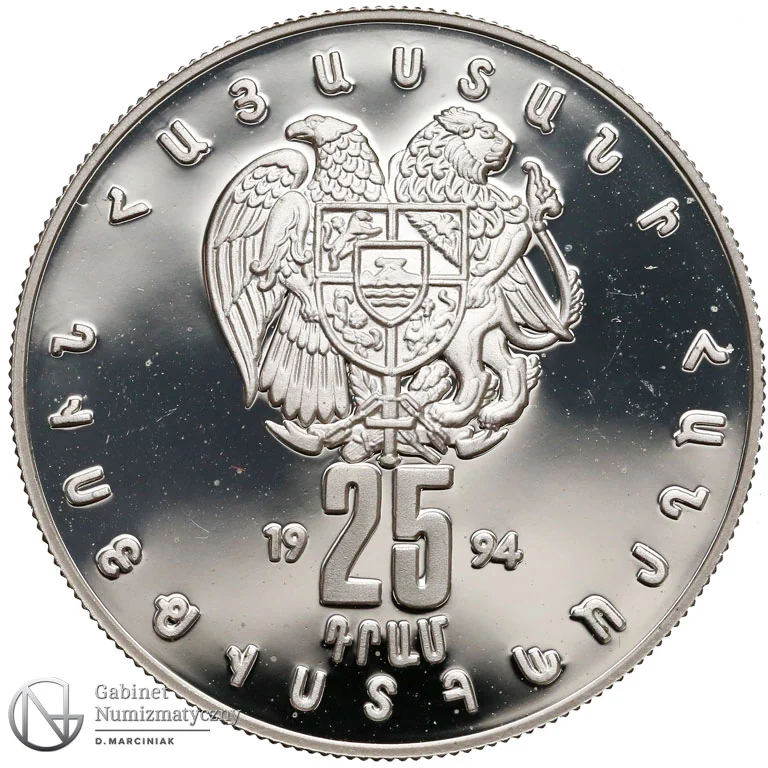
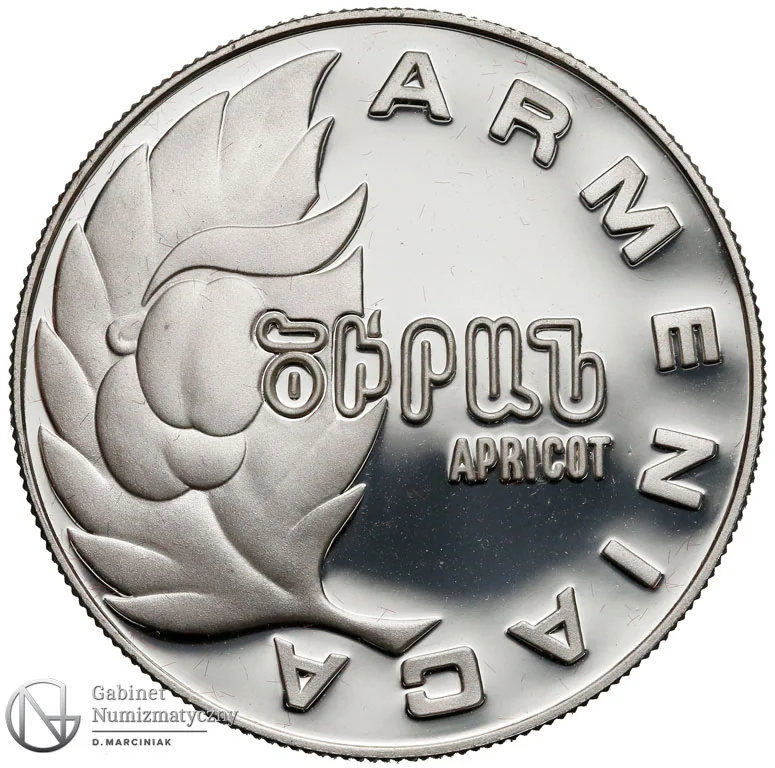
25 Dram – Armenia
Non-circulating coins
Commemoration: Apricot
Armenia
Context

Material
References
KM: #Click to copy to clipboard59
Numista: #100215
Value
Exchange value: 25 AMD
Bullion value: $75.41
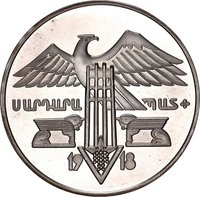
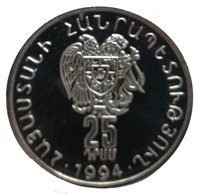
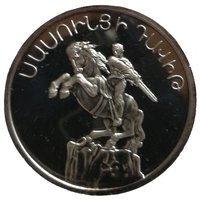
Obverse
Reverse
Edge
Reeded
Categories
| Symbols> Coat of Arms |
| Plant> Fruit |
Mints
| Name | Mark |
|---|---|
| Royal Mint | — |
Mintings
| Year | Mint Mark | Mintage | Quality | Collection |
|---|---|---|---|---|
| 1994 | — | 10,000 | Proof |
Historical background
In 1994, Armenia was in the throes of a profound economic crisis, emerging from the dual shocks of the dissolution of the Soviet Union and a devastating war with Azerbaijan over Nagorno-Karabakh. The national currency, the Armenian dram (AMD), was introduced in November 1993 to replace the Russian ruble, but its first full year in circulation was marked by extreme instability and hyperinflation. The economy was crippled by a blockade from Turkey and Azerbaijan, severe energy shortages, and the collapse of industrial production, leading to a dramatic fall in GDP and widespread poverty. The government initially financed its deficits by printing money, which caused the dram to lose value rapidly, with inflation soaring to an annual rate of over 5,000% in 1994, severely eroding savings and wages.
Recognizing the unsustainable situation, the Armenian government, under Prime Minister Grant Bagratyan, embarked on a radical stabilization program in late 1994, strongly supported by the International Monetary Fund (IMF). This program represented a decisive shift toward a market economy and included strict fiscal austerity, the elimination of most price controls, and a critical move to cease financing the budget deficit through money creation. A key monetary policy change was the introduction of a unified floating exchange rate, replacing the complex and unsustainable system of multiple official rates that had fostered a large black market for foreign currency.
These harsh measures laid the essential groundwork for future recovery, successfully curbing hyperinflation by year's end and establishing the dram as a functioning, albeit still weak, national currency. The stabilization came at a significant social cost, deepening poverty in the short term, but it marked the beginning of Armenia's transition from a planned to a market economy. The reforms of 1994 set the stage for the economic growth and relative monetary stability that would follow in the latter half of the 1990s under continued IMF guidance.
Recognizing the unsustainable situation, the Armenian government, under Prime Minister Grant Bagratyan, embarked on a radical stabilization program in late 1994, strongly supported by the International Monetary Fund (IMF). This program represented a decisive shift toward a market economy and included strict fiscal austerity, the elimination of most price controls, and a critical move to cease financing the budget deficit through money creation. A key monetary policy change was the introduction of a unified floating exchange rate, replacing the complex and unsustainable system of multiple official rates that had fostered a large black market for foreign currency.
These harsh measures laid the essential groundwork for future recovery, successfully curbing hyperinflation by year's end and establishing the dram as a functioning, albeit still weak, national currency. The stabilization came at a significant social cost, deepening poverty in the short term, but it marked the beginning of Armenia's transition from a planned to a market economy. The reforms of 1994 set the stage for the economic growth and relative monetary stability that would follow in the latter half of the 1990s under continued IMF guidance.

💎 Extremely Rare