

1 Ducat – Russian Empire
Russia
Context
Year: 1796
Country: Russia 
Issuer: Russian Empire
Ruler: Paul I
Currency:
(1700—1917)
Demonetized: Yes
Total mintage: 2,500
Material
References
KM: #Click to copy to clipboard142
Numista: #102749
Value
Bullion value: $573.07
Obverse
Description:
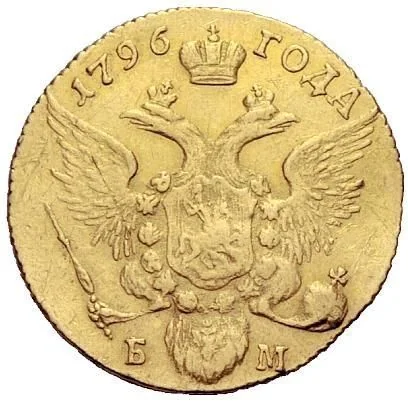
Russian double-headed eagle with date above. БМ (BM) banking coin.
Inscription:
1796 ГОДА
Б М
Б М
Script: Cyrillic
Reverse
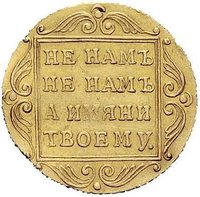
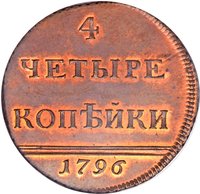
Description:
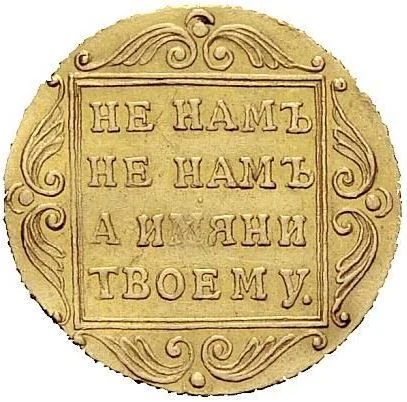
Psalm 115:1: "Not to us, but to your name."
Inscription:
НЕ НАМЪ,
НЕ НАМЪ,
А ИМЯНИ
ТВОЕМУ.
НЕ НАМЪ,
А ИМЯНИ
ТВОЕМУ.
Script: Cyrillic
Edge
Diagonal reeding
Mintings
| Year | Mint Mark | Mintage | Quality | Collection |
|---|---|---|---|---|
| 1796 | БМ | 2,500 | BU |
Historical background
By 1796, the final year of Catherine the Great's reign, the Russian Empire's currency system was fundamentally a copper standard, burdened by significant inflationary pressures and structural complexity. The primary circulating coin was the copper kopeck, with the silver rouble serving as the main unit of account. However, decades of costly wars, particularly against the Ottoman Empire, had been financed not by taxation but by the large-scale issuance of assignats, paper money introduced in 1769. These assignats, nominally convertible to copper, had been printed in ever-increasing volumes, leading to a severe depreciation of the paper currency against silver. By 1796, the assignat rouble had lost approximately 30% of its value compared to the silver rouble, creating a disruptive dual-system where prices were often quoted in both "silver roubles" and cheaper "assignat roubles."
The system was further complicated by a chronic shortage of precious metal coinage. While silver roubles and gold imperials were minted, they were largely hoarded, used for state expenses like foreign trade and military campaigns abroad, or held by the wealthy, leaving the bulk of domestic commerce to rely on bulky copper coins and the depreciating paper. The copper coinage itself was cumbersome; a single silver rouble's worth in copper kopeks could weigh over a kilogram, making large transactions physically difficult. This monetary disarray created widespread confusion in commerce, hindered economic development, and placed a heavy, hidden tax on the population through inflation.
Catherine the Great was aware of the crisis, and in her final year, plans were drawn up to stabilize the currency by withdrawing and burning a portion of the assignats to restore their value. However, these reforms were not implemented before her death in November 1796. The unstable legacy she left to her son, Emperor Paul I, was a treasury drained by war, a massive public debt, and a fractured monetary system that would demand immediate and drastic attention, setting the stage for his early attempts at financial reform upon his accession.
The system was further complicated by a chronic shortage of precious metal coinage. While silver roubles and gold imperials were minted, they were largely hoarded, used for state expenses like foreign trade and military campaigns abroad, or held by the wealthy, leaving the bulk of domestic commerce to rely on bulky copper coins and the depreciating paper. The copper coinage itself was cumbersome; a single silver rouble's worth in copper kopeks could weigh over a kilogram, making large transactions physically difficult. This monetary disarray created widespread confusion in commerce, hindered economic development, and placed a heavy, hidden tax on the population through inflation.
Catherine the Great was aware of the crisis, and in her final year, plans were drawn up to stabilize the currency by withdrawing and burning a portion of the assignats to restore their value. However, these reforms were not implemented before her death in November 1796. The unstable legacy she left to her son, Emperor Paul I, was a treasury drained by war, a massive public debt, and a fractured monetary system that would demand immediate and drastic attention, setting the stage for his early attempts at financial reform upon his accession.
✨ Legendary