

1 Rupee – Awadh
India
Context
Years: 1776–1777
Country: India 
Issuer: Awadh
Ruler: Shah Alam II
Currency:
(1605—1857)
Demonetized: Yes
Material
References
KM: #Click to copy to clipboard46.2
Numista: #102731
Value
Bullion value: $31.30
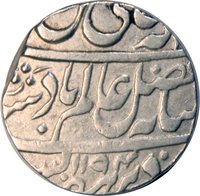
Obverse
Description:
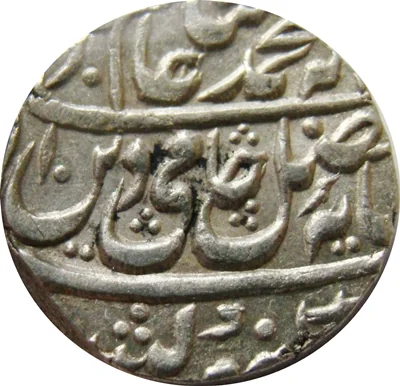
Shah Alam II, "saya-e-fazle elah" couplet.
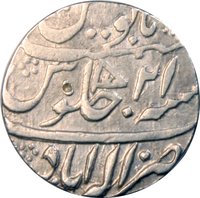
Reverse
Description:
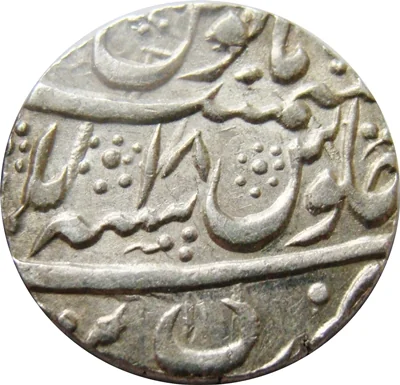
Sana, julus, zarb. Crescent below.
Edge
Mints
| Name | Mark |
|---|---|
| Bareli | — |
Mintings
| Year | Mint Mark | Mintage | Quality | Collection |
|---|---|---|---|---|
| 1776 | — | — | ||
| 1777 | — | — |
Historical background
In 1776, the currency situation in Awadh was a complex and transitional system, reflecting both its Mughal heritage and its growing entanglement with the British East India Company. The primary circulating medium was the silver rupee, with the dominant coin being the "Sicca Rupee" freshly minted in Calcutta, alongside older, variably worn Mughal-era rupees from mints like Benares and Farrukhabad. These coins circulated simultaneously but at different values, as the older coins, having lost weight, were discounted. This created a chaotic marketplace where money changers (sarrafs) were essential to assess and exchange coins, leading to transaction friction and localized exchange rates.
The Nawab of Awadh, Shuja-ud-Daula (r. 1754-1775), had recently died, and his successor Asaf-ud-Daula (r. 1775-1797) faced severe financial strain. A massive British-imposed subsidy, coupled with the costs of maintaining a large army and a lavish court, drained the treasury. This pressure directly impacted the currency system, as the Nawab’s minting authority was weakened. While Awadh had its own mints, the financial and political need for British subsidies meant that Company-minted Sicca Rupees, backed by their military and economic power, were becoming increasingly dominant in high-value trade and revenue payments.
Furthermore, the period saw a critical shortage of silver, a problem plaguing much of 18th-century India. This bullion famine restricted the minting of new local rupees and heightened the economic crisis. The chaotic multiplicity of coins, the drain of silver to pay the British, and the declining sovereign financial control of the Nawab created an unstable monetary environment. This instability was a microcosm of Awadh’s larger political decline, as the British East India Company, through its Resident and financial demands, was gradually eroding the state's fiscal autonomy, setting the stage for greater control in the decades to follow.
The Nawab of Awadh, Shuja-ud-Daula (r. 1754-1775), had recently died, and his successor Asaf-ud-Daula (r. 1775-1797) faced severe financial strain. A massive British-imposed subsidy, coupled with the costs of maintaining a large army and a lavish court, drained the treasury. This pressure directly impacted the currency system, as the Nawab’s minting authority was weakened. While Awadh had its own mints, the financial and political need for British subsidies meant that Company-minted Sicca Rupees, backed by their military and economic power, were becoming increasingly dominant in high-value trade and revenue payments.
Furthermore, the period saw a critical shortage of silver, a problem plaguing much of 18th-century India. This bullion famine restricted the minting of new local rupees and heightened the economic crisis. The chaotic multiplicity of coins, the drain of silver to pay the British, and the declining sovereign financial control of the Nawab created an unstable monetary environment. This instability was a microcosm of Awadh’s larger political decline, as the British East India Company, through its Resident and financial demands, was gradually eroding the state's fiscal autonomy, setting the stage for greater control in the decades to follow.
✨ Legendary