

5 Ducats – Austrian Empire
Austria
Context
Years: 1613–1618
Country: Austria 
Issuer: Austrian Empire
Ruler: Matthias
Currency:
(1520—1754)
Demonetized: Yes
References
KM: #Click to copy to clipboard179
Numista: #125687
Value
Bullion value: $2900.29
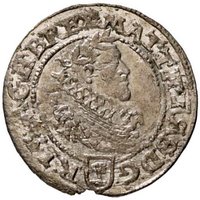
Obverse
Description:
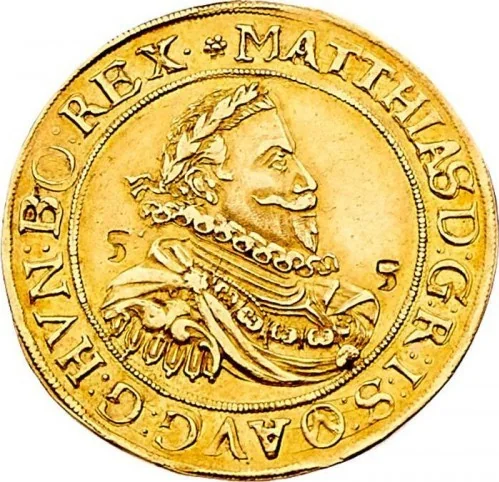
Laureate bust right, lion on shoulder, mint mark in legend.
Inscription:
MATTHIAS D G R I S (Λ) AVG G HVN BO REX
Script: Latin
Engraver: Fellner von Feldegg
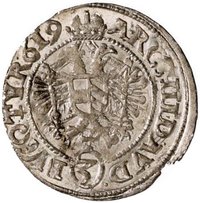
Reverse
Description:
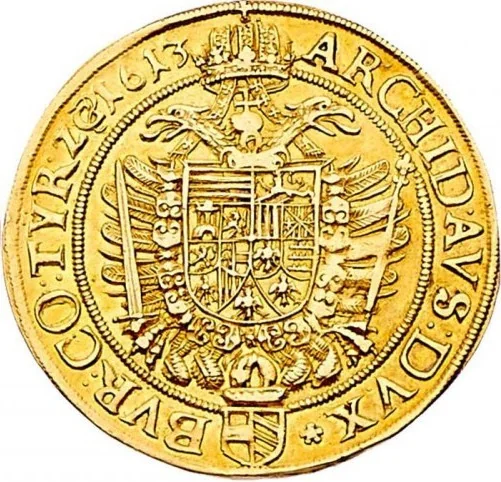
Imperial eagle with composite arms, small shield below in legend, date at end.
Inscription:
ARCHID AVS DVX // BVR CO TYR zc 1613
Script: Latin
Edge
Mints
| Name | Mark |
|---|---|
| Münze Österreich | — |
Mintings
| Year | Mint Mark | Mintage | Quality | Collection |
|---|---|---|---|---|
| 1613 | — | — | ||
| 1617 | — | — | ||
| 1618 | — | — |
Historical background
In 1613, the currency situation within the Habsburg-ruled Austrian Empire was complex and strained, reflecting the broader financial and political challenges of the early modern period. The empire did not have a unified monetary system; instead, various constituent lands (like Austria, Bohemia, and Hungary) minted their own coins, leading to a circulation of multiple silver and gold denominations with fluctuating values. The primary large silver coin was the Reichsthaler, but regional currencies like the Bohemian Groschen and Hungarian Denar were also prevalent, creating confusion and facilitating debasement.
The core of the monetary instability stemmed from the Crown's chronic fiscal deficits, exacerbated by the ongoing Long Turkish War (1593-1606) and rising tensions that would soon erupt into the Thirty Years' War (1618). To meet soaring military expenses, the Habsburg treasury, particularly under Emperor Matthias (1612-1619), frequently resorted to debasing the coinage. This involved reducing the precious metal content in minted coins while maintaining their face value, a short-term measure that generated immediate revenue but triggered severe inflation, price volatility, and a loss of public trust in the currency.
Consequently, the year 1613 fell within a period of significant monetary disorder. Prices for goods and services were unstable, and "bad money" (debased coinage) began to drive "good money" (full-weight coins) out of circulation, as described by Gresham's Law. This erosion of the monetary standard disproportionately harmed wage earners and creditors, while benefiting debtors and those controlling minting rights. The situation highlighted the weak central financial control of the Habsburg monarchy and foreshadowed the deeper economic crises that would engulf Central Europe during the coming decades of conflict.
The core of the monetary instability stemmed from the Crown's chronic fiscal deficits, exacerbated by the ongoing Long Turkish War (1593-1606) and rising tensions that would soon erupt into the Thirty Years' War (1618). To meet soaring military expenses, the Habsburg treasury, particularly under Emperor Matthias (1612-1619), frequently resorted to debasing the coinage. This involved reducing the precious metal content in minted coins while maintaining their face value, a short-term measure that generated immediate revenue but triggered severe inflation, price volatility, and a loss of public trust in the currency.
Consequently, the year 1613 fell within a period of significant monetary disorder. Prices for goods and services were unstable, and "bad money" (debased coinage) began to drive "good money" (full-weight coins) out of circulation, as described by Gresham's Law. This erosion of the monetary standard disproportionately harmed wage earners and creditors, while benefiting debtors and those controlling minting rights. The situation highlighted the weak central financial control of the Habsburg monarchy and foreshadowed the deeper economic crises that would engulf Central Europe during the coming decades of conflict.
✨ Legendary