

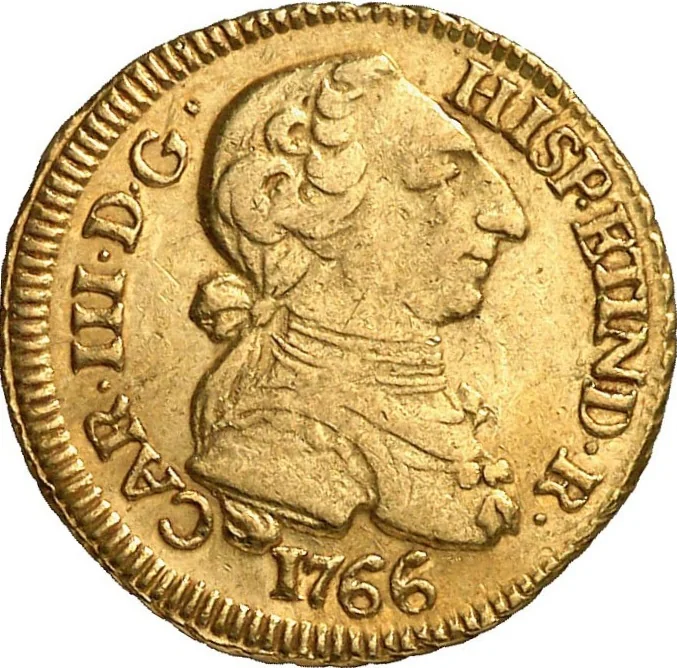
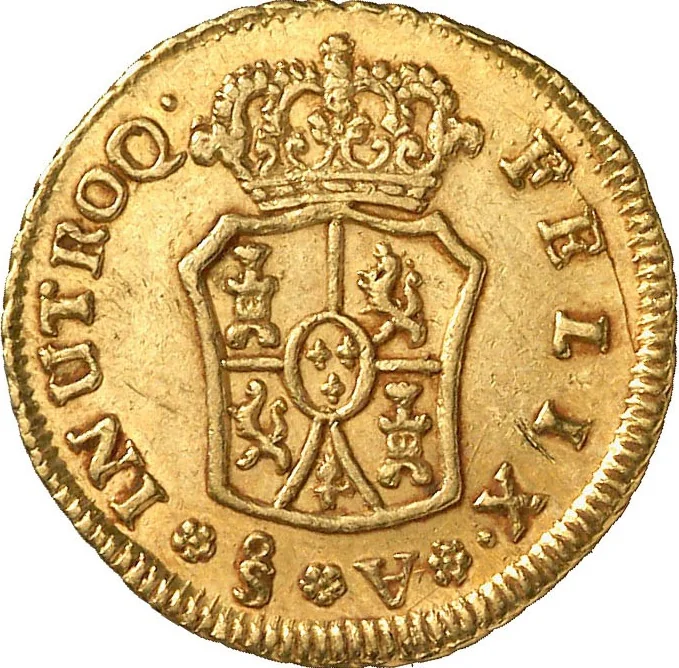
1 Escudo – Chile
Chile
Context
Years: 1764–1766
Issuer: Chile 
Ruler: Charles III
Currency:
(1541—1852)
Demonetized: Yes
Total mintage: 424
Material
References
KM: #Click to copy to clipboard22
Numista: #121820
Value
Bullion value: $519.55
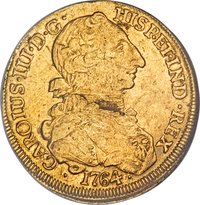
Obverse
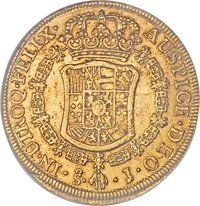
Reverse
Edge
Mintings
| Year | Mint Mark | Mintage | Quality | Collection |
|---|---|---|---|---|
| 1764 | So | 400 | ||
| 1766 | So | 24 |
Historical background
In 1764, the currency situation in the Kingdom of Chile, a colonial captaincy of the Spanish Empire, was characterized by severe scarcity and a chaotic mix of metallic currencies. The official monetary system was based on the Spanish peso, divided into 8 reales, but the colony suffered from a chronic shortage of official minted coins. This was primarily due to mercantilist policies that drained silver and gold to Spain, while also stemming from Chile's own limited mineral production compared to neighboring Peru. As a result, everyday commerce relied heavily on a confusing array of foreign coins—primarily Peruvian and Bolivian pesos, but also coins from other European empires and even cut or clipped pieces of currency, all circulating at fluctuating values.
The Spanish Crown's attempt to rectify this was the establishment of the first royal mint (Casa de Moneda) in Santiago in 1749. However, by 1764, its operation was still inconsistent and failed to meet the demand. The mint's production was hampered by technical difficulties, a lack of consistent bullion supply, and administrative challenges. Consequently, the promised flood of standardized coinage to unify the economy had not materialized, leaving the earlier problems largely unresolved. The persistence of this "monetary famine" stifled trade and economic growth, forcing local authorities and merchants to continue using improvised methods of exchange.
This unstable environment led to widespread use of credit, barter, and commodity money (like pesos de la tierra tied to agricultural goods), especially in rural areas and for smaller transactions. The situation created significant friction in commerce, as the value of any transaction was subject to complex negotiation over the origin, weight, and authenticity of the coins used. Thus, in 1764, Chile's currency system remained a fragmented and inefficient patchwork, a direct reflection of its colonial economic subordination and a significant obstacle to internal economic integration and development.
The Spanish Crown's attempt to rectify this was the establishment of the first royal mint (Casa de Moneda) in Santiago in 1749. However, by 1764, its operation was still inconsistent and failed to meet the demand. The mint's production was hampered by technical difficulties, a lack of consistent bullion supply, and administrative challenges. Consequently, the promised flood of standardized coinage to unify the economy had not materialized, leaving the earlier problems largely unresolved. The persistence of this "monetary famine" stifled trade and economic growth, forcing local authorities and merchants to continue using improvised methods of exchange.
This unstable environment led to widespread use of credit, barter, and commodity money (like pesos de la tierra tied to agricultural goods), especially in rural areas and for smaller transactions. The situation created significant friction in commerce, as the value of any transaction was subject to complex negotiation over the origin, weight, and authenticity of the coins used. Thus, in 1764, Chile's currency system remained a fragmented and inefficient patchwork, a direct reflection of its colonial economic subordination and a significant obstacle to internal economic integration and development.

✨ Legendary