

1 Escudo – Chile
Chile
Context
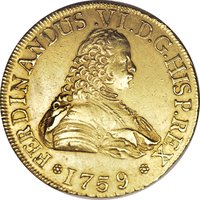
Year: 1759
Issuer: Chile 
Ruler: Ferdinand VI
Currency:
(1541—1852)
Demonetized: Yes
Total mintage: 328
Material

References
KM: #Click to copy to clipboard10
Numista: #121819
Value
Bullion value: $517.07
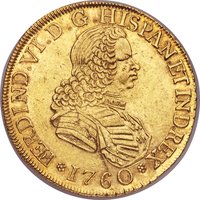
Obverse
Description:
Bust of Fernando VI, dated.
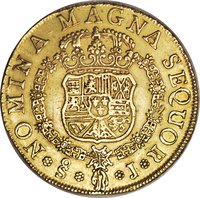
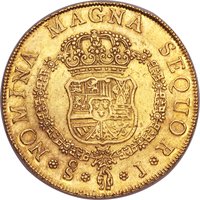
Reverse
Description:
Crest
Inscription:
NOMINA MAGNA SEQUOR
So J
So J
Edge
Mints
| Name | Mark |
|---|---|
| Casa de Moneda de Chile | (So) |
Mintings
| Year | Mint Mark | Mintage | Quality | Collection |
|---|---|---|---|---|
| 1759 | So | 328 |
Historical background
In 1759, the currency situation in the Kingdom of Chile, a captaincy general of the Spanish Empire, was characterized by a severe and chronic shortage of official coinage. The local economy operated primarily on a system of barter and the use of informal credit instruments, as the supply of coins from the royal mint in Lima, Peru, was insufficient to meet the needs of a growing colonial society engaged in agriculture, mining, and trade. This scarcity was a structural problem, exacerbated by Chile's geographical isolation, the Crown's mercantilist policies that drained precious metals to Spain, and the costs of the ongoing Arauco War against the Mapuche people, which consumed local resources.
The vacuum created by the lack of royal currency was filled by a widespread and officially tolerated use of macuquinas—crude, irregularly cut silver coins often minted in Potosí—as well as by gold dust measured by weight. More significantly, the Jesuit Order emerged as a crucial financial institution, issuing boletas de temporalidades (notes or tokens backed by their extensive agricultural holdings) that circulated as a trusted medium of exchange throughout the central valley. This private, faith-based currency effectively lubricated the local economy, demonstrating a pragmatic adaptation to imperial neglect.
Ultimately, the monetary landscape of 1759 reflected Chile's peripheral status within the empire. While the Spanish Crown legally mandated the use of its coinage, its practical authority over the circulating medium was limited. The situation was one of de facto decentralization, where economic activity depended on a patchwork of imperfect substitutes. This scarcity would persist until the establishment of a royal mint in Santiago in 1749 bore fruit, but in 1759, its output was still nascent and insufficient, leaving the colony in a transitional period reliant on informal and private currencies.
The vacuum created by the lack of royal currency was filled by a widespread and officially tolerated use of macuquinas—crude, irregularly cut silver coins often minted in Potosí—as well as by gold dust measured by weight. More significantly, the Jesuit Order emerged as a crucial financial institution, issuing boletas de temporalidades (notes or tokens backed by their extensive agricultural holdings) that circulated as a trusted medium of exchange throughout the central valley. This private, faith-based currency effectively lubricated the local economy, demonstrating a pragmatic adaptation to imperial neglect.
Ultimately, the monetary landscape of 1759 reflected Chile's peripheral status within the empire. While the Spanish Crown legally mandated the use of its coinage, its practical authority over the circulating medium was limited. The situation was one of de facto decentralization, where economic activity depended on a patchwork of imperfect substitutes. This scarcity would persist until the establishment of a royal mint in Santiago in 1749 bore fruit, but in 1759, its output was still nascent and insufficient, leaving the colony in a transitional period reliant on informal and private currencies.
✨ Legendary