

½ Skilling – Norway
Norway
Context
Year: 1676
Issuer: Norway 
Ruler: Christian V
Currency:
(1523—1746)
Demonetized: Yes
Total mintage: 262,000
References
KM: #Click to copy to clipboard133
Numista: #98995
Obverse
Description:
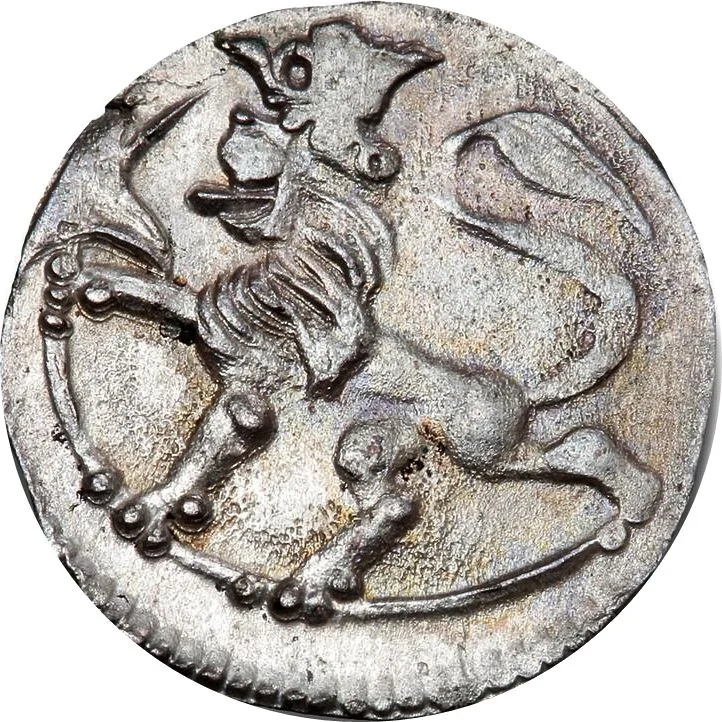
Norwegian lion with crown and axe, left-facing. Beaded rim.
Reverse
Description:
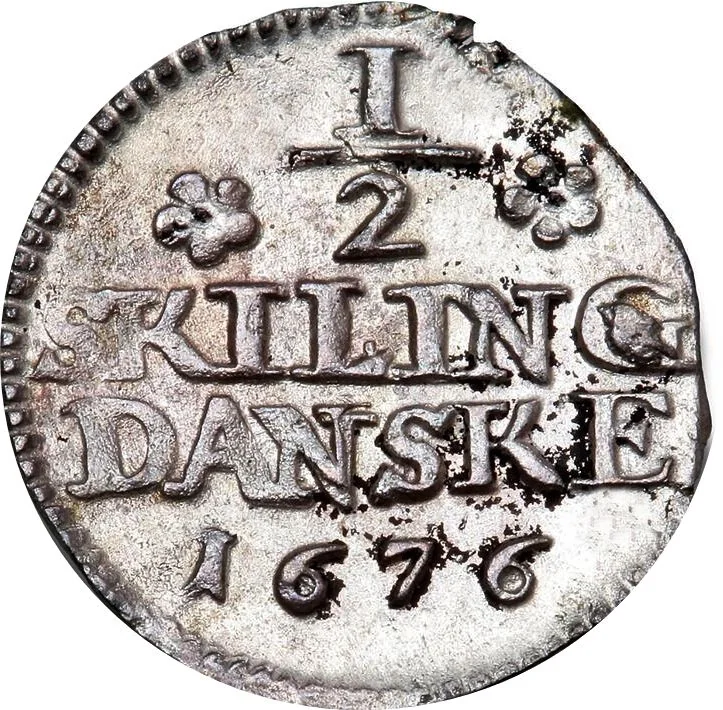
Value and date
on four lines.
Beaded rim ring.
on four lines.
Beaded rim ring.
Inscription:
✿ 1/2 ✿
SKILING
DANSKE
1676
SKILING
DANSKE
1676
Script: Latin
Edge
Mints
| Name | Mark |
|---|---|
| Christiania | — |
Mintings
| Year | Mint Mark | Mintage | Quality | Collection |
|---|---|---|---|---|
| 1676 | — | 262,000 |
Historical background
In 1676, Norway found itself in a precarious monetary situation, deeply entangled with its political union with Denmark under the absolutist King Christian V. The kingdom was embroiled in the Scanian War (1675–1679) against Sweden, a conflict that placed an immense financial strain on the state treasury. To fund the war effort, the government resorted to the widespread practice of debasement, sharply reducing the silver content in coins like the skilling and mark while ordering them to be accepted at their old, higher face value. This effectively created a two-tier currency system and triggered severe inflation, as the public quickly lost trust in the rapidly depreciating coinage.
The situation was exacerbated by a chronic shortage of physical currency, particularly high-value silver riksdaler, within Norway itself. Much of the nation's sound money was siphoned off to pay for imported goods and the costs of the war abroad, leaving the domestic economy to function with a flood of poor-quality coins. This led to practical hardships in trade and daily transactions, with merchants and farmers alike suffering from unpredictable price swings and the difficulty of assessing the true value of the mixed coinage in circulation.
Furthermore, the monetary chaos was compounded by the circulation of numerous foreign coins, especially from the German states, and the continued use of old, worn-out domestic coins. The government's attempts to legislate values and mandate acceptance of the new debased currency were largely ineffective, as market forces and public skepticism prevailed. Consequently, by 1676, Norway was experiencing a classic currency crisis: wartime inflation, a collapse in confidence, and a dysfunctional monetary system that undermined economic stability and placed a heavy burden on its population.
The situation was exacerbated by a chronic shortage of physical currency, particularly high-value silver riksdaler, within Norway itself. Much of the nation's sound money was siphoned off to pay for imported goods and the costs of the war abroad, leaving the domestic economy to function with a flood of poor-quality coins. This led to practical hardships in trade and daily transactions, with merchants and farmers alike suffering from unpredictable price swings and the difficulty of assessing the true value of the mixed coinage in circulation.
Furthermore, the monetary chaos was compounded by the circulation of numerous foreign coins, especially from the German states, and the continued use of old, worn-out domestic coins. The government's attempts to legislate values and mandate acceptance of the new debased currency were largely ineffective, as market forces and public skepticism prevailed. Consequently, by 1676, Norway was experiencing a classic currency crisis: wartime inflation, a collapse in confidence, and a dysfunctional monetary system that undermined economic stability and placed a heavy burden on its population.
✨ Legendary