

⅓ Thaler – Anhalt-Köthen
Germany
Context

References
KM: #Click to copy to clipboard28
Numista: #98261
Obverse
Description:
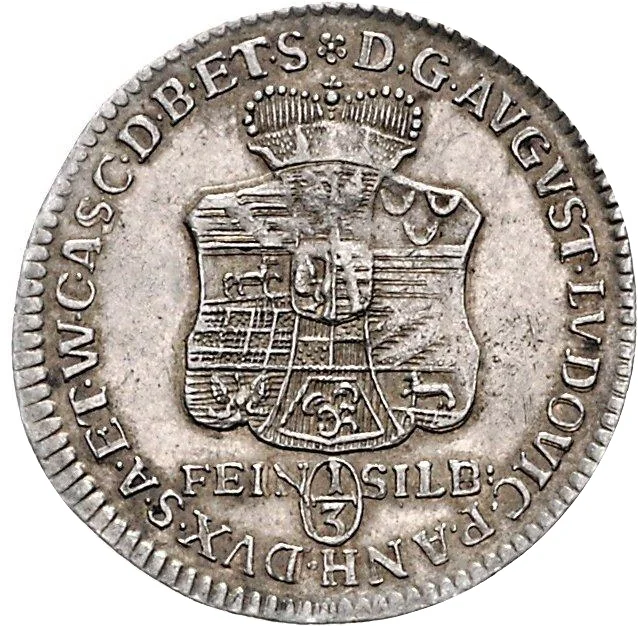
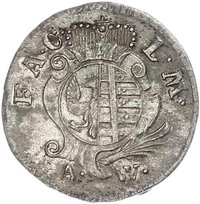
Crowned shield above value.
Inscription:
D.G.AVGVST.LVDOVIC.P.ANH.DVX.S.A.ET.W.C.ASC.D.B.ET.S.
FEIN 1/3 SILB:
FEIN 1/3 SILB:
Script: Latin
Reverse
Edge
Mints
| Name | Mark |
|---|---|
| Köthen | — |
Mintings
| Year | Mint Mark | Mintage | Quality | Collection |
|---|---|---|---|---|
| 1750 | — | — |
Historical background
In the mid-18th century, the currency situation in the small central German principality of Anhalt-Köthen was complex and fragmented, reflecting the broader monetary disarray of the Holy Roman Empire. The principality did not possess its own minting authority (Münzregal) and therefore relied on the circulation of coins issued by numerous other German states, particularly its larger and more influential neighbors. The most important of these was the Reichsthaler, a silver coin defined by imperial decree, but a plethora of regional Thaler, Gulden, and Groschen from Saxony, Brandenburg-Prussia, and Brunswick-Lüneburg also circulated, each with varying silver content and exchange rates.
This multiplicity of currencies created significant challenges for trade and daily life. Merchants and officials required constantly updated exchange lists (Kurstabellen) to conduct business, and the fluctuating value of coins, often degraded by states seeking seigniorage profit, led to economic uncertainty. Furthermore, Anhalt-Köthen was part of the Fuß (monetary standard) area of the nearby Saxon coinage circle, meaning its accounting was often pegged to the Leipzig Mark standard. This practical dependency on Saxony’s monetary policy left the principality vulnerable to decisions made outside its borders, especially during periods of currency debasement.
Prince August Ludwig, who ruled until 1755, managed this situation within the constraints of a small state’s economy. His administration focused on regulating and declaring the legal exchange rates (Tarife) for the myriad of foreign coins to provide some local stability. However, the lack of a unified, sovereign currency remained a structural weakness, inhibiting capital formation and complicating state finances. This monetary landscape was typical of the era, where local economies were entangled in a web of competing coinages until the greater standardization brought by the Konventionsfuß later in the century and, ultimately, 19th-century unification.
This multiplicity of currencies created significant challenges for trade and daily life. Merchants and officials required constantly updated exchange lists (Kurstabellen) to conduct business, and the fluctuating value of coins, often degraded by states seeking seigniorage profit, led to economic uncertainty. Furthermore, Anhalt-Köthen was part of the Fuß (monetary standard) area of the nearby Saxon coinage circle, meaning its accounting was often pegged to the Leipzig Mark standard. This practical dependency on Saxony’s monetary policy left the principality vulnerable to decisions made outside its borders, especially during periods of currency debasement.
Prince August Ludwig, who ruled until 1755, managed this situation within the constraints of a small state’s economy. His administration focused on regulating and declaring the legal exchange rates (Tarife) for the myriad of foreign coins to provide some local stability. However, the lack of a unified, sovereign currency remained a structural weakness, inhibiting capital formation and complicating state finances. This monetary landscape was typical of the era, where local economies were entangled in a web of competing coinages until the greater standardization brought by the Konventionsfuß later in the century and, ultimately, 19th-century unification.
✨ Legendary