

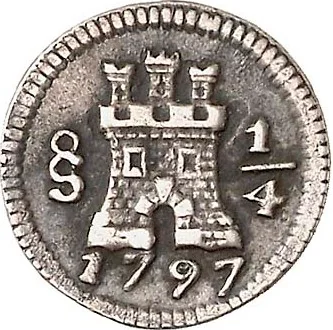
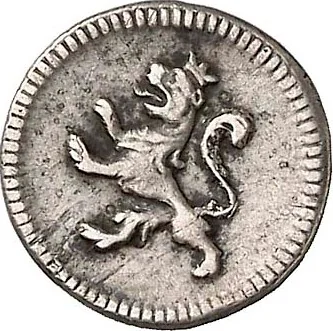
¼ real – Chile
Add to wishlist
Chile
Context
Years: 1796–1808
Issuer: Chile
Ruler: Charles IV
Currency:
(1541—1852)
Demonetized: Yes
Total mintage: 684,000
Material
References
KM: #
Numista: #120565
Value
Bullion value: $1.91
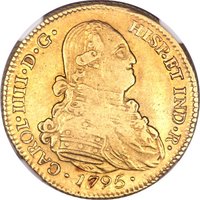
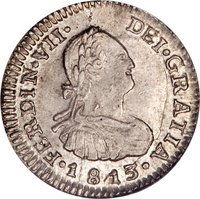
Obverse
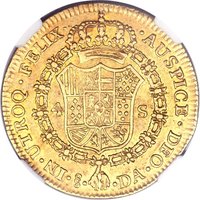
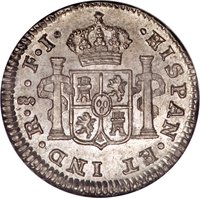
Reverse
Description:
Rampant lion.
Edge
Chained
Mints
| Name | Mark |
|---|---|
| Casa de Moneda de Chile | (So) |
Mintings
| Year | Mint Mark | Mintage | Quality | Collection |
|---|---|---|---|---|
| 1796 | So | 63,000 | ||
| 1797 | So | 66,000 | ||
| 1798 | So | 50,000 | ||
| 1799 | So | 42,000 | ||
| 1800 | So | 72,000 | ||
| 1801 | So | 57,000 | ||
| 1802 | So | 56,000 | ||
| 1803 | So | 54,000 | ||
| 1803 | /1 | — | ||
| 1804 | So | 56,000 | ||
| 1805 | So | — | ||
| 1806 | /5 | — | ||
| 1806 | So | 54,000 | ||
| 1807 | So | 57,000 | ||
| 1808 | /6 | — | ||
| 1808 | So | 57,000 |
Historical background
In 1796, the Captaincy General of Chile, a peripheral colony of the Spanish Empire, operated within a complex and strained monetary system. The official currency was the Spanish real, with 8 reales equaling one peso. However, the economy suffered from a severe and chronic shortage of specie (coined money). This scarcity was due to Chile's limited silver production, restrictive Spanish mercantile policies that drained bullion to the metropolis, and the colony's geographical isolation. As a result, the primary mediums of exchange were not coins but rather gold dust, measured in pesos and reales, and a wide array of credit instruments like promissory notes (pagarés) and bills of exchange drawn on merchants or the royal treasury.
The lack of standardized coinage led to widespread use of foreign coins, primarily Peruvian and Bolivian silver pieces (from the Potosí mint), which circulated at fluctuating values. This situation created a chaotic and inefficient market, hindering commerce and tax collection. The Spanish crown's attempts to regulate currency, such as setting official values for foreign coins, were largely ineffective on the ground. Furthermore, the royal treasury itself often resorted to issuing its own paper notes, known as libranzas, to pay for expenses, adding another layer of informal currency to the system.
Consequently, Chile's 1796 economy functioned on a fragile foundation of trust, barter, and cumbersome credit. Wealth was often stored in tangible assets like land or gold bullion rather than liquid cash. This monetary instability reflected Chile's colonial dependency and would become a pressing issue for the nascent republican governments following independence in the early 19th century, as they sought to establish a sovereign and unified currency.
The lack of standardized coinage led to widespread use of foreign coins, primarily Peruvian and Bolivian silver pieces (from the Potosí mint), which circulated at fluctuating values. This situation created a chaotic and inefficient market, hindering commerce and tax collection. The Spanish crown's attempts to regulate currency, such as setting official values for foreign coins, were largely ineffective on the ground. Furthermore, the royal treasury itself often resorted to issuing its own paper notes, known as libranzas, to pay for expenses, adding another layer of informal currency to the system.
Consequently, Chile's 1796 economy functioned on a fragile foundation of trust, barter, and cumbersome credit. Wealth was often stored in tangible assets like land or gold bullion rather than liquid cash. This monetary instability reflected Chile's colonial dependency and would become a pressing issue for the nascent republican governments following independence in the early 19th century, as they sought to establish a sovereign and unified currency.
💎 Extremely Rare