

2 Ducats – Spanish Netherlands
Netherlands
Context
Years: 1598–1612
Country: Netherlands 
Issuer: Spanish Netherlands
Currency:
(1506—1713)
Demonetized: Yes
Total mintage: 24,910
Material
Diameter: 30 mm
Weight: 7 g
Shape: Round
Magnetic: No
Alignment: Coin alignment
flip
References
KM: #Click to copy to clipboard7
Numista: #95950
Obverse
Description:
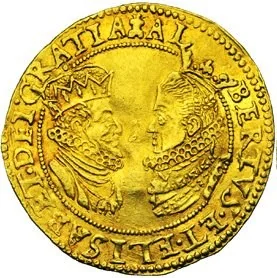
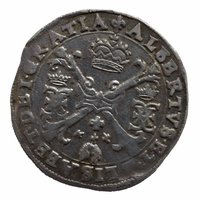
Confronting busts of Albert and Isabella. Mint mark: tower.
Inscription:
ALBERTVS · ET · ELISABET · DEI · GRATIA
Script: Latin
Reverse
Description:
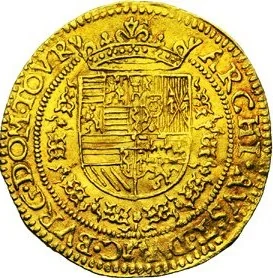
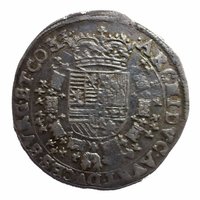
Arms crowned and encircled by the Golden Fleece collar.
Inscription:
ARCHI · AVST · DVC · BVRG · DOM · TOVR
Script: Latin
Edge
Mints
| Name | Mark |
|---|---|
| Tournai | — |
Mintings
| Year | Mint Mark | Mintage | Quality | Collection |
|---|---|---|---|---|
| — | Tour | 24,910 |
Historical background
In 1598, the currency situation in the Spanish Netherlands was one of profound crisis and complexity, a direct consequence of the ongoing Eighty Years' War (1568–1648). The region, a vital economic hub, was financially exhausted by the immense costs of the conflict and the burden of supporting the Spanish Army of Flanders. To meet these expenses, the authorities, under the rule of Philip II (and upon his death in 1598, his daughter Isabella and her husband Archduke Albert), repeatedly resorted to debasement—reducing the precious metal content in coins while maintaining their face value. This practice, intended as a short-term fiscal measure, led to a proliferation of coins of varying intrinsic worth from different mints, both domestic and foreign, circulating simultaneously.
The monetary chaos was characterized by the widespread circulation of heavily debased patards, stuivers, and double patards (known as "Philippusdaalders" or "Philippusguldens"). These coins, struck with lower silver content, drove older, purer coins out of circulation according to Gresham's Law ("bad money drives out good"). This triggered severe inflation, crippled trustworthy commerce, and created a confusing system where the nominal value of a coin bore little relation to its actual metal value. The public's confidence in the currency evaporated, and economic activity was severely hampered as merchants and individuals struggled to assess real prices and values.
Recognizing the destabilizing effects, the new sovereigns, the Archdukes Albert and Isabella, attempted reform shortly after assuming power in 1598. Their ordinance of 1599 aimed to stabilize the currency by officially recognizing the debased coinage in circulation but fixing their value at a lower rate relative to the older, better coins. This was an attempt to create a unified standard and restore some semblance of order. However, the deep-rooted problems of war finance and the entrenched practice of debasement meant that true monetary stability remained elusive for decades, with the currency situation reflecting the broader political and military fragility of the Spanish Netherlands.
The monetary chaos was characterized by the widespread circulation of heavily debased patards, stuivers, and double patards (known as "Philippusdaalders" or "Philippusguldens"). These coins, struck with lower silver content, drove older, purer coins out of circulation according to Gresham's Law ("bad money drives out good"). This triggered severe inflation, crippled trustworthy commerce, and created a confusing system where the nominal value of a coin bore little relation to its actual metal value. The public's confidence in the currency evaporated, and economic activity was severely hampered as merchants and individuals struggled to assess real prices and values.
Recognizing the destabilizing effects, the new sovereigns, the Archdukes Albert and Isabella, attempted reform shortly after assuming power in 1598. Their ordinance of 1599 aimed to stabilize the currency by officially recognizing the debased coinage in circulation but fixing their value at a lower rate relative to the older, better coins. This was an attempt to create a unified standard and restore some semblance of order. However, the deep-rooted problems of war finance and the entrenched practice of debasement meant that true monetary stability remained elusive for decades, with the currency situation reflecting the broader political and military fragility of the Spanish Netherlands.
✨ Legendary