

1 angel – England
Add to wishlist
United Kingdom
Context
Years: 1626–1643
Country: United Kingdom
Issuer: England
Ruler: Charles I
Currency:
(1158—1970)
Demonetized: Yes
Material
Diameter: 26 mm
Weight: 5 g
Gold Weight:: 4.97 g
Shape: Irregular round
Composition: 99.5% Gold
Magnetic: No
Technique: Hammered
References
KM: #
Numista: #95276
Value
Bullion value: $765.84
Obverse
Description:
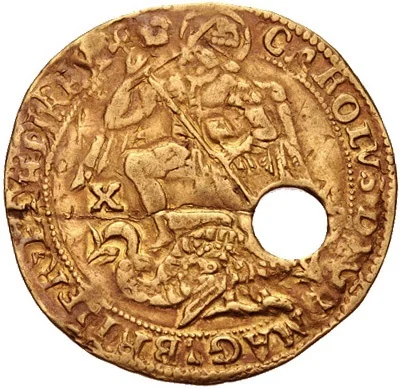
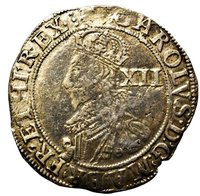
St. Michael slaying dragon, 'X' at left.
Inscription:
CAROLVS D G MAG BRI FRA ET HIB REX
Script: Latin
Reverse
Edge
Categories
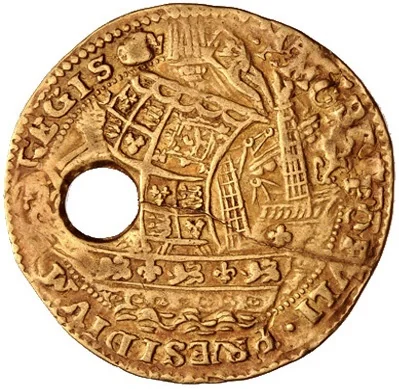
| Transportation> Watercraft |
| Symbols> Coat of Arms |
| Animal> Feline |
| Mythology> Fantastic animal |
| Geography> Sea |
Mints
| Name | Mark |
|---|---|
| Royal Mint (Tower of London) | — |
Mintings
| Year | Mint Mark | Mintage | Quality | Collection |
|---|---|---|---|---|
| — | — | — |
Historical background
In 1626, England’s currency was in a state of severe crisis, primarily driven by the practice of "clipping" and counterfeiting. The nation’s silver coinage, the backbone of its economy, was being physically degraded. Unscrupulous individuals would shave small amounts of precious metal from the edges of coins, while counterfeiters produced underweight imitations. This led to a proliferation of lightweight and damaged coins in circulation, causing widespread distrust. The fundamental principle that a coin’s face value should equal its intrinsic metal value was breaking down, creating monetary instability.
King Charles I, having just ascended to the throne in 1625, inherited this problem alongside expensive foreign policy commitments, including war with Spain. The poor state of the coinage had dire economic consequences: merchants began hoarding old, full-weight coins for their bullion value, while only the degraded coins remained in active use—a classic example of Gresham’s Law, where "bad money drives out good." This undermined both domestic trade and international commerce, as foreign merchants refused to accept English coin at face value. The Crown’s own revenue, collected in clipped and lightweight coin, was also diminished in real value.
The government recognized the need for reform, but decisive action was stalled. A full recoinage, which would involve calling in all old money and minting new, milled-edge coins (difficult to clip), was the obvious solution. However, this was a prohibitively expensive undertaking for a Crown already in financial difficulty and facing a contentious Parliament reluctant to grant funds. Consequently, the currency situation remained unresolved in 1626, acting as a persistent drag on the economy and exacerbating the wider fiscal tensions between the monarchy and Parliament that would define Charles’s reign.
King Charles I, having just ascended to the throne in 1625, inherited this problem alongside expensive foreign policy commitments, including war with Spain. The poor state of the coinage had dire economic consequences: merchants began hoarding old, full-weight coins for their bullion value, while only the degraded coins remained in active use—a classic example of Gresham’s Law, where "bad money drives out good." This undermined both domestic trade and international commerce, as foreign merchants refused to accept English coin at face value. The Crown’s own revenue, collected in clipped and lightweight coin, was also diminished in real value.
The government recognized the need for reform, but decisive action was stalled. A full recoinage, which would involve calling in all old money and minting new, milled-edge coins (difficult to clip), was the obvious solution. However, this was a prohibitively expensive undertaking for a Crown already in financial difficulty and facing a contentious Parliament reluctant to grant funds. Consequently, the currency situation remained unresolved in 1626, acting as a persistent drag on the economy and exacerbating the wider fiscal tensions between the monarchy and Parliament that would define Charles’s reign.
✨ Legendary