

1 Thaler – Austrian Empire
Austria
Context
Years: 1626–1631
Country: Austria 
Issuer: Austrian Empire
Ruler: Ferdinand II
Currency:
(1520—1754)
Demonetized: Yes
Material
References
KM: #Click to copy to clipboard628
Numista: #94095
Value
Bullion value: $72.80
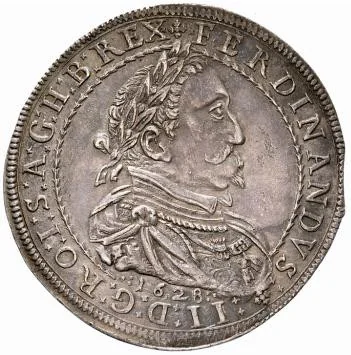
Obverse
Description:
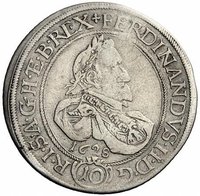
Right-facing laureate bust with straight collar, leaf circle, small date below.
Inscription:
FERDINANDVS // II D G RO I S A G H B REX
Script: Latin
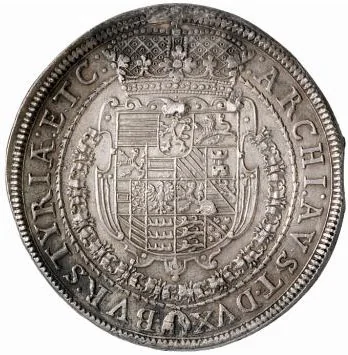
Reverse
Description:
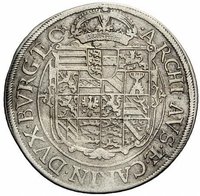
Crowned arms encircled by leaves and the Order of the Golden Fleece's chain, with the small shield of Styria above.
Inscription:
ARCHI AVST DVX // BVR STYRIÆ ETC
Script: Latin
Edge
Mints
| Name | Mark |
|---|---|
| Graz | — |
Mintings
| Year | Mint Mark | Mintage | Quality | Collection |
|---|---|---|---|---|
| 1626 | — | — | ||
| 1627 | — | — | ||
| 1628 | — | — | ||
| 1629 | — | — | ||
| 1630 | — | — | ||
| 1631 | — | — |
Historical background
In 1626, the Habsburg-ruled Austrian Empire was deeply embroiled in the Thirty Years' War (1618-1648), a conflict that placed immense fiscal strain on the imperial treasury. To finance massive military expenditures for armies and campaigns, the state, under Emperor Ferdinand II, increasingly resorted to currency debasement. The primary mechanism was the systematic reduction of the silver content in the small-denomination Kipper and Wipper coins (hellers, kreuzers) that circulated in daily life, while attempting to keep larger silver talers intact for international trade. This created a two-tiered monetary system that was inherently unstable.
The resulting period, known as the Kipper- und Wipperzeit (literally "Clipping and Swinging time"), peaked around 1621-1623 but its catastrophic consequences were fully felt by 1626. The empire was flooded with worthless small coins, leading to rampant inflation, a collapse of public trust in currency, and a severe economic crisis. Prices for basic necessities soared, causing widespread hardship among the common population and disrupting markets, as creditors were repaid in debased coinage and merchants hoarded good silver.
Although Ferdinand II attempted to stabilize the currency by issuing an imperial minting ordinance in 1623, which restored the Reichsthaler standard, the damage was profound and lingering. By 1626, the immediate hyperinflation had subsided, but the financial credibility of the Habsburg state was severely weakened. The crisis underscored the empire's fragmented financial structure, where control over mints was often leased to profit-seeking individuals, and highlighted the desperate fiscal measures necessitated by prolonged warfare, leaving a legacy of economic disruption that hampered recovery for years.
The resulting period, known as the Kipper- und Wipperzeit (literally "Clipping and Swinging time"), peaked around 1621-1623 but its catastrophic consequences were fully felt by 1626. The empire was flooded with worthless small coins, leading to rampant inflation, a collapse of public trust in currency, and a severe economic crisis. Prices for basic necessities soared, causing widespread hardship among the common population and disrupting markets, as creditors were repaid in debased coinage and merchants hoarded good silver.
Although Ferdinand II attempted to stabilize the currency by issuing an imperial minting ordinance in 1623, which restored the Reichsthaler standard, the damage was profound and lingering. By 1626, the immediate hyperinflation had subsided, but the financial credibility of the Habsburg state was severely weakened. The crisis underscored the empire's fragmented financial structure, where control over mints was often leased to profit-seeking individuals, and highlighted the desperate fiscal measures necessitated by prolonged warfare, leaving a legacy of economic disruption that hampered recovery for years.
✨ Legendary