

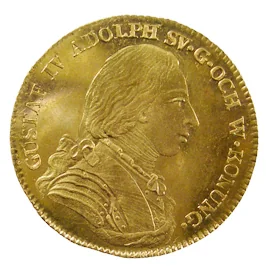
1 Ducat – Sweden
Sweden
Context
Year: 1804
Issuer: Sweden 
Ruler: Gustav IV Adolf
Currency:
(1798—1830)
Demonetized: Yes
Total mintage: 1,254
Material
References
KM: #Click to copy to clipboard567
Numista: #101116
Value
Bullion value: $569.55
Obverse
Reverse
Description:
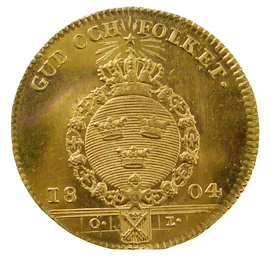
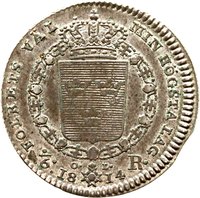
A crowned, lined orb bearing Sweden’s Three Crowns within the Seraphim Order chain. A radiant star and the King’s motto are above. The date is below, above a line. In the exergue, the crowned crossed arrows of Dalarna (indicating the gold’s origin) divide the mintmark on a brickwork background.
Inscription:
GUD OCH FOLKET •
O• L•
18 04
O• L•
18 04
Translation:
Good and the People •
O• L•
18 04
O• L•
18 04
Script: Latin
Language: Swedish
Edge
Categories
| Symbols> Coat of Arms |
Mintings
| Year | Mint Mark | Mintage | Quality | Collection |
|---|---|---|---|---|
| 1804 | OL | 1,254 |
Historical background
In 1804, Sweden operated under a complex and strained monetary system, a legacy of the disastrous Russo-Swedish War (1788–1790) and the assassination of King Gustav III in 1792. The national currency was the Riksdaler Riksmynt, but the economy was plagued by a severe shortage of silver coinage. To finance the war, the government had heavily relied on issuing irredeemable paper money called Riksgälds Sedlar (government debt notes), which were not backed by sufficient precious metal reserves. This led to a de facto dual system where paper notes circulated at a fluctuating and discounted value compared to silver coins, causing inflation and public distrust.
The situation was managed, albeit with difficulty, under the rule of Gustav IV Adolf. The state’s finances were burdened by debt, and the Riksens Ständers Bank (precursor to the Riksbank) struggled to maintain confidence. While the paper money was legally accepted, its practical value was lower, and merchants often preferred the more stable silver Riksdaler Specie. This period was one of cautious stagnation rather than crisis; the king’s rigid adherence to a silver standard in principle, combined with an avoidance of new major wars, prevented a complete collapse of the currency. However, the underlying weakness was clear, as the economy lacked the robust specie reserves needed to unify the system.
This fragile equilibrium would soon be shattered. Within a few years, Sweden’s involvement in the Napoleonic Wars, leading to the loss of Finland in 1809 and the subsequent deposition of Gustav IV Adolf, would trigger a full-blown financial crisis. The state would be forced to issue even more paper money to cover its expenses, resulting in severe depreciation. Thus, 1804 represents a precarious calm before the storm, a moment when the structural flaws in Sweden's currency were contained but not resolved, setting the stage for the monetary upheavals of the coming decade.
The situation was managed, albeit with difficulty, under the rule of Gustav IV Adolf. The state’s finances were burdened by debt, and the Riksens Ständers Bank (precursor to the Riksbank) struggled to maintain confidence. While the paper money was legally accepted, its practical value was lower, and merchants often preferred the more stable silver Riksdaler Specie. This period was one of cautious stagnation rather than crisis; the king’s rigid adherence to a silver standard in principle, combined with an avoidance of new major wars, prevented a complete collapse of the currency. However, the underlying weakness was clear, as the economy lacked the robust specie reserves needed to unify the system.
This fragile equilibrium would soon be shattered. Within a few years, Sweden’s involvement in the Napoleonic Wars, leading to the loss of Finland in 1809 and the subsequent deposition of Gustav IV Adolf, would trigger a full-blown financial crisis. The state would be forced to issue even more paper money to cover its expenses, resulting in severe depreciation. Thus, 1804 represents a precarious calm before the storm, a moment when the structural flaws in Sweden's currency were contained but not resolved, setting the stage for the monetary upheavals of the coming decade.
✨ Legendary