

1 Thaler – Austrian Empire
Austria
Context
Year: 1670
Country: Austria 
Issuer: Austrian Empire
Ruler: Leopold I
Currency:
(1520—1754)
Demonetized: Yes
Material
References
KM: #Click to copy to clipboard1268.1
Numista: #93418
Value
Bullion value: $81.64
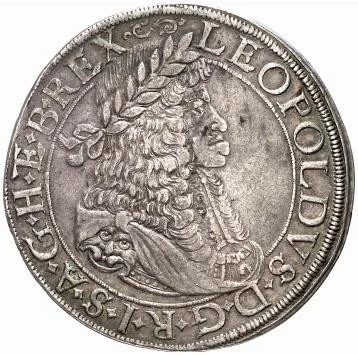
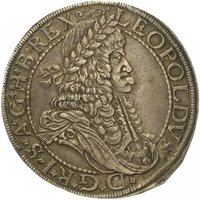
Obverse
Description:
Laureate head right, lion on shoulder, beaded border.
Inscription:
LEOPOLDVS D G R I S A G H ET B REX
Script: Latin
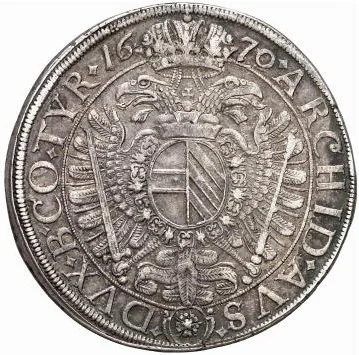
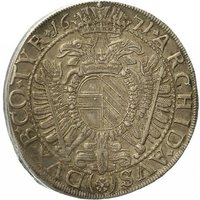
Reverse
Description:
Imperial double-headed eagle with Austrian shield. Date flanking crown; mint mark (flower) in legend below.
Inscription:
ARCHID AVS // DVX B CO TYR
Script: Latin
Edge
Mints
| Name | Mark |
|---|---|
| Münze Österreich | — |
Mintings
| Year | Mint Mark | Mintage | Quality | Collection |
|---|---|---|---|---|
| 1670 | — | — |
Historical background
In 1670, the currency system of the Habsburg Monarchy, often referred to as the Austrian Empire, was a complex and unstable patchwork of various coins and standards, reflecting the diverse and non-integrated nature of its territories. The official currency was based on the silver Reichsthaler, a large coin used for major transactions and state finance. However, everyday commerce was dominated by smaller silver coins like Groschen and Kreuzers, and a proliferation of copper Kreuzers known as Kipper- und Wipperzeit coinage, a legacy of the inflationary debasement crisis that had plagued Central Europe earlier in the century.
This period was one of fragile stabilization under Emperor Leopold I, following the severe financial and monetary chaos of the Thirty Years' War. The government in Vienna struggled to impose order, but the circulation was flooded with debased coins from both imperial and provincial mints, as well as foreign currencies like Dutch leeuwendaalders and Ottoman akçe, particularly in the Hungarian frontier regions. The value and metal content of coins could vary significantly from one region to another, causing confusion, facilitating fraud, and hindering efficient taxation and trade across the empire's domains from Austria to Bohemia.
The situation was further strained by the immense costs of continuous warfare, primarily against the Ottoman Empire (culminating in the 1683 siege of Vienna) and involvement in the Franco-Dutch War. These pressures forced the treasury to repeatedly seek revenue through seigniorage—the profit from minting coins—often at the expense of stable silver content. Consequently, while the worst excesses of debasement were past, the monetary system in 1670 remained fragile, chronically short of high-quality specie, and a significant obstacle to the centralizing and modernizing ambitions of the Habsburg state.
This period was one of fragile stabilization under Emperor Leopold I, following the severe financial and monetary chaos of the Thirty Years' War. The government in Vienna struggled to impose order, but the circulation was flooded with debased coins from both imperial and provincial mints, as well as foreign currencies like Dutch leeuwendaalders and Ottoman akçe, particularly in the Hungarian frontier regions. The value and metal content of coins could vary significantly from one region to another, causing confusion, facilitating fraud, and hindering efficient taxation and trade across the empire's domains from Austria to Bohemia.
The situation was further strained by the immense costs of continuous warfare, primarily against the Ottoman Empire (culminating in the 1683 siege of Vienna) and involvement in the Franco-Dutch War. These pressures forced the treasury to repeatedly seek revenue through seigniorage—the profit from minting coins—often at the expense of stable silver content. Consequently, while the worst excesses of debasement were past, the monetary system in 1670 remained fragile, chronically short of high-quality specie, and a significant obstacle to the centralizing and modernizing ambitions of the Habsburg state.
✨ Legendary