

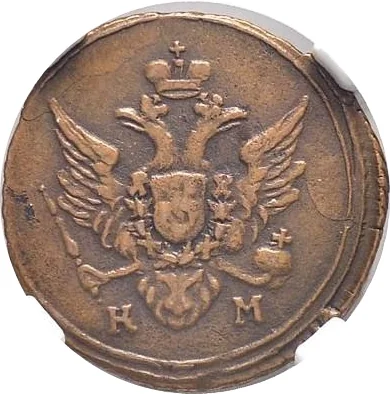
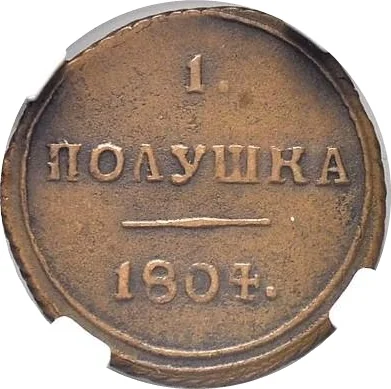
1 polushka – Russian Empire
Add to wishlist
Russia
Context
Years: 1803–1807
Country: Russia
Issuer: Russian Empire
Ruler: Alexander I
Currency:
(1700—1917)
Demonetized: Yes
Material
References
Numista: #100191
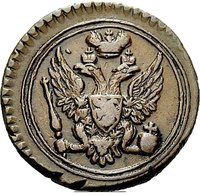
Obverse
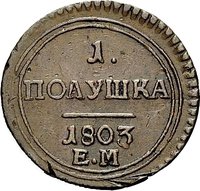
Reverse
Edge
Diagonal reeding
Mintings
| Year | Mint Mark | Mintage | Quality | Collection |
|---|---|---|---|---|
| 1803 | КМ | — | ||
| 1804 | КМ | — | ||
| 1805 | КМ | — | ||
| 1807 | КМ | — |
Historical background
In 1803, the currency system of the Russian Empire was a complex and challenging legacy of the 18th century, primarily based on the silver ruble. However, the reality was a bimetallic system in disarray. The state minted silver rubles and smaller denominations, as well as gold coins (like the chervonets) and heavy copper pyataks (5 kopeks), but the values between these metals often fluctuated. Crucially, there was a severe shortage of precious metal coinage in daily circulation, a problem exacerbated by the vast size of the empire and persistent budget deficits from military campaigns.
To address the chronic lack of circulating specie, the state heavily relied on the mass production of assignats (assignatsii), paper banknotes first introduced by Catherine the Great in 1769. By 1803, these notes existed in parallel with metal coins but were not fully convertible, leading to a fluctuating and usually depreciated market value. While the official rate was 1 paper ruble = 1 silver ruble, in reality, the assignat traded at a significant discount, effectively creating a dual-currency economy where prices were often quoted differently in silver and paper.
The situation in 1803 fell within the relatively stable early reign of Alexander I, who inherited this problematic system. His government, under the influence of advisors like Count Vasiliev, was aware of the need for monetary reform to stabilize the currency and restore public credit. However, the immediate priority was managing the debt from previous wars, and the looming conflict with Napoleonic France (the War of the Third Coalition would begin in 1805) would soon impose new financial strains. Thus, while the structural weaknesses of the currency were well understood, comprehensive reform was postponed, leaving the empire to function on an unstable foundation of depreciating paper and scarce silver.
To address the chronic lack of circulating specie, the state heavily relied on the mass production of assignats (assignatsii), paper banknotes first introduced by Catherine the Great in 1769. By 1803, these notes existed in parallel with metal coins but were not fully convertible, leading to a fluctuating and usually depreciated market value. While the official rate was 1 paper ruble = 1 silver ruble, in reality, the assignat traded at a significant discount, effectively creating a dual-currency economy where prices were often quoted differently in silver and paper.
The situation in 1803 fell within the relatively stable early reign of Alexander I, who inherited this problematic system. His government, under the influence of advisors like Count Vasiliev, was aware of the need for monetary reform to stabilize the currency and restore public credit. However, the immediate priority was managing the debt from previous wars, and the looming conflict with Napoleonic France (the War of the Third Coalition would begin in 1805) would soon impose new financial strains. Thus, while the structural weaknesses of the currency were well understood, comprehensive reform was postponed, leaving the empire to function on an unstable foundation of depreciating paper and scarce silver.
✨ Legendary