

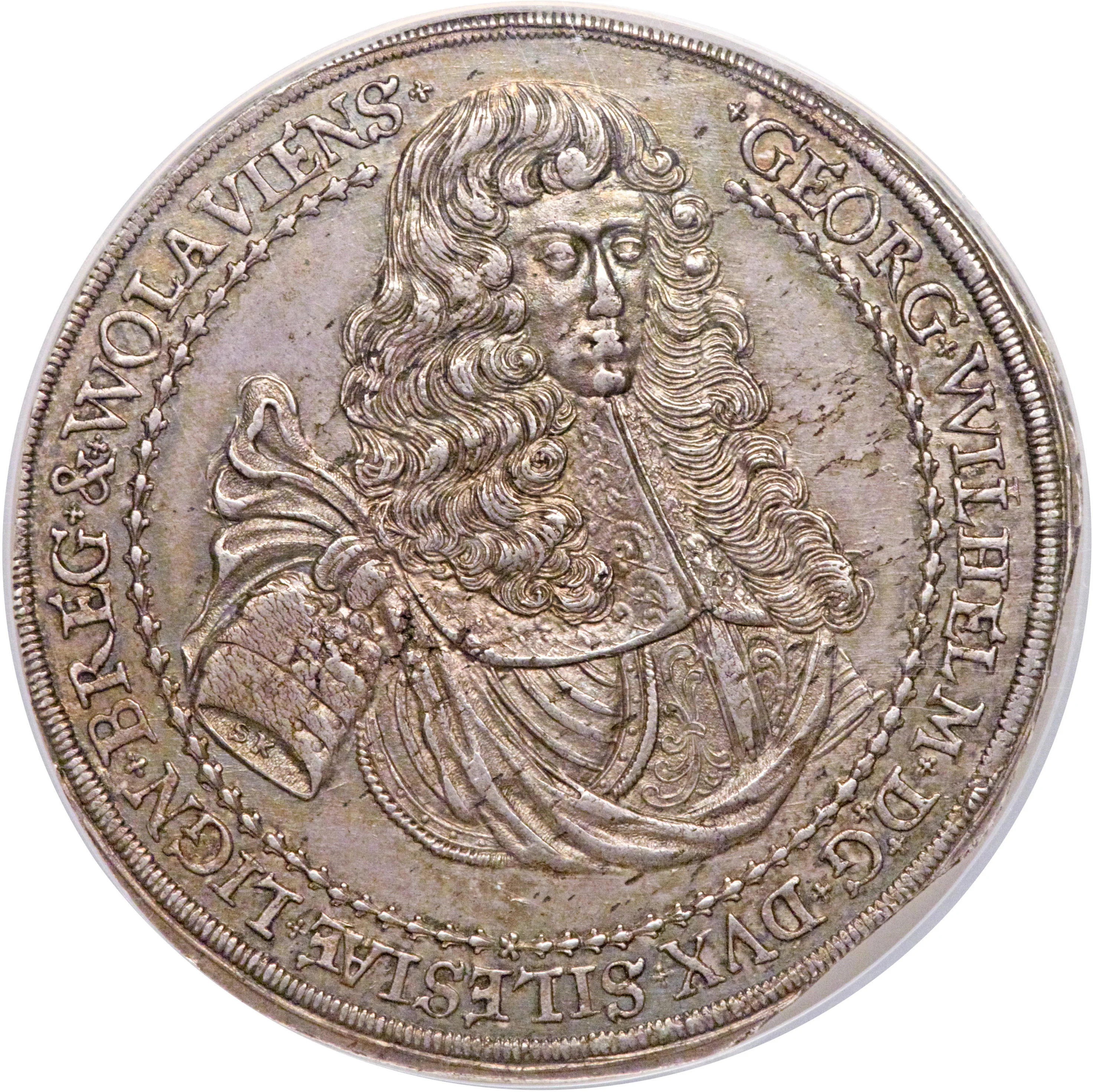
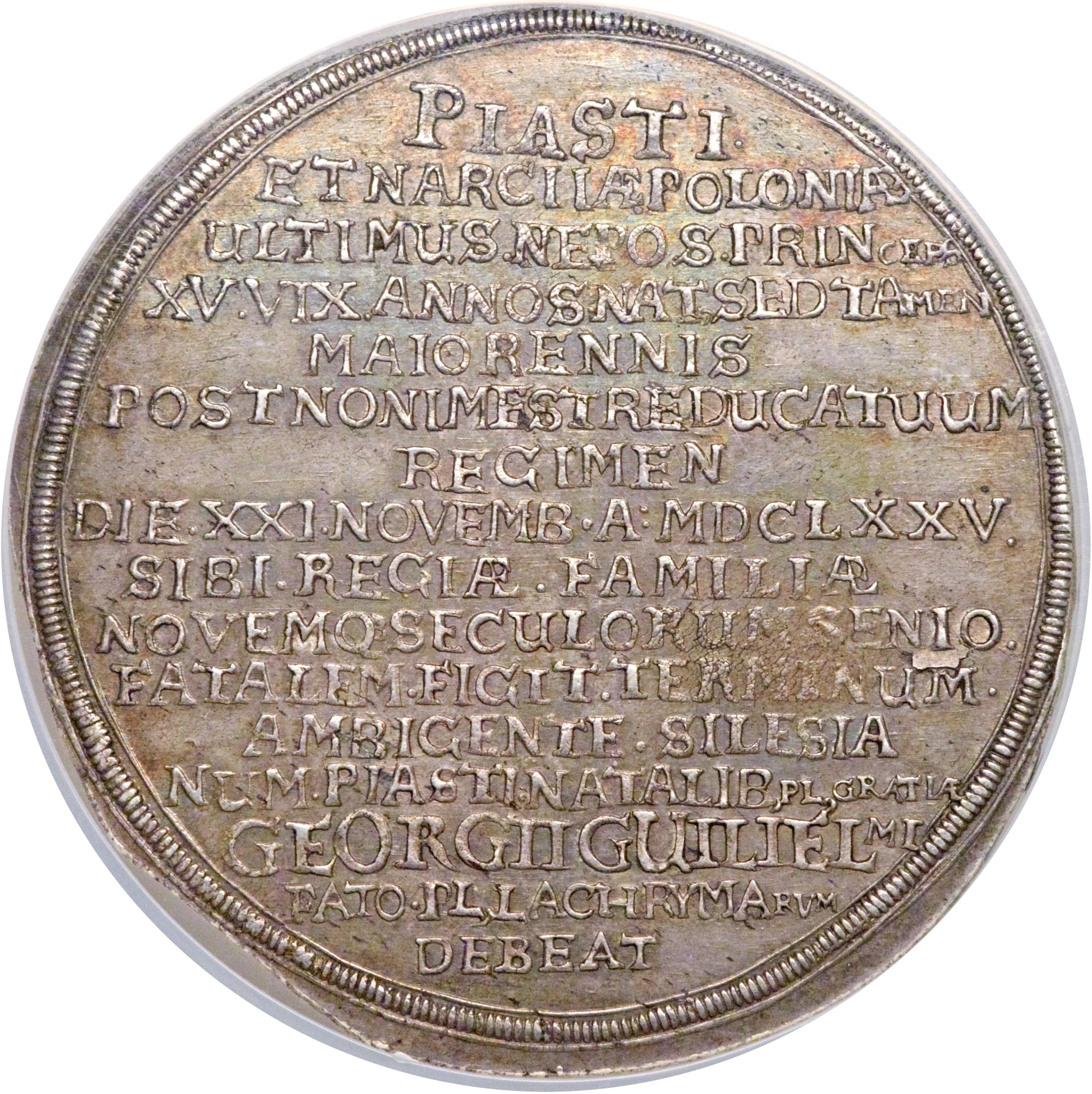
1¼ Thaler – Duchy of Liegnitz-Brieg
Circulating commemorative coins
Commemoration: Death of Georg Wilhelm
Context
Year: 1675
Country: Bohemia
Issuer: Duchy of Liegnitz-Brieg
Ruler: George William
Currency:
Demonetized: Yes
References
KM: #Click to copy to clipboard536
Numista: #92240
Value
Bullion value: $94.40
Obverse
Inscription:
·GEORG·WILHELM·D:G·DVX·SILESIAE·LIGN·BREG·&·WOLAVIENS·
Script: Latin
Reverse
Description:
Sixteen-line inscription.
Inscription:
PIASTI
ET NARCIIÆ POLONIÆ
ULTIMUS . NEPOS . PRINCEPS
XV . VIX . ANNOS . NAT SED TAMEN
MAIORENNIS
POST NONIMESTRE DUCATUUM
REGIMEN
DIE. XXI . NOVEMB . A : MDCLXXV
SIBI . REGIÆ . FAMILIÆ
NOVEMQ SECULORUM SENIO
FATALEM . FIGIT . TERMINUM
AMBIGENTE . SILESIA
NUM . PIASTI . NATA LIB, PL, GRATIÆ
GEORGII GUILIELMI
FATO . PL, LACHRYMARVM
DEBEAT
ET NARCIIÆ POLONIÆ
ULTIMUS . NEPOS . PRINCEPS
XV . VIX . ANNOS . NAT SED TAMEN
MAIORENNIS
POST NONIMESTRE DUCATUUM
REGIMEN
DIE. XXI . NOVEMB . A : MDCLXXV
SIBI . REGIÆ . FAMILIÆ
NOVEMQ SECULORUM SENIO
FATALEM . FIGIT . TERMINUM
AMBIGENTE . SILESIA
NUM . PIASTI . NATA LIB, PL, GRATIÆ
GEORGII GUILIELMI
FATO . PL, LACHRYMARVM
DEBEAT
Script: Latin
Edge
Mintings
| Year | Mint Mark | Mintage | Quality | Collection |
|---|---|---|---|---|
| 1675 | — | — |
Historical background
In 1675, the Duchy of Liegnitz-Brieg, a Silesian principality under the Bohemian Crown, faced a complex and deteriorating currency situation deeply intertwined with its political fate. The death of the last Piast duke, George William, in November 1675, triggered the immediate reversion of the duchy to the Habsburg Emperor Leopold I. This political uncertainty and the subsequent Habsburg administrative takeover created a vacuum in monetary authority, exacerbating existing economic instability. The region's coinage was part of the broader Silesian monetary system, which was persistently troubled by the influx of debased coinage from neighboring states, particularly the Polish-Lithuanian Commonwealth.
The circulating medium was a chaotic mix. Imperial thalers, Silesian regional issues, and a flood of inferior Polish coins like grossi and schillings competed for acceptance, leading to significant problems with valuation and trust. This "bad money" drove out the good, as Gresham's Law took hold, causing hoarding of full-weight silver coins and further distorting local trade. The Habsburg authorities, now in control, inherited this disordered system and viewed it as a source of potential revenue and a problem to be rationalized according to imperial interests, rather than those of the defunct duchy.
Consequently, the currency situation in 1675 was one of transition and uncertainty, marked more by the consequences of political annexation than by stable monetary policy. The immediate focus for the new Habsburg administration was the sequestration of the late duke's assets and the integration of the territory, with comprehensive monetary reform for Silesia as a whole coming later. Thus, for the merchants and subjects of the former duchy, the year ended with the tangible problems of a debased and unreliable coinage, now compounded by the unpredictable fiscal policies of a distant, centralized imperial power.
The circulating medium was a chaotic mix. Imperial thalers, Silesian regional issues, and a flood of inferior Polish coins like grossi and schillings competed for acceptance, leading to significant problems with valuation and trust. This "bad money" drove out the good, as Gresham's Law took hold, causing hoarding of full-weight silver coins and further distorting local trade. The Habsburg authorities, now in control, inherited this disordered system and viewed it as a source of potential revenue and a problem to be rationalized according to imperial interests, rather than those of the defunct duchy.
Consequently, the currency situation in 1675 was one of transition and uncertainty, marked more by the consequences of political annexation than by stable monetary policy. The immediate focus for the new Habsburg administration was the sequestration of the late duke's assets and the integration of the territory, with comprehensive monetary reform for Silesia as a whole coming later. Thus, for the merchants and subjects of the former duchy, the year ended with the tangible problems of a debased and unreliable coinage, now compounded by the unpredictable fiscal policies of a distant, centralized imperial power.
✨ Legendary