

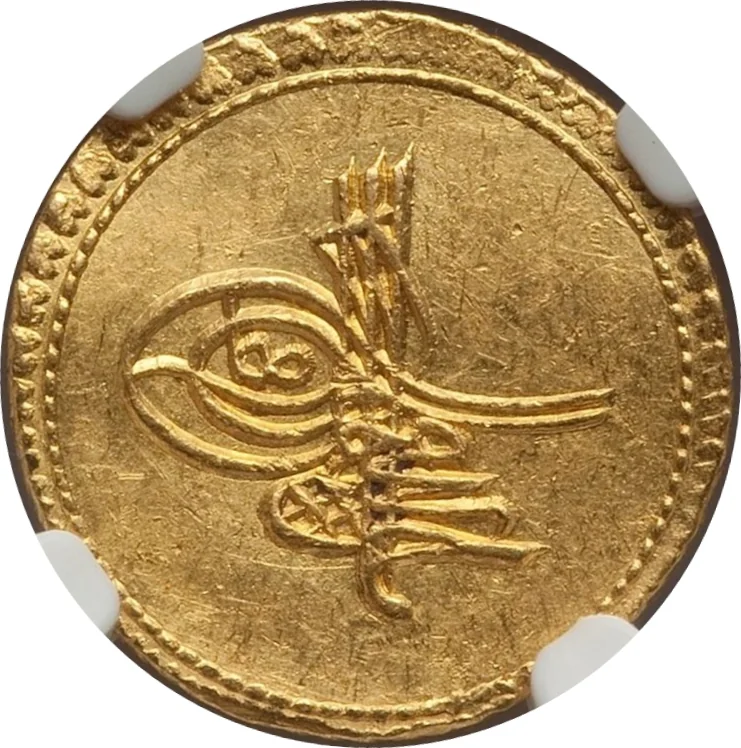
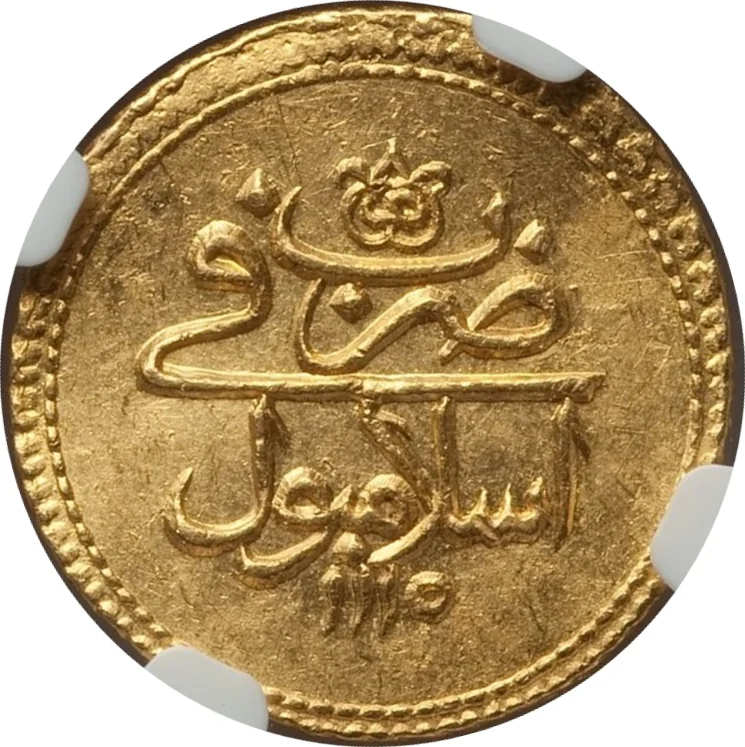
1 Findik – Ottoman Empire
Turkey
Context
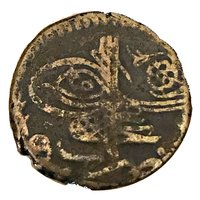
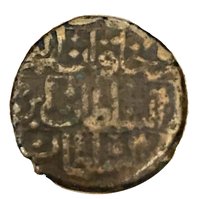
Years: 1703–1730
Country: Turkey 
Issuer: Ottoman Empire
Issuing organization: State Treasury
Ruler: Ahmed III
Currency:
(1688—1844)
Demonetized: Yes
Material
References
KM: #Click to copy to clipboard173
Numista: #89310
Value
Bullion value: $582.12
Mints
| Name | Mark |
|---|---|
| Constantinople | — |
Mintings
| Year | Mint Mark | Mintage | Quality | Collection |
|---|---|---|---|---|
| — | — | — | ||
| — | حر | — |
Historical background
In 1703, the Ottoman Empire’s currency system was in a state of profound crisis, a direct result of decades of fiscal mismanagement and external pressures. The primary silver coin, the akçe, had been drastically debased over the 17th century, losing both its silver content and public trust. To finance prolonged wars against the Habsburgs and Russia, as well as extravagant court expenditures, the state repeatedly resorted to clipping coin weights and altering metal alloys. This created a chaotic monetary environment with multiple coins of uncertain value in circulation, severely disrupting trade and tax collection.
The situation was exacerbated by the influx of high-quality European silver coins, particularly the Spanish real and Dutch lion dollar, which circulated more freely in Mediterranean trade than the debased Ottoman issues. This "good money" was often hoarded or exported, while "bad money" flooded the markets, in line with Gresham’s Law. The imperial treasury, struggling with chronic deficits, found its revenue—collected in devalued currency—increasingly inadequate to meet its obligations, which were often fixed in theoretical accounting units like the kuruş (piastre).
This monetary instability contributed directly to the Edirne Event of 1703, a major janissary and popular uprising in Istanbul. The rebellion was fueled not only by political discontent but also by the economic hardship caused by inflation and currency chaos. The deposition of Sultan Mustafa II that year was, in part, a consequence of this financial breakdown, highlighting how currency debasement could directly threaten the stability of the Ottoman throne and state.
The situation was exacerbated by the influx of high-quality European silver coins, particularly the Spanish real and Dutch lion dollar, which circulated more freely in Mediterranean trade than the debased Ottoman issues. This "good money" was often hoarded or exported, while "bad money" flooded the markets, in line with Gresham’s Law. The imperial treasury, struggling with chronic deficits, found its revenue—collected in devalued currency—increasingly inadequate to meet its obligations, which were often fixed in theoretical accounting units like the kuruş (piastre).
This monetary instability contributed directly to the Edirne Event of 1703, a major janissary and popular uprising in Istanbul. The rebellion was fueled not only by political discontent but also by the economic hardship caused by inflation and currency chaos. The deposition of Sultan Mustafa II that year was, in part, a consequence of this financial breakdown, highlighting how currency debasement could directly threaten the stability of the Ottoman throne and state.
✨ Legendary