

1 skilling – Denmark
Add to wishlist
Denmark
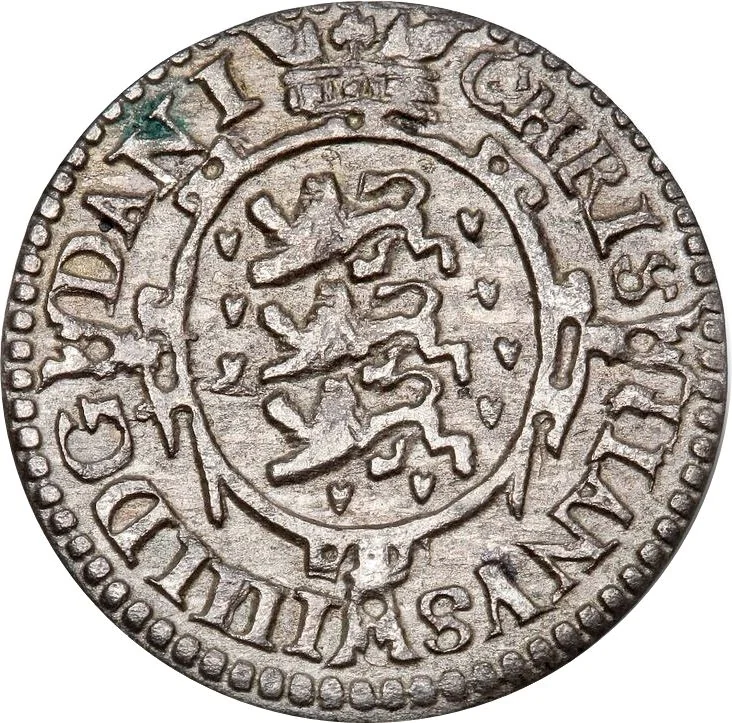
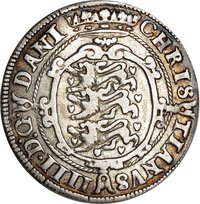
Obverse
Description:
Large crowned oval shield bearing the Danish coat of arms over a forked cross, with the legend divided by the cross arms.
Inscription:
CHRIS | TIANVS | IIII · D:G | DANI
Script: Latin
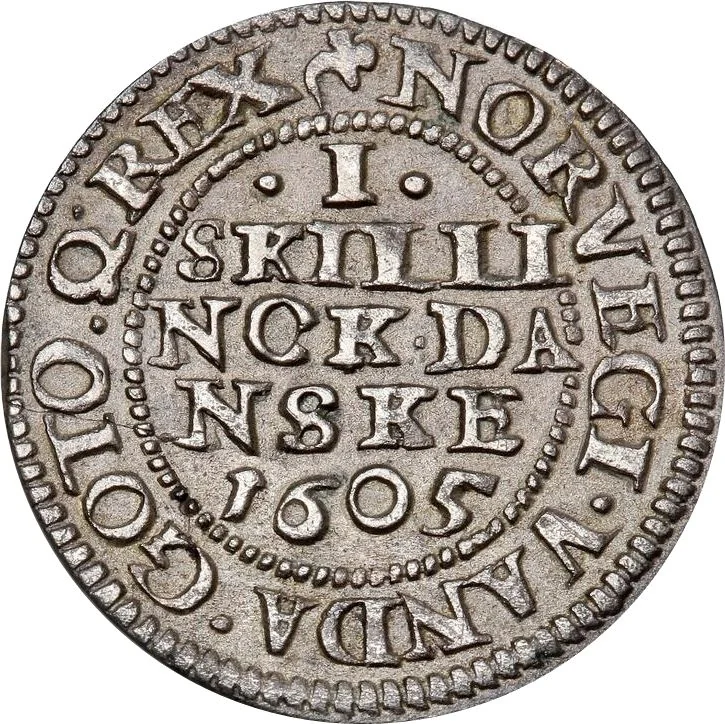
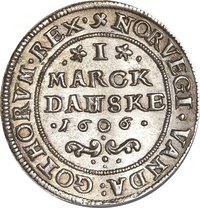
Reverse
Description:
Value in letters above date within pearled circle; legend around rim.
Inscription:
*I*
SKILLI
NCK.DA
NSKE
1605
...................................................
NORVEGI:VANDA:GOTO:Q:REX:
SKILLI
NCK.DA
NSKE
1605
...................................................
NORVEGI:VANDA:GOTO:Q:REX:
Script: Latin
Edge
Mints
| Name | Mark |
|---|---|
| Copenhagen | ☘ |
Historical background
In 1605, Denmark was operating under a complex and often chaotic monetary system, a legacy of the Kalmar Union and the economic strains of the 16th century. The official currency was based on the rigsdaler (rix-dollar), a large silver coin that served as the primary unit of account for large transactions and state finance. However, the actual circulating medium was a bewildering array of both domestic and foreign coins, including skilling and mark denominations, as well as German, Dutch, and Baltic coins that entered through trade. The system was not decimalized; 1 rigsdaler was equal to 6 mark, and 1 mark was equal to 16 skilling, making everyday calculations cumbersome.
This period was marked by significant currency instability and debasement. King Christian IV, who reigned from 1588 to 1648, was engaged in costly projects, including wars and grand building programs like the construction of Rosenborg Castle and the founding of Christiania (now Oslo). To finance these ambitions, the state frequently reduced the silver content in coins while maintaining their face value, a practice known as debasement. This led to inflation, a loss of public trust in the coinage, and the phenomenon of "good" older coins being hoarded or melted down while "bad" new coins circulated, a classic example of Gresham's Law.
Consequently, trade and daily commerce in 1605 were hampered by uncertainty. Merchants and farmers had to constantly evaluate and negotiate the worth of individual coins based on their weight, wear, and origin, not just their stamped value. This monetary confusion created a drag on the economy and was a point of contention within the realm. While efforts at reform were discussed, a stable and unified national currency system would not be fully realized for many decades, making 1605 a year typical of the period's challenging financial conditions.
This period was marked by significant currency instability and debasement. King Christian IV, who reigned from 1588 to 1648, was engaged in costly projects, including wars and grand building programs like the construction of Rosenborg Castle and the founding of Christiania (now Oslo). To finance these ambitions, the state frequently reduced the silver content in coins while maintaining their face value, a practice known as debasement. This led to inflation, a loss of public trust in the coinage, and the phenomenon of "good" older coins being hoarded or melted down while "bad" new coins circulated, a classic example of Gresham's Law.
Consequently, trade and daily commerce in 1605 were hampered by uncertainty. Merchants and farmers had to constantly evaluate and negotiate the worth of individual coins based on their weight, wear, and origin, not just their stamped value. This monetary confusion created a drag on the economy and was a point of contention within the realm. While efforts at reform were discussed, a stable and unified national currency system would not be fully realized for many decades, making 1605 a year typical of the period's challenging financial conditions.
💎 Extremely Rare