

1 Royalin – Danish India
India
Context
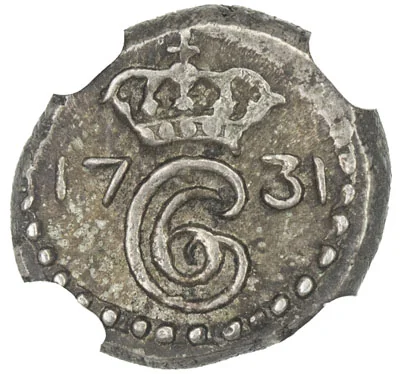
Year: 1731
Country: India 
Issuer: Danish India
Ruler: Christian VI
Currency:
(1730—1818)
Demonetized: Yes
Material
References
KM: #Click to copy to clipboard140
Numista: #119834
Obverse
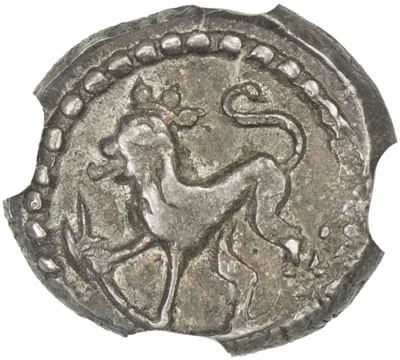
Reverse
Description:
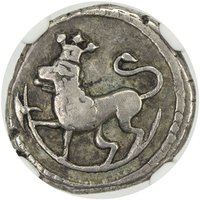
Crowned Norse lion left of battle axe.
Edge
Mintings
| Year | Mint Mark | Mintage | Quality | Collection |
|---|---|---|---|---|
| 1731 | — | — |
Historical background
In 1731, the currency situation in Danish India, centered on the trading outpost of Tranquebar (Tharangambadi) and the larger settlement of Serampore (Frederiksnagore) acquired later, was complex and fundamentally shaped by its role within regional trade networks. The Danish Asiatic Company, operating with limited capital and influence compared to its powerful British and Dutch rivals, did not impose a dominant, unified monetary system. Instead, the local economy functioned on a practical bimetallic standard heavily reliant on a proliferation of foreign silver coins, particularly Spanish Pillar Dollars (8 Reales) and Mexican Dollars, which served as the de facto major trade currency across the Indian Ocean.
The official Danish currency, the Danish Indian Rupee (or Rigsdaler), was minted at the Tranquebar mint but existed alongside a multitude of circulating coins. These included not only Spanish and Mexican silver but also coins from the Mughal Empire, the British East India Company, the Dutch VOC, and various South Indian regional kingdoms. This created a constant need for assayers and money-changers, as transactions required evaluating the weight, purity, and prevailing exchange rates of each coin type. The value of the Danish Indian Rupee itself was pegged to the larger and more prevalent French Indian Rupee (the Fanam system), a testament to Danish India's minor economic position and its pragmatic integration into the existing French-influenced monetary landscape of the Coromandel Coast.
This monetary pluralism, while flexible for commerce, posed significant challenges for administration and local trade, leading to frequent complaints about confusion and fraud. The Danish authorities issued periodic ordinances to fix exchange rates between the various silver coins and the smaller copper Kasu used for everyday transactions, but these were difficult to enforce. Thus, in 1731, the currency situation was one of managed chaos—a hybrid system where official Danish coinage played a secondary role to the inflow of internationally recognized silver dollars, all governed by a fragile web of official rates that sought to bring order to a inherently diverse and market-driven monetary environment.
The official Danish currency, the Danish Indian Rupee (or Rigsdaler), was minted at the Tranquebar mint but existed alongside a multitude of circulating coins. These included not only Spanish and Mexican silver but also coins from the Mughal Empire, the British East India Company, the Dutch VOC, and various South Indian regional kingdoms. This created a constant need for assayers and money-changers, as transactions required evaluating the weight, purity, and prevailing exchange rates of each coin type. The value of the Danish Indian Rupee itself was pegged to the larger and more prevalent French Indian Rupee (the Fanam system), a testament to Danish India's minor economic position and its pragmatic integration into the existing French-influenced monetary landscape of the Coromandel Coast.
This monetary pluralism, while flexible for commerce, posed significant challenges for administration and local trade, leading to frequent complaints about confusion and fraud. The Danish authorities issued periodic ordinances to fix exchange rates between the various silver coins and the smaller copper Kasu used for everyday transactions, but these were difficult to enforce. Thus, in 1731, the currency situation was one of managed chaos—a hybrid system where official Danish coinage played a secondary role to the inflow of internationally recognized silver dollars, all governed by a fragile web of official rates that sought to bring order to a inherently diverse and market-driven monetary environment.

✨ Legendary