

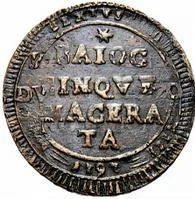
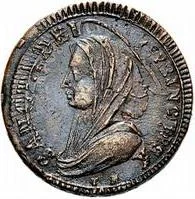
5 Baiocchi – Macerata
Italy
Obverse
Description:
Town in circle, value inside, date below.
Inscription:
PIVS PAPA SEXTVS ANNO XXIII
1797
1797
Script: Latin
Reverse
Edge
Categories
| Person> Religious figure |
Mints
| Name | Mark |
|---|---|
| Macerata | — |
Mintings
| Year | Mint Mark | Mintage | Quality | Collection |
|---|---|---|---|---|
| 1797 | — | — | ||
| 1798 | — | — |
Historical background
In 1797, the city of Macerata, then part of the Papal States, found itself in a state of profound monetary and political chaos. This was a direct consequence of the French Revolutionary Wars, as Napoleon Bonaparte's armies had swept through northern Italy the previous year, defeating Papal forces. The Treaty of Tolentino, imposed by France in February 1797, was crippling: it demanded a massive war indemnity of 21 million scudi from the Pope and the seizure of countless artworks and treasures. To meet these exorbitant demands, local authorities across the Marche, including in Macerata, were forced to confiscate gold, silver, and church assets, drastically draining the region's hard currency reserves.
This extraction of precious metals led to a severe shortage of official coinage, creating a vacuum filled by a flood of low-quality, emergency money. The most prevalent and problematic of these were the mandati, or papal treasury bonds, which were initially intended as credit notes but began to circulate as forced currency. Their value plummeted rapidly due to over-issuance and a complete lack of public confidence. Simultaneously, the French military administration introduced their own occupation currency, the franco, further complicating the monetary landscape and symbolizing the loss of Papal sovereignty.
Consequently, Macerata's economy in 1797 operated amidst a confusing multiplicity of devaluing currencies—official Papal coins became scarce, mandati were distrusted and worth fractions of their face value, and French notes were resented. This monetary instability exacerbated social hardship, disrupted trade, and fueled inflation, as prices soared in response to the worthless paper. The currency situation thus mirrored the broader reality: a city in transition, its traditional economic structures shattered by war, extraction, and the impending end of centuries of direct Papal rule.
This extraction of precious metals led to a severe shortage of official coinage, creating a vacuum filled by a flood of low-quality, emergency money. The most prevalent and problematic of these were the mandati, or papal treasury bonds, which were initially intended as credit notes but began to circulate as forced currency. Their value plummeted rapidly due to over-issuance and a complete lack of public confidence. Simultaneously, the French military administration introduced their own occupation currency, the franco, further complicating the monetary landscape and symbolizing the loss of Papal sovereignty.
Consequently, Macerata's economy in 1797 operated amidst a confusing multiplicity of devaluing currencies—official Papal coins became scarce, mandati were distrusted and worth fractions of their face value, and French notes were resented. This monetary instability exacerbated social hardship, disrupted trade, and fueled inflation, as prices soared in response to the worthless paper. The currency situation thus mirrored the broader reality: a city in transition, its traditional economic structures shattered by war, extraction, and the impending end of centuries of direct Papal rule.
✨ Legendary