

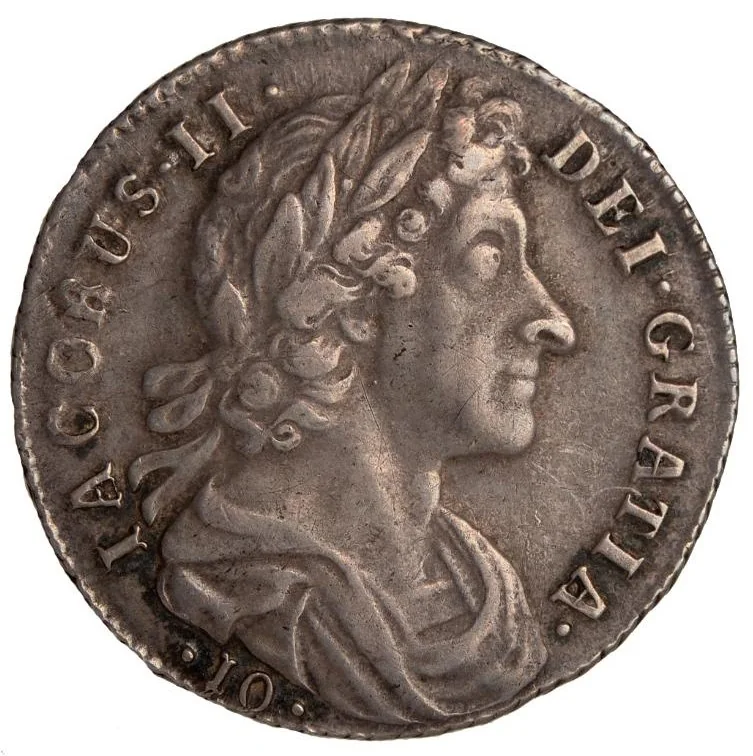
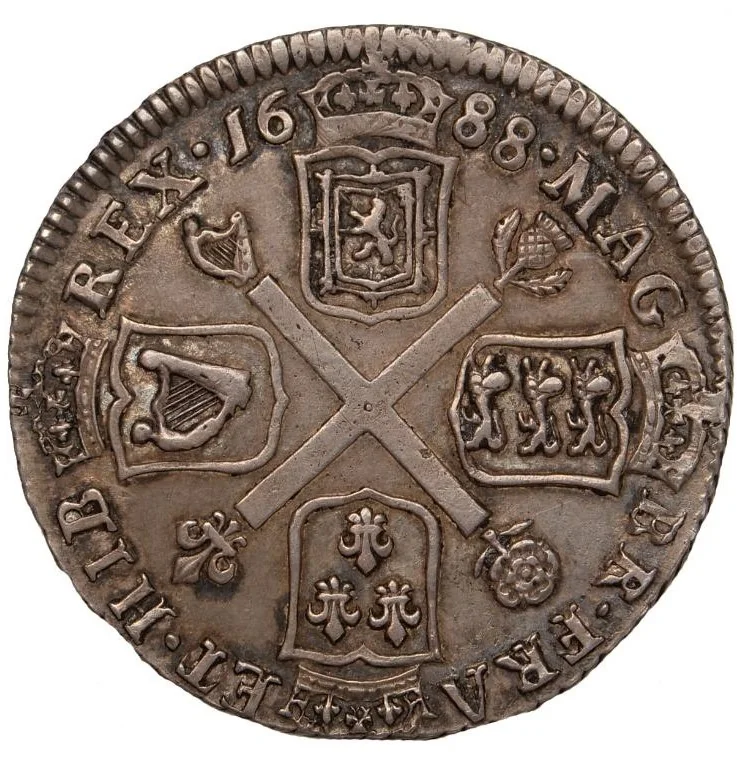
10 Shillings – Scotland
United Kingdom
Context
Years: 1687–1688
Country: United Kingdom 
Issuer: Scotland 
Ruler: James VII
Currency:
(1136—1707)
Demonetized: Yes
Material
References
KM: #Click to copy to clipboard121
Numista: #88220
Value
Bullion value: $17.24
Obverse
Description:
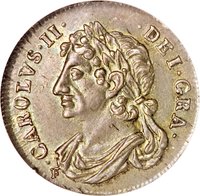
Bust of James VII, right profile.
Inscription:
JACOBUS · II · DEI · GRATIA ·
Script: Latin
Reverse
Description:
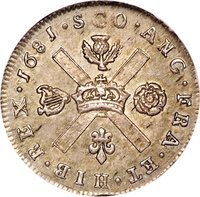
A cross of the arms of Scotland, England, France, and Ireland.
Inscription:
· MAG · BR · FRA · ET · HIB · REX · 1688
Script: Latin
Edge
Mints
| Name | Mark |
|---|---|
| Edinburgh | — |
Mintings
| Year | Mint Mark | Mintage | Quality | Collection |
|---|---|---|---|---|
| 1687 | — | — | ||
| 1688 | — | — |
Historical background
In 1687, Scotland existed as a separate kingdom from England, united only by the shared monarchy of James VII (James II of England). As such, it maintained its own distinct and often troubled monetary system. The official currency was the Scottish pound (£ Scots), but its value had been artificially pegged for centuries at a rate of 12:1 against the much stronger English pound sterling. This reflected Scotland's weaker economy and chronic trade deficits, which led to a persistent shortage of specie (gold and silver coin) in circulation.
The physical coinage in use was a chaotic mixture. While the Scottish mint produced some coins, like the merk (worth 13 shillings and 4 pence Scots), the money supply was dominated by a bewildering array of foreign coins—primarily Spanish pieces of eight, Dutch guilders, and French écus—brought in by trade. These circulated alongside older, often clipped or debased Scottish issues. The government's attempts to assign these foreign coins a legal value in £ Scots frequently failed to match their market value based on metal content, leading to confusion, arbitrage, and economic instability.
This monetary disorder was a significant symptom of Scotland's broader economic struggles and a key motivator for the political elite who would, just over a decade later, support the Treaty of Union in 1707. The promise of adopting England's stable and prestigious sterling, along with access to its growing colonial trade, was a powerful argument for dissolution of the Scottish Parliament. Thus, the currency situation of 1687 was not merely a financial nuisance but a foundational pressure point leading toward the end of Scotland's independent statehood.
The physical coinage in use was a chaotic mixture. While the Scottish mint produced some coins, like the merk (worth 13 shillings and 4 pence Scots), the money supply was dominated by a bewildering array of foreign coins—primarily Spanish pieces of eight, Dutch guilders, and French écus—brought in by trade. These circulated alongside older, often clipped or debased Scottish issues. The government's attempts to assign these foreign coins a legal value in £ Scots frequently failed to match their market value based on metal content, leading to confusion, arbitrage, and economic instability.
This monetary disorder was a significant symptom of Scotland's broader economic struggles and a key motivator for the political elite who would, just over a decade later, support the Treaty of Union in 1707. The promise of adopting England's stable and prestigious sterling, along with access to its growing colonial trade, was a powerful argument for dissolution of the Scottish Parliament. Thus, the currency situation of 1687 was not merely a financial nuisance but a foundational pressure point leading toward the end of Scotland's independent statehood.
✨ Legendary