Logo Title
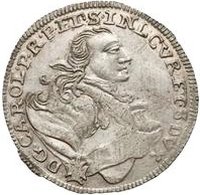
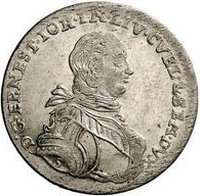
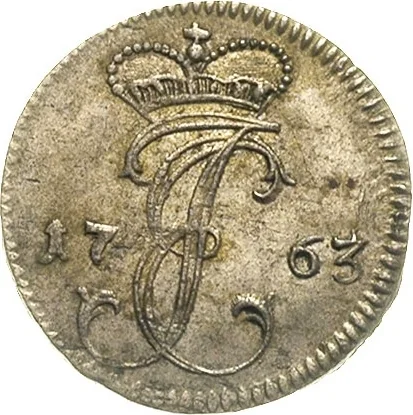
obverse
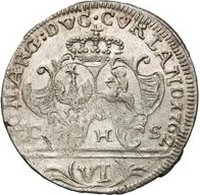
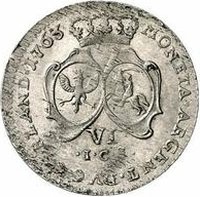
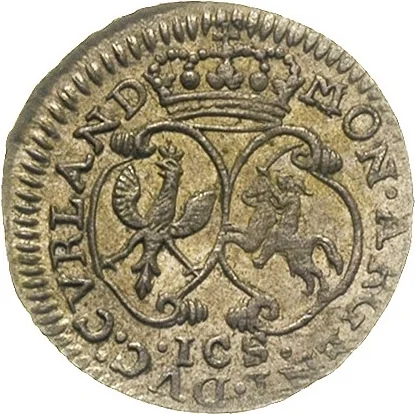
reverse
Warszawskie Centrum Numizmatyczne s.j.

1 Grossus – Duchy of Courland and Semigallia

Context
Years: 1763–1764
Country: Livonia
Currency:
(1586—1795)
Subdivision: 1 Grossus = 1⁄36 Thaler
Demonetized: Yes
Material
Diameter: 18 mm
Weight: 0.96 g
Silver weight: 0.96 g
Shape: Round
Composition: Silver
Magnetic: No
Technique: Milled
References
KM: #Click to copy to clipboard24
Numista: #87866
Value
Bullion value: $2.75

Obverse

Description:
Dated crowned monogram.
Inscription:
EJ

17 - 63
Script: Latin

Reverse

Description:
Shield with eagle beside shield with horseman under crown, encircled by legend.
Inscription:
MON · ARGENT · DVC : CVRLAND ·ICS·
Script: Latin

Edge

Plain

Categories

Symbols> Coat of Arms

Mints

NameMark
Mitau

Mintings

YearMint MarkMintageQualityCollection
1763·ICS·
1763ICS
1764·ICS·

Historical background

In 1763, the Duchy of Courland and Semigallia existed in a state of political and economic limbo, which directly impacted its currency situation. Formally a vassal of the Polish-Lithuanian Commonwealth, the Duchy had been under effective Russian military occupation since the Seven Years' War. The reigning Duke, Ernst Johann von Biron, had only recently been restored to his throne in 1763 with the backing of Empress Catherine the Great, following years of exile. This political instability and external dominance meant the Duchy had little sovereign control over its monetary policy, which was heavily influenced by the economic interests of its powerful neighbors, particularly Russia.

The circulating currency within the Duchy was not a unified, sovereign Courlandic system but a complex mixture of foreign and older coins. Polish-Lithuanian coins, such as groschens and złotys, circulated widely due to the feudal link. Simultaneously, Russian rubles and kopecks, brought in by troops and trade, held significant weight. Furthermore, older Swedish coins from previous periods of domination and even Prussian thalers from regional trade remained in use. The Duchy itself had limited minting activity; the last significant coinage occurred decades prior under Duke Jacob Kettler (1642-1682), whose "ducats" and "shillings" were still remembered but no longer defined the economy.

Consequently, the monetary situation in 1763 was characterized by fragmentation and uncertainty. The lack of a strong, modern coinage from the Ducal mint hindered local economic sovereignty and complicated trade. Merchants and subjects had to navigate fluctuating exchange rates between the multiple circulating currencies, which were often valued by their precious metal content rather than a stable nominal decree. This chaotic environment reflected the Duchy's precarious position as a small buffer state, whose financial tools were subordinate to the geopolitical currents flowing from St. Petersburg and Warsaw.
💎 Very Rare