

1 liard – Austrian Netherlands
Add to wishlist
Belgium
Context
Years: 1744–1745
Country: Belgium
Issuer: Austrian Netherlands
Ruler: Maria Theresa
Currency:
(1744—1798)
Demonetized: Yes
Total mintage: 12,878,655
References
KM: #
Numista: #8751
Obverse
Description:
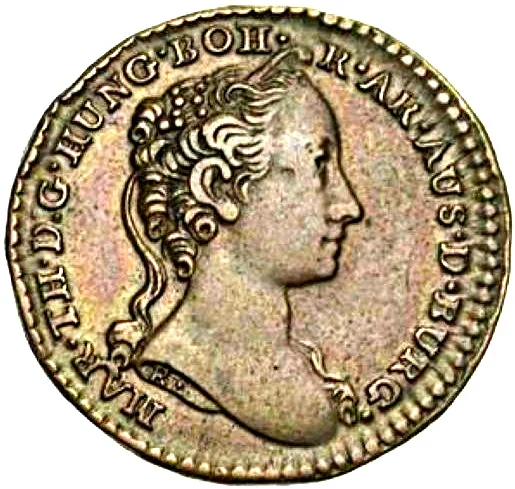
Young portrait of Maria Theresia facing right. Legend reads "Maria Theresia Dei Gratia Hungariae Bohemiae Regina Archidux Austriae Dux Burgundiae". Three variants exist: an "R" at bust base, an "H" below bust, or both "R" and "H".
Inscription:
MAR·TH·D:G·HUNG·BOH·R·AR·AUS·D·BURG
R
R
Script: Latin
Engraver: Jacques Roëttiers
Reverse
Description:
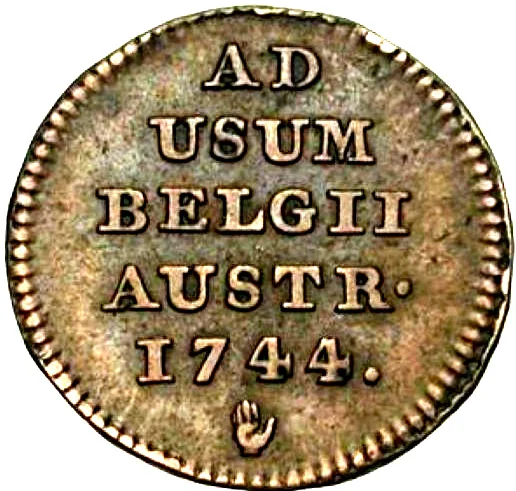
Legend in five lines,
date below,
mint mark underneath.
date below,
mint mark underneath.
Inscription:
AD
USUM
BELGII
AUSTR·
1744·
(mintmark)
USUM
BELGII
AUSTR·
1744·
(mintmark)
Script: Latin
Engraver: Jacques Roëttiers
Edge
Plain
Mints
| Name | Mark |
|---|---|
| Antwerp | — |
| Royal Mint of Belgium | angelface |
| Bruges | lion |
Mintings
Historical background
In 1744, the currency situation in the Austrian Netherlands was one of profound instability and complexity, a direct consequence of the War of the Austrian Succession (1740-1748). The region, a valuable Habsburg possession, had become a primary theatre of military conflict, with French armies occupying much of its territory. This wartime disruption severed normal economic and fiscal links with the central government in Vienna, leading to a severe shortage of official coinage. The Habsburg authorities, financially strained by the wider war, could not effectively supply or regulate the currency in this distant and contested province.
The vacuum was filled by a chaotic influx of foreign coins, particularly French louis d'or and écus, but also Dutch guilders and German talers, all circulating at fluctuating and arbitrary values. This proliferation of disparate currencies, combined with the widespread practice of clipping and debasing coins, led to rampant inflation and crippling uncertainty in daily commerce. Local authorities and cities, attempting to bring order, periodically issued ordinances to fix exchange rates, but these were largely ineffective against market forces and the sheer volume of foreign specie introduced by occupying armies.
Ultimately, the monetary chaos of 1744 was a symptom of the political and military crisis facing the Habsburg Monarchy. The loss of sovereign control over the territory directly translated to a loss of control over its monetary system. The situation would only begin to stabilise after the war's conclusion with the Treaty of Aix-la-Chapelle in 1748, which restored Austrian authority and allowed for a gradual re-imposition of a standardized monetary system, though the region's economic landscape had been deeply scarred by the conflict.
The vacuum was filled by a chaotic influx of foreign coins, particularly French louis d'or and écus, but also Dutch guilders and German talers, all circulating at fluctuating and arbitrary values. This proliferation of disparate currencies, combined with the widespread practice of clipping and debasing coins, led to rampant inflation and crippling uncertainty in daily commerce. Local authorities and cities, attempting to bring order, periodically issued ordinances to fix exchange rates, but these were largely ineffective against market forces and the sheer volume of foreign specie introduced by occupying armies.
Ultimately, the monetary chaos of 1744 was a symptom of the political and military crisis facing the Habsburg Monarchy. The loss of sovereign control over the territory directly translated to a loss of control over its monetary system. The situation would only begin to stabilise after the war's conclusion with the Treaty of Aix-la-Chapelle in 1748, which restored Austrian authority and allowed for a gradual re-imposition of a standardized monetary system, though the region's economic landscape had been deeply scarred by the conflict.
🌱 Fairly Common