

500 Lire (Virgil) – Italy
Non-circulating coins
Commemoration: 2000th Anniversary of the Death of Virgil
Italy
Context

Material

References
KM: #Click to copy to clipboard110
Numista: #12014
Value
Exchange value: 500 ITL
Bullion value: $26.11
Inflation-adjusted value: 2917.04 ITL
Obverse
Description:
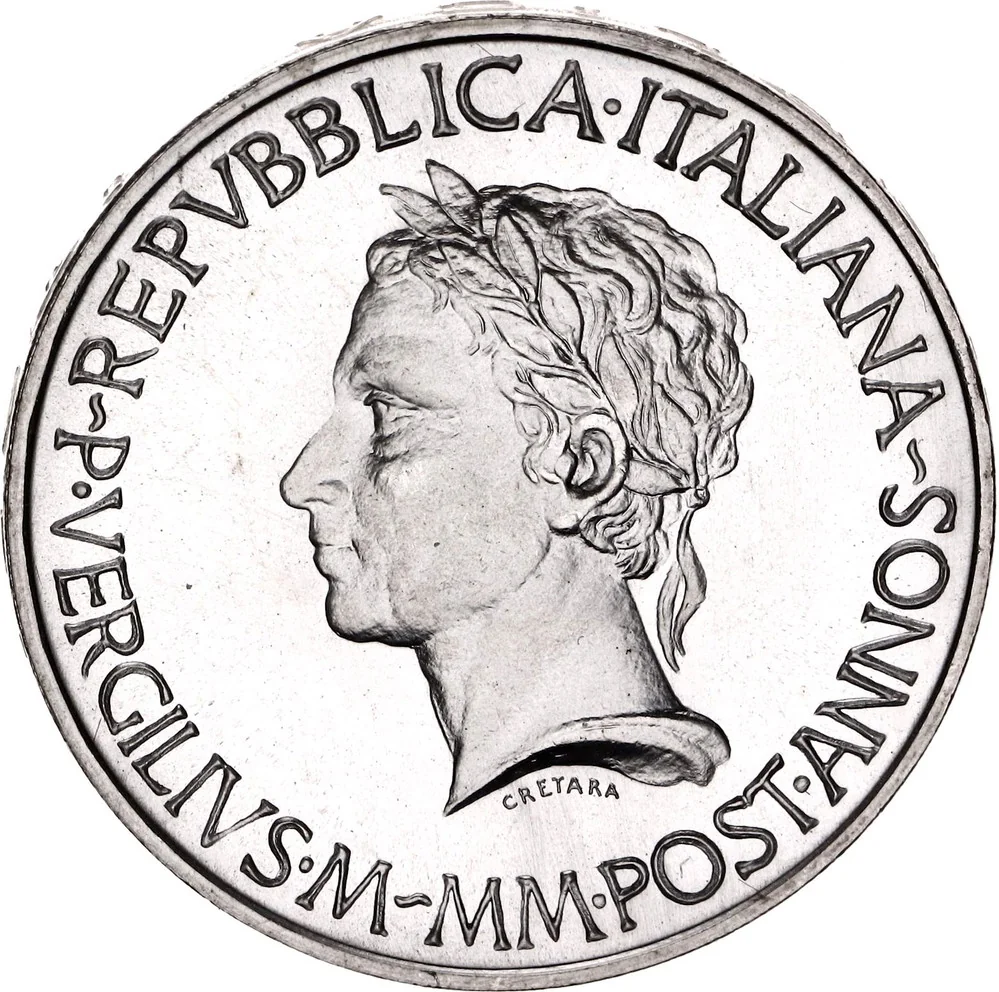
Laureate Virgil facing left, name below.
Inscription:
-REPVBBLICA•ITALIANA-
P•VERGILIVS.M MM.POST.ANNOS
CRETARA
P•VERGILIVS.M MM.POST.ANNOS
CRETARA
Translation:
THE ITALIAN REPUBLIC
PUBLIUS VERGILIUS THREE THOUSAND YEARS AFTER
CRETARA
PUBLIUS VERGILIUS THREE THOUSAND YEARS AFTER
CRETARA
Script: Latin
Language: Latin
Engraver: Laura Cretara
Reverse
Description:
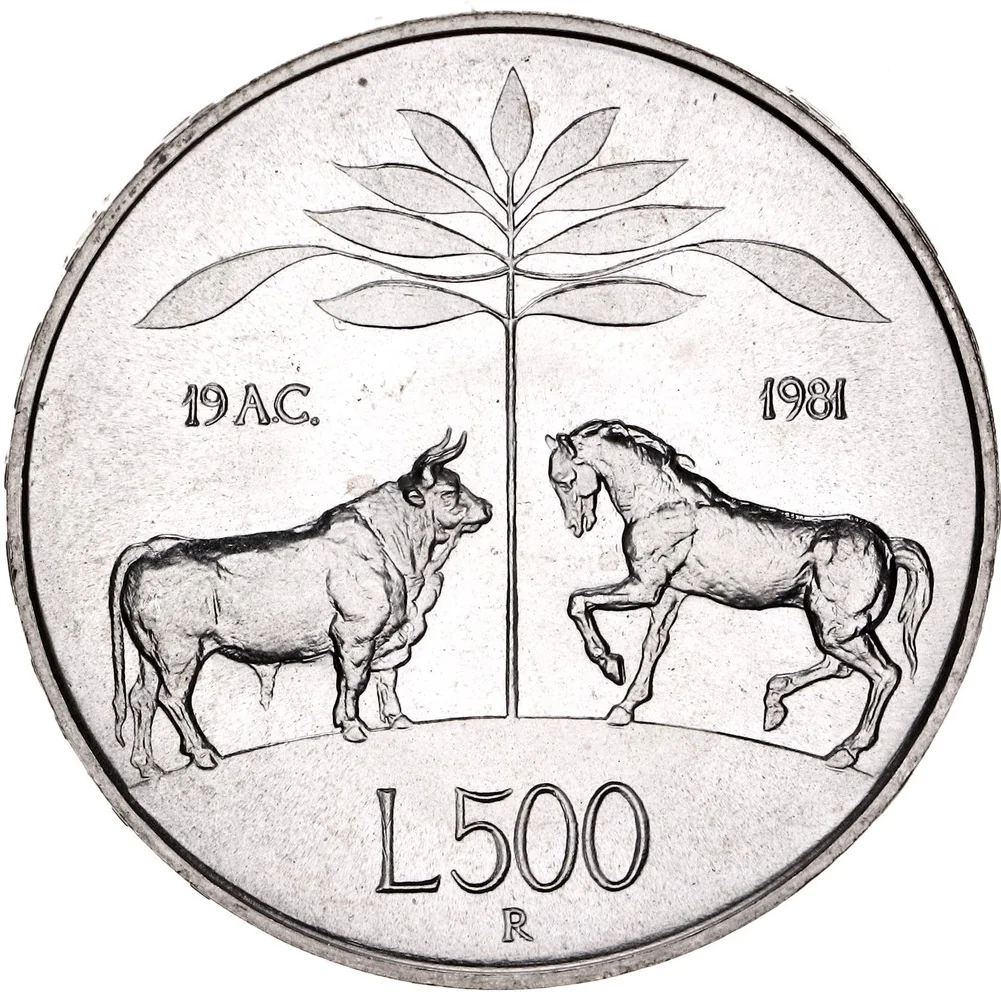
A stylized fertility tree flanked by an ox (work) and a horse (epic poetry). The years 19 A.C. (the poet's death) and 1981 appear at left and right. The exergue contains the value and mintmark.
Inscription:
19 A.C. 1981
L. 500
R
L. 500
R
Translation:
Nineteen hundred and eighty-one
Five hundred Lire
Five hundred Lire
Script: Latin
Engraver: Laura Cretara
Edge
Mints
| Name | Mark |
|---|---|
| Rome | R |
Mintings
| Year | Mint Mark | Mintage | Quality | Collection |
|---|---|---|---|---|
| 1981 | R | 340,988 |
Historical background
In 1981, Italy's currency situation was defined by its participation in the European Monetary System (EMS), established in 1979 to create a zone of monetary stability. The Italian lira, however, was a perennial weak link within the system's Exchange Rate Mechanism (ERM). High domestic inflation, persistently over 20%—driven by aggressive wage indexation (scala mobile) and large public deficits—eroded the lira's competitiveness. This created constant downward pressure, forcing the Banca d'Italia to frequently intervene in foreign exchange markets and raise interest rates to defend the lira's agreed-upon central parity against stronger currencies like the German Deutsche Mark.
The pivotal event of the year was the so-called "divorce" between the Banca d’Italia and the Italian Treasury in July 1981. Prior to this, the central bank was obligated to act as the buyer of last resort for any unsold government bonds at Treasury auctions, effectively monetizing the public debt. This arrangement fueled inflation and undermined confidence in the lira. The divorce, orchestrated by Treasury Minister Beniamino Andreatta and Bank Governor Carlo Azeglio Ciampi, ended this automatic financing. It was a crucial step toward establishing central bank independence, aiming to break the inflationary cycle and restore credibility to Italian monetary policy.
Consequently, 1981 marked a turning point of constrained sovereignty. While the divorce set Italy on a path toward greater monetary discipline and eventual Eurozone membership, it came at a significant short-term cost. The government now faced higher market interest rates to finance its debt, increasing fiscal pressure. The lira remained under strain, requiring several realignments within the EMS throughout the 1980s. Thus, the currency situation was one of transition, caught between the legacy of domestic inflationary pressures and the new, stricter demands of European monetary integration.
The pivotal event of the year was the so-called "divorce" between the Banca d’Italia and the Italian Treasury in July 1981. Prior to this, the central bank was obligated to act as the buyer of last resort for any unsold government bonds at Treasury auctions, effectively monetizing the public debt. This arrangement fueled inflation and undermined confidence in the lira. The divorce, orchestrated by Treasury Minister Beniamino Andreatta and Bank Governor Carlo Azeglio Ciampi, ended this automatic financing. It was a crucial step toward establishing central bank independence, aiming to break the inflationary cycle and restore credibility to Italian monetary policy.
Consequently, 1981 marked a turning point of constrained sovereignty. While the divorce set Italy on a path toward greater monetary discipline and eventual Eurozone membership, it came at a significant short-term cost. The government now faced higher market interest rates to finance its debt, increasing fiscal pressure. The lira remained under strain, requiring several realignments within the EMS throughout the 1980s. Thus, the currency situation was one of transition, caught between the legacy of domestic inflationary pressures and the new, stricter demands of European monetary integration.
🌱 Fairly Common