

30 kreuzers – Austrian Partition of Poland
Add to wishlist
Poland
Context
Years: 1775–1777
Country: Poland
Issuer: Austrian Partition of Poland
Ruler: Maria Theresa
Currency:
(1772—1815)
Demonetized: Yes
References
KM: #
Numista: #86633
Obverse
Description:
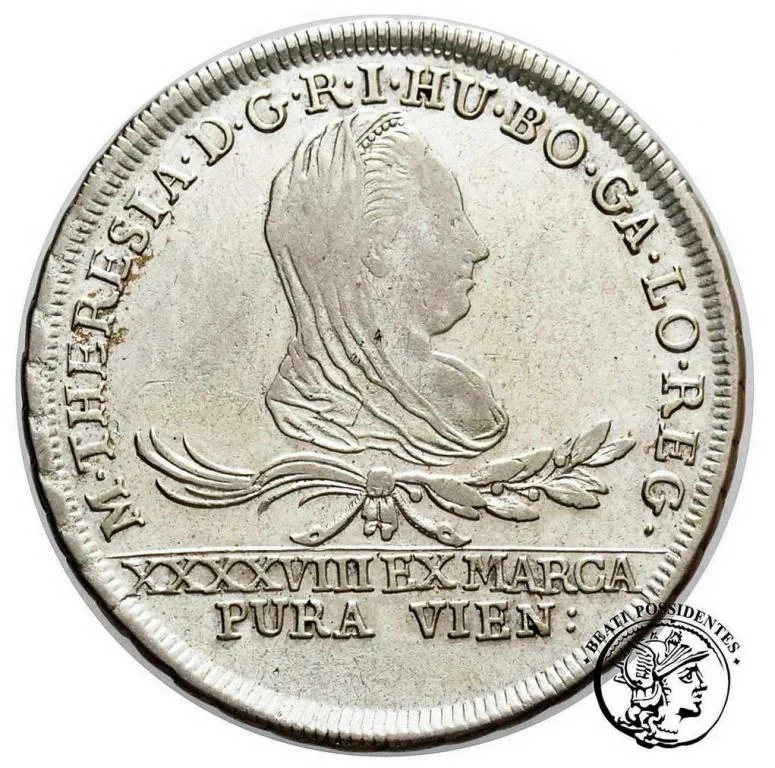
Veiled portrait over wreath, legend around (from 8h), silver value in exergue.
Inscription:
M THERESIA D G R I HU BO GA LO REG
XXXXVIII EX MARCA
PURA VIEN
XXXXVIII EX MARCA
PURA VIEN
Script: Latin
Reverse
Description:
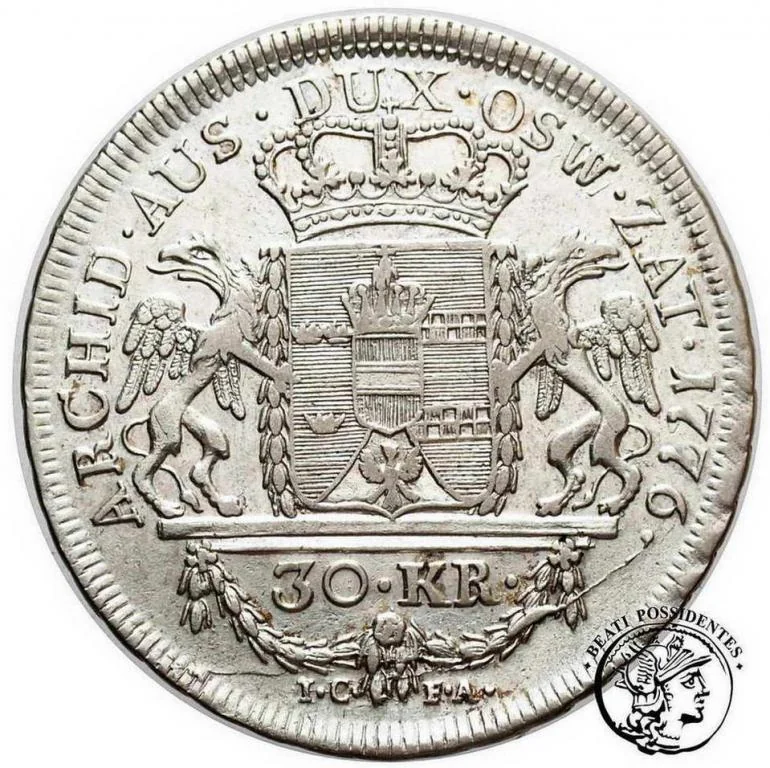
Crowned arms with griffon supporters, value and wreath below, encircled by the legend "Archidux Austriae Dux Oswieczimi Zatmari".
Inscription:
ARCHID AUS DUX OSW ZAT 1776
30 KR
IC FA
30 KR
IC FA
Script: Latin
Edge
Mintings
| Year | Mint Mark | Mintage | Quality | Collection |
|---|---|---|---|---|
| 1775 | C | — | ||
| 1775 | ICFA | — | ||
| 1776 | ICFA | — | ||
| 1777 | ICFA | — |
Historical background
Following the First Partition of Poland in 1772, the Habsburg monarchy, which annexed the territory known as Galicia, faced immediate monetary chaos. The new Austrian province was flooded with a bewildering array of coins, primarily Polish złoty and grosz from the former Commonwealth, but also Prussian, Russian, and various German thalers and kreuzers. This created a dysfunctional economy where exchange rates fluctuated wildly, hindering trade and tax collection. The Austrian state, with its centralizing tendencies, viewed this monetary disarray as both an economic and administrative problem that required swift imperial standardization.
In response, a series of currency decrees were issued between 1773 and 1775 to forcibly integrate Galicia into the Austrian monetary system. The key ordinance of 1775 established fixed exchange rates for the withdrawal of Polish currency. The principal coin of the Commonwealth, the złoty (or złotówka), was officially valued at 8 Austrian kreuzers, though its intrinsic silver content was often lower, effectively imposing a financial loss on the local population. A transition period was allowed for the exchange of old coins, but the clear objective was their complete replacement by the Austrian gulden (florin), subdivided into 60 kreuzers.
The reform was a classic tool of imperial consolidation, designed to streamline administration and bind Galicia's economy directly to Vienna. While it succeeded in creating a uniform currency system, facilitating Habsburg control and tax flows, it was economically extractive. The fixed exchange rate amounted to a devaluation of held Polish currency, effectively transferring wealth from Galician subjects to the imperial coffers. Thus, by 1775, the monetary landscape was forcibly transformed from one of Polish legacy to one of Austrian imposition, underscoring the partition's role in dismantling Polish economic sovereignty.
In response, a series of currency decrees were issued between 1773 and 1775 to forcibly integrate Galicia into the Austrian monetary system. The key ordinance of 1775 established fixed exchange rates for the withdrawal of Polish currency. The principal coin of the Commonwealth, the złoty (or złotówka), was officially valued at 8 Austrian kreuzers, though its intrinsic silver content was often lower, effectively imposing a financial loss on the local population. A transition period was allowed for the exchange of old coins, but the clear objective was their complete replacement by the Austrian gulden (florin), subdivided into 60 kreuzers.
The reform was a classic tool of imperial consolidation, designed to streamline administration and bind Galicia's economy directly to Vienna. While it succeeded in creating a uniform currency system, facilitating Habsburg control and tax flows, it was economically extractive. The fixed exchange rate amounted to a devaluation of held Polish currency, effectively transferring wealth from Galician subjects to the imperial coffers. Thus, by 1775, the monetary landscape was forcibly transformed from one of Polish legacy to one of Austrian imposition, underscoring the partition's role in dismantling Polish economic sovereignty.
💎 Extremely Rare