

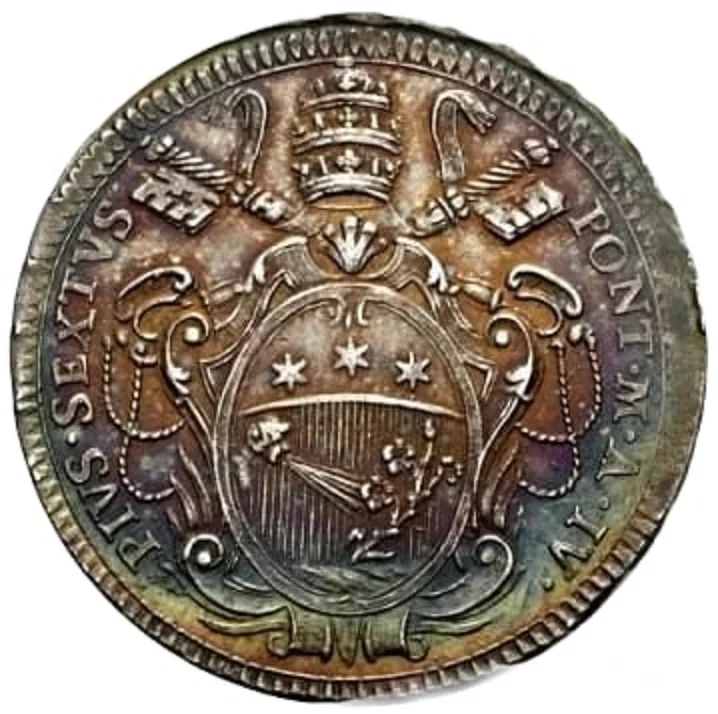
½ Scudo – Papal States
Vatican City
Context
Years: 1778–1796
Country: Vatican City 
Issuer: Papal States
Ruler: Pius VI
Currency:
(1534—1835)
Demonetized: Yes
Material
References
KM: #Click to copy to clipboard1214
Numista: #86237
Value
Bullion value: $35.30
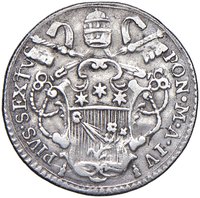
Obverse
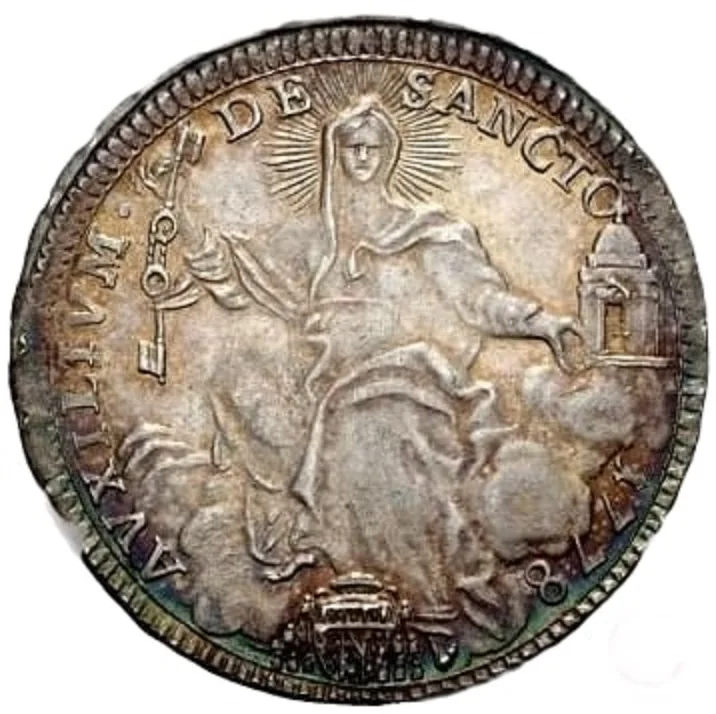
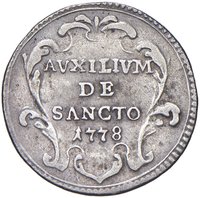
Reverse
Description:
The seated Virgin Mary.
Inscription:
AVXILIVM٠ DE ٠ SANCTO 1778
Arm of mint president Mons. Giuseppe Vai below
Arm of mint president Mons. Giuseppe Vai below
Script: Latin
Edge
Embossed leaves
Mints
| Name | Mark |
|---|---|
| Rome | — |
Mintings
| Year | Mint Mark | Mintage | Quality | Collection |
|---|---|---|---|---|
| 1778 | — | — | ||
| 1779 | — | — | ||
| 1780 | — | — | ||
| 1785 | — | — | ||
| 1796 | — | — |
Historical background
In 1778, the Papal States, a mosaic of central Italian territories under the sovereign temporal rule of the Pope, operated within a complex and archaic monetary system. The primary unit was the Papal Scudo, a silver coin theoretically divided into 100 Baiocchi, with each Baiocco further divided into 5 Quattrini. However, the reality was one of significant fragmentation and debasement. Alongside the official papal coinage, numerous local currencies from cities like Bologna and Ferrara remained in circulation, and foreign coins, particularly Spanish and Austrian, were widely used due to trade. This created a chaotic exchange environment where the intrinsic metal value of a coin often mattered more than its official face value, leading to confusion and facilitating fraud.
The financial situation of the Papal government itself was a primary cause of monetary instability. Chronic fiscal deficits, driven by administrative costs, patronage, and limited economic development, pressured the treasury. A common, though damaging, solution was the periodic debasement of the coinage—reducing the precious metal content in coins while maintaining their nominal value. This practice, essentially a form of inflation, eroded public trust in the currency. While providing short-term revenue, it discouraged commerce and savings, as people hoarded older, purer coins (Gresham's Law in action) and distrusted the government's monetary authority.
Therefore, the currency situation in 1778 was not one of crisis but of persistent, structural weakness. It reflected the broader challenges of the Ancien Régime Papal States: fragmented regional identities, inefficient administration, and a fiscal model unable to modernize. The system functioned enough for daily life, especially in local markets, but it acted as a drag on economic integration and growth. This monetary confusion would persist until the Napoleonic invasions swept the old system away, and even after the restoration, it remained a problem until the Papal States' final absorption into a unified Italy in 1870.
The financial situation of the Papal government itself was a primary cause of monetary instability. Chronic fiscal deficits, driven by administrative costs, patronage, and limited economic development, pressured the treasury. A common, though damaging, solution was the periodic debasement of the coinage—reducing the precious metal content in coins while maintaining their nominal value. This practice, essentially a form of inflation, eroded public trust in the currency. While providing short-term revenue, it discouraged commerce and savings, as people hoarded older, purer coins (Gresham's Law in action) and distrusted the government's monetary authority.
Therefore, the currency situation in 1778 was not one of crisis but of persistent, structural weakness. It reflected the broader challenges of the Ancien Régime Papal States: fragmented regional identities, inefficient administration, and a fiscal model unable to modernize. The system functioned enough for daily life, especially in local markets, but it acted as a drag on economic integration and growth. This monetary confusion would persist until the Napoleonic invasions swept the old system away, and even after the restoration, it remained a problem until the Papal States' final absorption into a unified Italy in 1870.
💎 Extremely Rare