

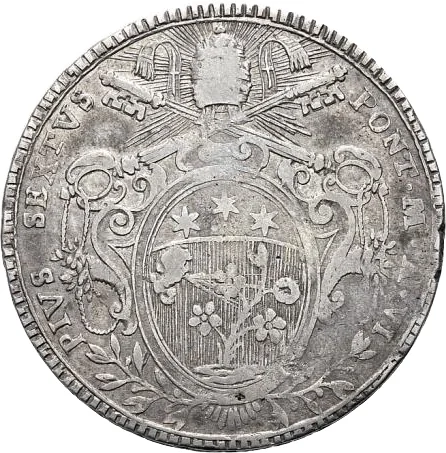
Obverse
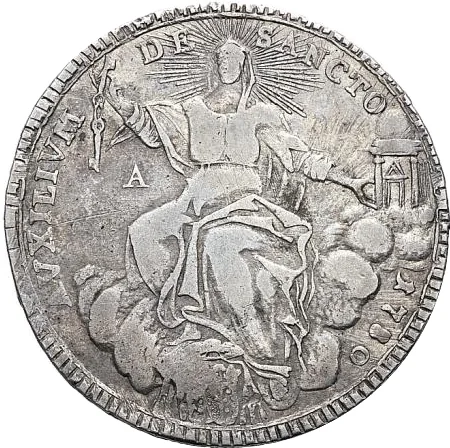
Reverse
Edge
Mints
| Name | Mark |
|---|---|
| Ancona | — |
Mintings
| Year | Mint Mark | Mintage | Quality | Collection |
|---|---|---|---|---|
| 1780 | A | — |
Historical background
In 1780, Ancona, a bustling port city on the Adriatic coast, operated within the complex monetary landscape of the Papal States, under the temporal rule of Pope Pius VI. The official currency was the Papal scudo, subdivided into 100 baiocchi, with further units like the grosso and quattrino in common use. However, the reality in Ancona's markets and docks was one of significant monetary plurality. As a major hub for Mediterranean trade, a multitude of foreign coins circulated freely alongside papal issues, including Venetian zecchini, Tuscan fiorini, Spanish reales, and Ottoman piastres. Their value was not fixed by decree but fluctuated based on weight, fineness, and the daily assessments of money-changers (banchieri).
This proliferation of specie was both a necessity and a source of administrative difficulty. International commerce required flexible exchange, but the variety of coins led to frequent confusion, disputes, and opportunities for fraud. The papal authorities, based in Rome, struggled to enforce uniform monetary standards across their territories. In Ancona, the practical authority over daily transactions fell to the local Cambio (exchange office) and guilds, which published periodic tavole di valutazione (valuation tables) to guide merchants. These tables were essential for converting the myriad foreign coins into a notional scudo value for accounting and taxation purposes.
Underlying this chaotic yet functional system was a broader tension between Ancona's mercantile needs and papal fiscal policy. The Papal States often faced budgetary shortfalls, leading to periodic debasements of the coinage—reducing the silver content in subsidiary coins like the baiocco to generate seigniorage revenue. This erosion of trust in the lower-denomination coinage particularly affected the local populace and small-scale trade, creating a disconnect between the stable high-value coins used in wholesale maritime commerce and the inflationary pressures felt in the city's everyday economy. Thus, Ancona in 1780 navigated a dual monetary world: one of cosmopolitan exchange vital for its prosperity, and another of localized instability influenced by distant papal finances.
This proliferation of specie was both a necessity and a source of administrative difficulty. International commerce required flexible exchange, but the variety of coins led to frequent confusion, disputes, and opportunities for fraud. The papal authorities, based in Rome, struggled to enforce uniform monetary standards across their territories. In Ancona, the practical authority over daily transactions fell to the local Cambio (exchange office) and guilds, which published periodic tavole di valutazione (valuation tables) to guide merchants. These tables were essential for converting the myriad foreign coins into a notional scudo value for accounting and taxation purposes.
Underlying this chaotic yet functional system was a broader tension between Ancona's mercantile needs and papal fiscal policy. The Papal States often faced budgetary shortfalls, leading to periodic debasements of the coinage—reducing the silver content in subsidiary coins like the baiocco to generate seigniorage revenue. This erosion of trust in the lower-denomination coinage particularly affected the local populace and small-scale trade, creating a disconnect between the stable high-value coins used in wholesale maritime commerce and the inflationary pressures felt in the city's everyday economy. Thus, Ancona in 1780 navigated a dual monetary world: one of cosmopolitan exchange vital for its prosperity, and another of localized instability influenced by distant papal finances.
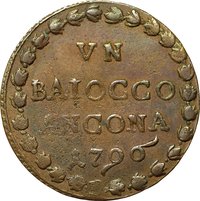
💎 Extremely Rare